Electrical safety begins underground. Whether you are wiring a home, commissioning a substation, or protecting a hazardous-area plant, understanding the types of earthing is the single most important step toward preventing electric shock, equipment damage, and fire. Yet earthing remains one of the most misunderstood subjects in electrical engineering.
In this complete 2026 guide, the engineering team at Cabex India breaks down every major earthing method — from traditional plate and pipe earthing to modern maintenance-free chemical earthing — along with the internationally recognised TN, TT, and IT system configurations. By the end, you will know exactly which earthing solution fits your application and why it matters.
What Is Earthing (Grounding)?
Earthing, also called grounding, is the process of connecting the non-current-carrying metal parts of an electrical installation — and sometimes the system neutral — to the general mass of the earth using a low-resistance conductor. This connection creates a deliberate, safe path for fault current to flow into the ground.
When insulation fails or a live conductor touches a metal enclosure, earthing ensures the fault current is diverted safely, tripping protective devices like fuses, MCBs, or RCDs before anyone is harmed. In India, earthing practice is governed primarily by IS 3043 (Code of Practice for Earthing), while the international community follows IEC 60364.
Why Earthing Matters
- Human safety: Prevents fatal electric shocks by keeping touch voltages low.
- Equipment protection: Shields sensitive devices from surges and faults.
- Lightning & surge dissipation: Channels high-energy transients safely to ground.
- System stability: Provides a stable voltage reference for the entire installation.
- Regulatory compliance: Meets IS 3043, IEC 60364, and local electrical codes.
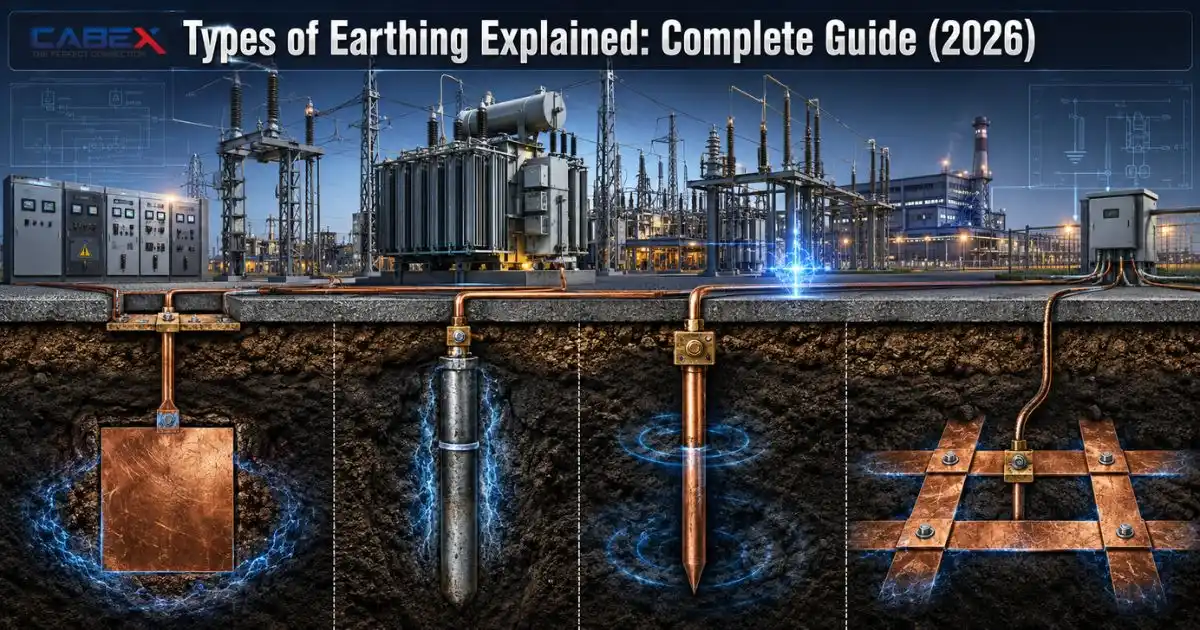
Types of Earthing: The Two Broad Categories
Before diving into specifics, it helps to know that the types of earthing fall into two broad families:
- Electrode-based earthing methods — how the electrode is physically installed (plate, pipe, rod, strip, chemical).
- System earthing configurations — how the supply neutral and protective conductors relate to earth (TN, TT, IT).
The table below summarises the five most common electrode-based types of earthing at a glance.
| Earthing Method | Electrode Used | Typical Application | Relative Cost |
| Plate Earthing | GI or copper plate | Homes, buildings, substations | Medium |
| Pipe Earthing | GI pipe | Residential & commercial | Low |
| Rod Earthing | Copper/GI rod | Substations, towers | Low–Medium |
| Strip / Wire Earthing | GI/copper strip | Large grids, transmission | Medium |
| Chemical Earthing | Filled electrode + compound | Critical & high-spec sites | High |
Electrode-Based Types of Earthing Explained
1. Plate Earthing
Plate earthing uses a metal plate — typically galvanised iron (GI) measuring 60 × 60 × 6 mm or copper measuring 60 × 60 × 3.15 mm — buried vertically in a pit at least 3 metres deep. The plate is surrounded by alternating layers of charcoal and salt to retain moisture and lower soil resistivity.
Advantages: Large contact surface area, reliable low resistance, long service life.
Limitations: Requires more excavation and periodic watering through a funnel pipe.
Best for: Residential buildings, commercial premises, and substations where space allows.
2. Pipe Earthing
One of the most widely used and economical types of earthing in India, pipe earthing employs a GI pipe (usually 38–40 mm diameter, 2–3 m long) driven vertically into the ground. The pipe is perforated to allow water to keep the surrounding soil moist, and charcoal–salt layers improve conductivity.
Advantages: Cost-effective, easy to install, good for moist soils.
Limitations: Performance drops in dry or rocky terrain; needs regular watering.
Best for: Homes and small commercial installations.
3. Rod Earthing
Rod earthing is similar to pipe earthing but uses solid copper-bonded or GI rods driven deep into the soil — often several metres — to reach permanently moist layers. Rods can be coupled together to achieve greater depth and lower resistance.
Advantages: Minimal excavation, fast installation, excellent for deep moist soil.
Limitations: Less effective in shallow rocky ground.
Best for: Substations, transmission towers, and areas with high water tables.
4. Strip or Wire Earthing
Strip earthing uses GI or copper strips/conductors laid horizontally in shallow trenches, often in a radial or grid pattern. This method is favoured where deep electrodes are impractical or where a large earthing grid is required.
Advantages: Ideal for rocky soil and large-area grounding grids.
Limitations: Requires long trench runs and more conductor material.
Best for: Power stations, transmission lines, and large industrial earth mats.
5. Chemical (Maintenance-Free) Earthing
Modern chemical earthing — sometimes called maintenance-free earthing — uses a hollow electrode filled with a conductive compound, surrounded by a back-fill compound (BFC) that absorbs moisture and keeps resistance consistently low. It is the most advanced of the electrode-based types of earthing.
Advantages: Stable low resistance year-round, virtually maintenance-free, long lifespan, performs in poor soil.
Limitations: Higher upfront cost.
Best for: Data centres, hospitals, telecom towers, hazardous areas, and any safety-critical site.
System-Based Types of Earthing: TN, TT & IT
Beyond the physical electrode, the way an installation connects its neutral and protective conductors to earth defines the system earthing arrangement. Under IEC 60364, there are three principal families — TN, TT, and IT — with TN further divided into TN-S, TN-C, and TN-C-S.
| System | Neutral Earthing | Protective Conductor (PE) | Key Characteristic |
| TN-S | Earthed at source | Separate N and PE throughout | Safest TN variant; clean earth |
| TN-C | Earthed at source | Combined PEN conductor | Economical but higher risk |
| TN-C-S | Earthed at source | PEN split into N + PE in building | Common in distribution networks |
| TT | Earthed at source | Independent local earth electrode | RCDs essential; widely used |
| IT | Isolated / high impedance | Local earth electrode | Continuity on first fault |
TN Systems
In a TN system, the supply neutral is solidly earthed at the source (transformer), and exposed metal parts are connected back to that point. TN-S keeps neutral (N) and protective earth (PE) fully separate — the safest option for sensitive equipment. TN-C combines them into a single PEN conductor (economical but riskier), while TN-C-S (the popular “PME” arrangement) combines them up to the building and separates them inside.
TT System
In a TT system, the supply neutral is earthed at the source, but each installation has its own independent earth electrode. Because fault-loop impedance is higher, residual current devices (RCDs) are mandatory. TT is common in residential and rural settings in India.
IT System
In an IT system, the source is either isolated from earth or connected through a high impedance. Its biggest advantage is that the installation can keep running after a first insulation fault, making it ideal for hospitals, mines, and continuous-process industries where downtime is dangerous.
Comparison: Choosing the Right Type of Earthing
Selecting among the types of earthing depends on soil resistivity, available space, budget, and how critical uninterrupted operation is. The quick-reference table below helps you decide.
| Selection Factor | Recommended Earthing Type | Why |
| Limited budget, moist soil | Pipe earthing | Low cost, easy install |
| Rocky / hard terrain | Strip earthing | Horizontal layout avoids deep digging |
| Deep moist soil | Rod earthing | Reaches stable moisture layer |
| Safety-critical / no maintenance | Chemical earthing | Consistent low resistance |
| Sensitive electronics | TN-S system + plate/chemical | Clean, separate earth path |
Earthing Standards & Best Practices in 2026
- IS 3043: India’s foundational earthing code; the third revision is under circulation to modernise design and testing guidance.
- IEC 60364: Defines the TN, TT, and IT system classifications used worldwide.
- Earth resistance targets: Generally ≤ 1 Ω for power stations, ≤ 5 Ω for large installations, and as low as practicable for residential.
- Periodic testing: Measure earth resistance regularly using a clamp or fall-of-potential method.
- Use certified accessories: Corrosion-resistant clamps, conductors, and electrodes ensure long-term reliability.
Why Choose Cabex India for Earthing Solutions
With over 25 years of engineering expertise, Cabex India (Cabex Electrical Components, Jamnagar, Gujarat) is a trusted manufacturer of ATEX & IECEx-certified earthing and lightning protection accessories. Across every one of the types of earthing covered above, Cabex India supplies the high-quality components that make installations safe and durable, including:
- Earthing electrodes, rods, and plates
- Earth clamps, lugs, and connectors
- Lightning protection accessories
- Conductors, cable glands, and fixings for hazardous areas
When safety, compliance, and longevity matter, Cabex India delivers “The Perfect Connection.” Explore the full earthing range at cabexindia.com to specify the right solution for your project.
Upgrade Your Earthing Setup with Cabex India
Whatever type of earthing your project needs, your installation is only as reliable as the components that hold it together. Cabex India’s Earthing System Accessories — electrodes, clamps, lugs, connectors, and lightning protection fittings — are engineered for low resistance, corrosion resistance, and long-term safety.
Explore the full Earthing System Accessories range at cabexindia.com and build a connection you can trust.
Conclusion
Understanding the different types of earthing is essential for anyone responsible for electrical safety. Electrode-based methods — plate, pipe, rod, strip, and chemical earthing — determine how effectively fault current reaches the ground, while system configurations like TN, TT, and IT define how your installation behaves during a fault. The right choice depends on your soil, space, budget, and criticality.
By combining the correct earthing method with certified, corrosion-resistant accessories from Cabex India and following IS 3043 and IEC 60364, you can build an installation that protects people, equipment, and uptime for decades. Earth it right the first time — because reliable earthing is never optional.
Frequently Asked Questions (FAQs)
1. What are the main types of earthing?
The main types of earthing are plate, pipe, rod, strip, and chemical earthing, plus the TN, TT, and IT system arrangements.
2. Which type of earthing is best for homes?
Most homeowners choose pipe and plate earthing, while engineers prefer chemical earthing where the site demands maintenance-free, low resistance.
3. What is the difference between TN, TT, and IT systems?
TN connects equipment to the source earth, TT uses an independent local electrode, and IT isolates the source for fault-tolerant operation.
4. What earth resistance value is acceptable?
Aim for ≤1 Ω at power stations, ≤5 Ω for large installations, and as low as practicable for residential setups.
5. Where can I buy reliable earthing accessories?
Cabex India offers ATEX & IECEx-certified earthing electrodes, clamps, and lightning protection accessories at cabexindia.com.