Nobody loses sleep over a cable gland — until one fails inside a live AI rack pulling 40kW. Most conversations about AI data center infrastructure jump straight to GPUs, fiber counts, and liquid cooling loops. The small brass or nylon fitting that seals every cable entering every enclosure barely gets a mention, even though it is the first line of defence against moisture, dust, and the mechanical stress of dense cabling. That gap matters more now than ever. As India races toward gigawatt-scale AI data center capacity, the components that were “good enough” for a 15kW enterprise rack are being asked to survive conditions they were never specified for.
What a Cable Gland Actually Does in an AI Data Center
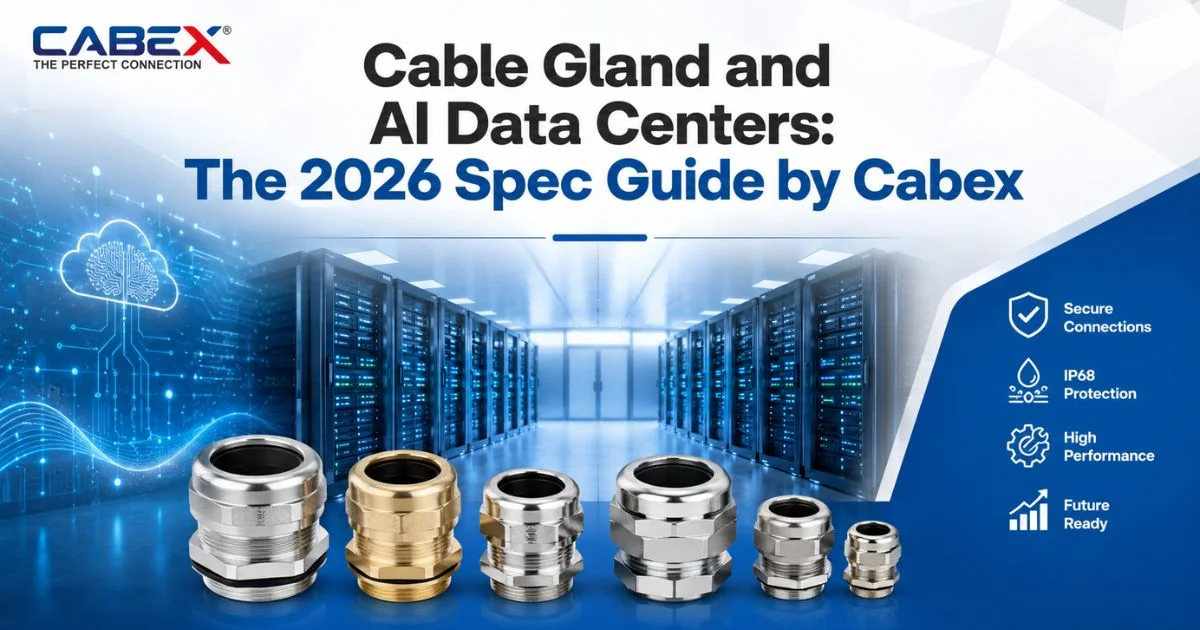
A cable gland is a mechanical fitting that seals and secures a cable where it enters an enclosure, rack, or panel, protecting against dust, moisture, and physical strain while maintaining the enclosure’s ingress protection rating. In a standard IT rack, this is a low-stakes component. In an AI rack, it’s load-bearing infrastructure in every sense — sealing high-density power and fiber runs against the heat, vibration, and humidity swings that come with round-the-clock GPU operation.
Why AI Racks Are Harder on Cable Glands Than Traditional Racks
In practice, what we find is that most cable entry failures trace back to a spec written for a different era of data center — one designed around 15kW racks, not the 40kW-plus halls AI workloads now demand. Generative AI data centers require roughly ten times more fiber than conventional setups to support GPU clusters and low-latency interconnects, and average rack densities have climbed from 15kW in 2022 to 40kW in new AI-optimised halls, nearly doubling the horizontal cable runs packed into every rack. More cables through the same entry point means more mechanical stress on every gland, more heat cycling on every seal, and a much smaller margin for error.
💡 Key Insight: The data center wire and cable market alone is projected to grow from $20.9 billion in 2025 to $54.8 billion by 2031 — and every metre of that cable still needs a properly rated entry point.
Most guides stop at “use IP68 for outdoor, IP66 for indoor.” What they don’t tell you is that AI halls increasingly use liquid cooling manifolds routed near cable pathways, which changes the risk profile from occasional splash exposure to sustained condensation and micro-leak risk — a scenario closer to marine or offshore specification than typical indoor IT.
India’s AI Data Center Boom, in Numbers
This isn’t a hypothetical scaling problem — it’s already happening in India, right now, at a pace most procurement teams haven’t fully priced in.
| Metric | Figure | Source Context |
| India’s operational data center capacity | Crossed 1.8 GW by mid-2026, up 59% in H1 2026 alone | Savills India report |
| Projected capacity by 2030 | Above 7 GW | Savills India report |
| India data center market value | $9.79 billion (2025) rising to $21.03 billion by 2031 | Arizton market report |
| Planned AI-driven capacity additions (Mar 2025–Apr 2026) | Roughly 3.5 GW across ~30 large projects | CRN Asia report |
Mumbai alone is on track to cross 1 GW of operational capacity by the end of 2026, with secondary markets like Hyderabad, Chennai, Delhi NCR, and Pune absorbing the overflow as vacancy rates tighten to under 13%. Every one of these builds needs enclosures, panels, and racks — and every one of those needs cable glands specified correctly the first time, because retrofitting a live AI hall is far costlier than getting the spec right at design stage.
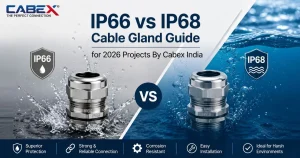
IP66 vs IP67 vs IP68 — Which Rating an AI Rack Actually Needs
This is where most spec sheets get vague, and vague specs are exactly what cause field failures. Here’s a straight comparison for AI-specific scenarios:
| IP Rating | What It Protects Against | Best Fit for AI Data Center Use |
| IP66 | Dust-tight, resists powerful water jets | Indoor server halls with no direct liquid cooling exposure |
| IP67 | Dust-tight, temporary immersion | Rooms with active cooling condensation risk but no standing water |
| IP68 | Continuous immersion at rated depth/pressure | Liquid-cooled AI racks, below-floor cable routing, coastal or high-humidity sites |
The IEC 62444 standard governs construction and performance requirements for cable glands, and it’s the baseline every AI-ready facility should specify against — not just the IP number on a datasheet, but full compliance documentation from the manufacturer.
Material Selection: Brass, Nickel-Plated Brass, or Stainless Steel
What most spec sheets don’t mention is that material choice matters as much as IP rating once you’re running racks continuously at high thermal load.
| Material | Strength | Where It Fits |
| Brass | Good conductivity, cost-effective | Standard indoor racks, stable climate-controlled halls |
| Nickel-plated brass | Corrosion resistance + conductivity | Humid coastal sites, Gulf export projects, mixed indoor/outdoor runs |
| Stainless steel | Maximum corrosion and chemical resistance | Liquid-cooled AI halls, industrial-adjacent sites, high-vibration environments |
Premium IP68-rated glands in this category are commonly built to hold a seal at 5 bar pressure for 30 minutes and operate across a temperature range of roughly -40°C to +150°C — a range that matters when a rack cycles between ambient room temperature and the localized heat spike near a GPU cluster.
IEC 62444 Compliance — What Procurement Teams Should Actually Check
A cable gland that “looks like” IP68 on a listing page isn’t the same as one with third-party test certification behind it. Before signing off on a bulk order for an AI data center build, verify:
- Standard cited on the datasheet — Look specifically for IEC 62444, not just a generic “IP68” claim.
- Material certification — Brass composition, plating thickness, and elastomer seal specification should be documented, not assumed.
- Manufacturer quality system — ISO 9001 certification is a reasonable baseline indicator of consistent manufacturing.
- Sample testing before bulk procurement — Request samples and test installation ease and seal compression before committing to a large order.
- Hazardous area compliance where relevant — For sites with explosive atmosphere requirements, cross-check against IEC 60079-0 as well.
The Most Common Mistake We See in Data Center Cable Gland Specs
Here’s what most guides skip: the gland itself can be perfectly rated and still fail — because of installation, not product defect. Improper cable gland installation accounts for roughly 60% of industrial equipment failures linked to moisture ingress, and in our experience specifying components for high-density industrial and export projects, under-torqued glands and mismatched cable-to-gland diameter are the two most repeated errors on site. Neither shows up in a datasheet review. Both show up six months later, during the first heavy monsoon season.
Talk to Cabex India About AI-Ready Cable Gland Specifications — Get a Response Within 24 Hours
Cable Glands for AI Data Centers vs. Traditional Server Rooms
The short version: traditional server room specs undersize for what AI infrastructure actually demands. A traditional enterprise rack, drawing 5–15kW with modest cable density, tolerates IP66 brass fittings without much risk. An AI-optimised rack running 40kW-plus, dense fiber bundles, and proximity to liquid cooling infrastructure needs IP68-rated, corrosion-resistant glands specified against IEC 62444 from day one — not upgraded after a failure. Specifying for the AI-era load from the start costs marginally more upfront and avoids a far more expensive mid-build retrofit.
FAQs
What IP rating is recommended for cable gland and AI data centers?
IP68 generally suits AI-optimised racks best, particularly where liquid cooling infrastructure sits nearby or cable routing runs below raised floors. IP66 remains acceptable for traditional, lower-density server rooms without direct moisture exposure.
Why do AI data centers need more cable glands and cable management than traditional data centers?
AI data centers use roughly ten times more fiber to support GPU clusters and low-latency interconnects, and rack densities have risen from around 15kW to 40kW-plus, which multiplies the number of cable entry points and the mechanical stress on each one.
Is IEC 62444 mandatory for data center cable gland procurement in India?
IEC 62444 isn’t a legal mandate in India, but manufacturers and specifiers worldwide recognise it as the standard construction and performance benchmark for cable glands, and most credible AI data center EPC contractors specify against it as a procurement baseline.
What material cable gland is best for humid or coastal AI data center sites?
Specifiers generally prefer nickel-plated brass or stainless steel for humid, coastal, or export-market sites because of their corrosion resistance compared to standard brass, particularly for facilities that run continuously without downtime for maintenance.
How much is India’s AI data center capacity expected to grow by 2030?
India’s operational data center capacity should exceed 7 GW by 2030, up from around 1.8 GW in mid-2026, as AI and hyperscale demand continue to drive growth.
Conclusion
India’s AI data center build-out isn’t slowing down, and the components that seemed like an afterthought in 15kW racks are now load-bearing decisions in 40kW ones. Getting the cable gland spec right — IP rating, material, and IEC 62444 compliance — at design stage costs far less than fixing it after the first failure. As of 2026, that’s no longer a nice-to-have. It’s baseline infrastructure planning for anyone building AI-ready in India.