Every EV charger has one weak point. In fact, it sits where the cable enters the enclosure, and a good gland decides whether it holds. Water, dust, heat, and pulling force all attack that spot first.
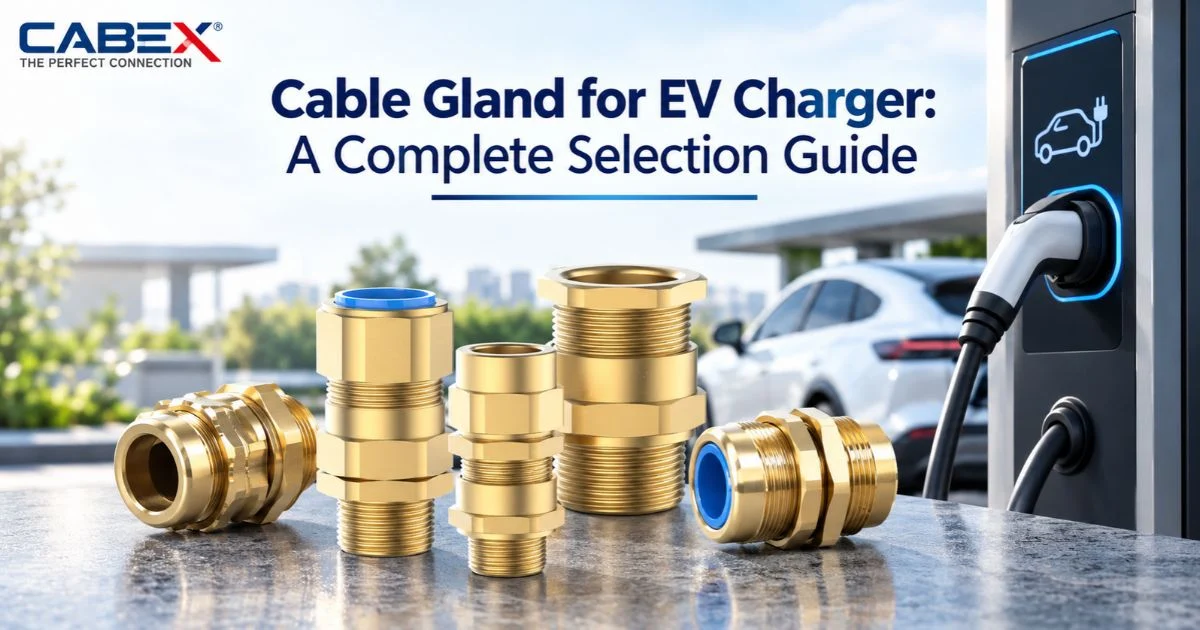
A cable gland for EV charger units is a sealed fitting that secures the cable at the enclosure entry. It blocks water and dust, relieves strain, and keeps earth continuity intact. The right gland keeps a charger safe, compliant, and reliable outdoors.
- How it works: A compression seal grips the cable sheath. A locknut fixes the gland to the enclosure. For armoured cable, a clamp bonds the armour to earth.
- When to use it: Fit one at every cable entry on wallboxes, AC posts, DC fast chargers, and cabinets.
- What it involves: Match the gland to cable diameter, thread, material, and IP rating. The part costs little next to the charger, but material and certification drive the price.
Why Does Every EV Charging Point Need a Cable Gland?
EV charging is growing fast. According to the IEA’s Global EV Outlook 2026, the world added nearly 1.8 million public chargepoints in 2025. That is a 33% rise, and it lifted the global total above 7 million. As a result, millions of new cable entries now sit outdoors. Each one fails if the gland is poor.
A gland does four jobs. First, it seals the entry against rain, dust, and washdown water. Second, it holds the cable so plug movement never loads the terminals. Third, it keeps the enclosure’s protection rating intact. Fourth, it maintains earth bonding on armoured cable.
In short, a quality cable gland for EV charger hardware protects people, equipment, and warranty at the same time. Our industrial cable glands range covers the most common charger enclosure entries. The same range also works as a cable gland for EV charging stations. Use it at public sites, fleet depots, and private car parks.
How Does a Cable Gland for EV Charger Work?
Think of a cable gland for EV charger entries as a sleeve with a seal. First, the cable passes through the body. Then a compression nut squeezes a rubber seal around the outer sheath. As a result, that seal blocks water and dust.
For armoured cable, a second part grips the steel wires. This clamp holds the cable against pull. In addition, it gives the fault current a safe path to earth. Therefore, a cable gland for EV charging stations does both mechanical and electrical work.
Heat adds another challenge for any cable gland for EV charging stations. For example, chargers warm up during long sessions, then cool overnight. These cycles stress seals, so material quality matters. A well-made gland keeps its grip through thousands of cycles. However, a cheap one loosens and lets moisture in.
Vibration matters too on every cable gland for EV charging stations. Heavy plugs and swinging cables tug at the entry every day. Therefore, the gland absorbs that movement instead of the terminals.
What IP Rating Does a Cable Gland for EV Charging Stations Need?
A cable gland for EV charging stations should reach IP66 or IP68 in most outdoor sites. The charger as a whole needs at least IP54 in practice. The gland should never be the weakest part of the enclosure.
IEC 61851-1 sets the baseline for charging stations. According to Schneider Electric’s Electrical Installation Guide, the standard recommends only IP44 outdoors. However, IP54 is the general rule in practice. The same guide notes that outdoor chargers must work down to -25°C. This means gland seals must stay flexible in deep cold.
Moreover, standards keep moving upward. For example, GARO raised its public charger rating from IP44 to IP54 after third-party testing. The company noted that some markets already demand stricter outdoor ratings. A cable gland for EV charger enclosures rated IP66 or IP68 leaves headroom for that trend.
| IP rating | Protection level | Typical use at a charger |
| IP44 | Splash-proof, solid objects over 1 mm | Sheltered indoor or covered bays |
| IP54 | Dust-protected, splash-proof | Minimum for outdoor chargers |
| IP66 | Dust-tight, strong water jets | Open outdoor sites, rain, washdown |
| IP68 | Dust-tight, continuous immersion | Flood-prone ground, underground pits |
Source: IP codes defined in IEC 60529; charger baselines per IEC 61851-1.
For a deeper comparison, read our guide to IP66 vs IP68 cable glands.
Which Material Is Best for an EV Charger Cable Gland?
Nickel-plated brass suits most chargers, and a brass cable gland for EV charger cabinets is the usual choice. Stainless steel fits coastal and chemical sites. Nylon works for light-duty signal cables. Your choice depends on climate, cable type, and budget.
| Feature | Nickel-plated brass | Stainless steel (316) | Nylon (polyamide) |
| Best for | Public AC and DC chargers | Coastal, desert, washdown sites | Home wallboxes, signal cables |
| Corrosion resistance | Very good | Excellent | Excellent (no rust) |
| Mechanical strength | High | Very high | Moderate |
| Armour and earth bonding | Yes | Yes | No |
| UV and heat tolerance | Excellent | Excellent | Good, grade dependent |
| Relative cost | Medium | High | Low |
Armoured power cables need a metal cable gland for EV charging stations. Only metal can clamp the armour and carry fault current. Nylon, however, is fine for small control and data cables inside an AC wallbox.
For humid or salty air, consider stainless steel. A stainless cable gland for EV charging stations near the coast resists salt spray for years. Brass with good plating still performs well in most climates. In either case, check that the seal material is rated for sunlight and temperature swings.
How Do You Choose the Right Cable Gland for an EV Charger?
Follow five steps to choose a cable gland for EV charger projects. Each step removes a common cause of field failure.
Step 1: Measure the cable
Measure the outer diameter of the cable. Every gland has a sealing range, for example 13 to 20 mm. For best results, choose a gland where your cable sits in the middle of that range. Otherwise, a cable at the extreme edge seals poorly.
Step 2: Match the thread
Metric threads from M20 to M63 are the global norm. North American chargers often use NPT threads. Older equipment may use PG threads. So confirm the enclosure entry first. Our guide to cable gland thread types explains how to convert between them.
Step 3: Pick the IP rating and material
Use the earlier tables. A cable gland for EV charging stations in the open needs IP66 or higher. Coastal or industrial sites often justify stainless steel.
Step 4: Check temperature and UV
Outdoor chargers must handle -25°C or colder under IEC 61851-1. Meanwhile, summer sun can push enclosure surfaces far higher. Therefore, ask for seal and body temperature ratings in writing.
Step 5: Confirm certification
For compliance, look for IEC 62444, the standard for cable glands in electrical installations. Ask for IP test reports, RoHS declarations, and CE marking where your market needs them. Our team can supply certificates on request through the Cabex India contact page.
What Gland Size Fits Each Type of EV Charger?
Gland size follows cable size, and cable size follows charger power. Size every cable gland for EV charger entries separately. The table gives typical starting points only. Always confirm against the actual cable datasheet.
| Charger type | Typical power | Typical gland thread | Notes |
| Home AC wallbox | 7 to 22 kW | M20 to M32 | Often unarmoured cable |
| Public AC post | 22 kW | M25 to M40 | Add a separate gland for data cable |
| DC fast charger | 50 to 150 kW | M40 to M63 | Armoured feeder, EMC glands for control |
| Ultra-fast cabinet | 150 kW and above | M63 and larger | Multiple large entries, often armoured |
Also, larger chargers need shielded signal cables. These carry communication and control data. Standard glands can leave the shield uncovered. An EMC cable gland for EV charging stations fixes this. It connects the cable screen to the enclosure through 360 degrees of contact. Therefore, it limits interference and protects charger electronics.
How Do You Install a Cable Gland on an EV Charger?
Good installation matters as much as good hardware on a cable gland for EV charging stations. Follow these steps when you fit a cable gland for EV charger enclosures.
- Drill or punch the correct entry hole size. Remove burrs.
- Fit the sealing washer between the gland body and enclosure.
- Thread the gland in and tighten the locknut inside the enclosure.
- Prepare the cable. For armoured cable, expose the armour to the clamp length.
- Insert the cable, seat the armour in the clamp, and tighten the dome nut.
- Tighten to the torque in the gland datasheet. Never use more.
- Leave a small drip loop outside so water runs away from the entry.
First, over-tightening a cable gland for EV charger enclosures is the most common mistake. It crushes the seal, so the IP rating is lost. Under-tightening is the second, and it lets the cable slip and water creep in. For a full walkthrough, see our guide on how to install a cable gland.
What Mistakes Should You Avoid?
Several errors cause most charger entry failures. Avoid these when fitting a cable gland for EV charging stations.
- Using a plastic gland on armoured cable. It cannot clamp the armour or carry earth current.
- Mixing thread standards. A metric gland in a PG hole will not seal.
- Ignoring temperature range. Cheap seals harden in the cold and crack.
- Reusing old glands. Compressed seals lose their grip after removal.
- Leaving unused entries open. Fit a blanking plug rated to the same IP level.
Moreover, always protect unused holes, because a single open entry cancels the IP rating of the whole charger.
Which Standards Apply to a Cable Gland for EV Charger Installations?
Several standards work together on every cable gland for EV charging stations project. IEC 60529 defines IP codes. IEC 61851-1 covers general charging system requirements, covers plugs and sockets and covers the glands themselves.
Charging sites in explosive or industrial areas may need more. For example, a charger near a fuel depot may need flameproof parts. Our explosion-proof cable glands cover those cases.
What Does a Cable Gland for EV Charger Projects Cost?
Price depends on four things. For a cable gland for EV charger orders, these are material, size, IP rating, and certification. A small nylon gland costs the least. A large stainless steel armoured gland costs the most.
Even so, the gland is a tiny share of total charger cost. For instance, a failed gland can cause water damage, downtime, and a site visit. That bill can exceed the price of a hundred glands, so quality pays off. Therefore, buying quality at the start saves money.
Bulk orders of a cable gland for EV charging stations also lower the unit price. Ask for a project quote that covers every entry size on your charger model. Buyers with several sites should also ask about consistent batch quality.
How Do You Maintain Glands on Outdoor Chargers?
Inspect each cable gland for EV charger entries during routine service visits. Look for cracked seals, loose dome nuts, and corrosion on the body. Check that the cable has not slipped. Then wipe off dirt that can trap moisture.
Replace any cable gland for EV charging stations that shows damage. Do not try to patch it with sealant. Sealant hides a failing seal and fails again soon after. Finally, check the earth bond on armoured cables with a continuity tester.
Also, record each inspection. Then a simple log helps you spot patterns, such as one site that corrodes faster than the rest.
Who Should Specify a Cable Gland for EV Charging Stations?
Three groups usually specify a cable gland for EV charger builds. First, charger manufacturers choose glands during product design. Second, electrical contractors choose them on site when cable runs differ from the plan. Third, fleet and property owners choose them when they extend or repair a network.
Each group buying a cable gland for EV charging stations should share three details with the supplier. These are the cable datasheet, the entry size, and the site climate. With that information, a supplier can recommend the correct gland in one reply.
Final Thoughts: Choosing a Cable Gland for EV Charger Projects
The gland is a small part with a big job. Every cable gland for EV charger projects should match the cable, thread, climate, and charger power. Aim for IP66 or higher outdoors. Pick brass or stainless steel for armoured cable. Fit EMC glands on shielded signal cables. In short, the right cable gland for EV charging stations protects the whole investment.
Get these basics right and every cable gland for EV charger entry stays sealed, earthed, and compliant for years. Ready to specify glands for your next charging project? Contact Cabex India for sizing help, samples, and export documentation.
Frequently Asked Questions
What is a cable gland for EV charger use?
It is a sealed fitting that secures and protects the cable where it enters a charger enclosure.
What IP rating should an EV charger cable gland have?
Choose IP66 or higher for outdoor chargers, since the charger itself usually needs at least IP54.
Can I use a nylon cable gland for EV charger wallboxes?
Yes, for unarmoured home wallbox cables, but armoured cables need a metal gland.
Does a cable gland for EV charging stations need EMC shielding?
Yes, when shielded control or data cables enter a DC fast charger or cabinet.
Which thread size is most common for EV charger glands?
Metric threads between M20 and M63 are the most common worldwide.