
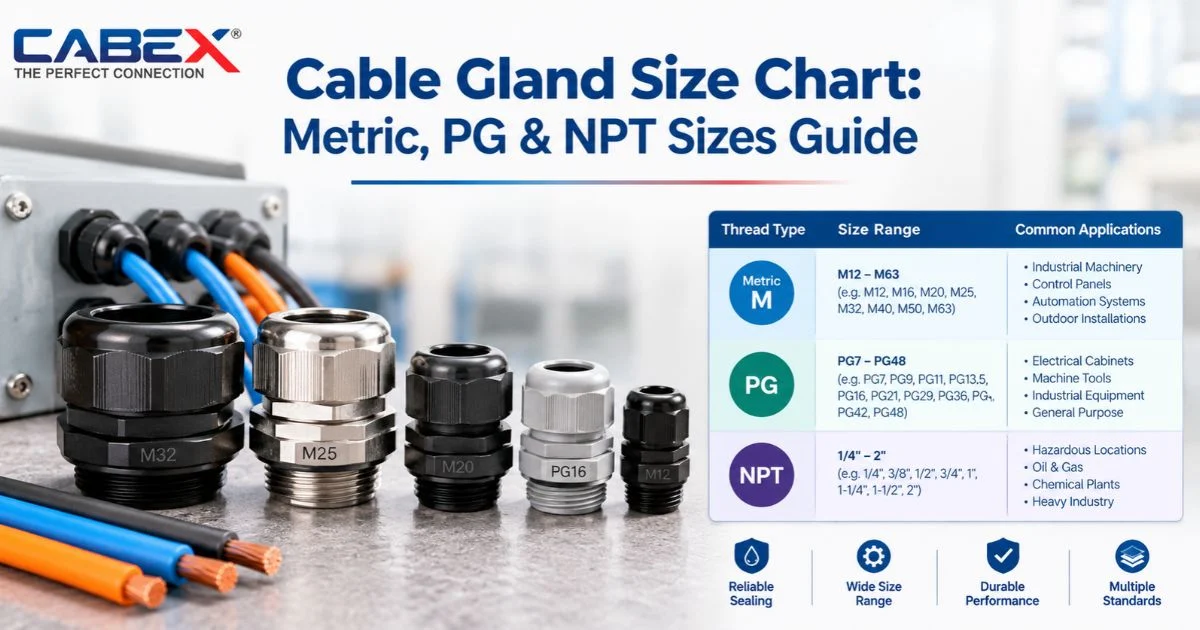
A cable gland size chart matches each gland thread, like M20 or PG13.5, to the cable diameter it seals. It also lists the entry hole size, so you can pick a gland that fits both enclosure and cable.
- How it works: Measure your cable’s outer diameter, then find the row whose range covers it.
- When to use it: Check the cable gland size chart before every order, enclosure drill-out or thread-conversion decision.
- What it involves: You need the cable diameter, thread type, entry hole size and required IP rating.
What Does a Cable Gland Size Chart Show?
A cable gland chart lists four details for every gland size. First, it shows the thread, such as M20×1.5. Second, it gives the cable outer diameter range. Third, it lists the entry hole you must drill or tap. Finally, it may show the spanner flat size and thread length.
Why does this matter? A gland that is too large cannot compress its seal. Likewise, a gland that is too small crushes the cable sheath. In both cases, the seal fails, and water or dust gets in. A reliable cable gland size chart removes that guesswork before you order.
Engineers in every region use a cable gland chart the same way. Whether you wire a panel in Rotterdam, Dubai or Houston, the steps stay the same. Measure the cable, pick the thread, then match the range.
Metric Cable Gland Size Chart (M12 to M63)
In fact, metric is the most common gland thread worldwide. According to the IEC 62444 standard, the document covers cable glands with IEC 60423 metric entry threads. It treats other thread types only as a guide. As a result, metric sizing has the strongest standard backing. PG and NPT buyers should check the maker’s datasheet.
Use this cable gland chart for standard single-seal glands:
| Metric thread | Approx. entry hole (mm) | Typical cable OD range (mm) |
| M12 × 1.5 | 12.5 | 3 – 6.5 |
| M16 × 1.5 | 16.5 | 4 – 8 |
| M20 × 1.5 | 20.5 | 6 – 12 |
| M25 × 1.5 | 25.5 | 13 – 18 |
| M32 × 1.5 | 32.5 | 18 – 25 |
| M40 × 1.5 | 40.5 | 22 – 32 |
| M50 × 1.5 | 50.5 | 30 – 38 |
| M63 × 1.5 | 63.5 | 37 – 44 |
Indicative values for standard glands. Exact ranges vary by model, so confirm them on your supplier’s datasheet.
Also, every metric size uses a 1.5 mm pitch. For example, M20 means a 20 mm thread diameter. That direct link to millimetres makes the metric cable gland chart the easiest to read. Print this cable gland size chart and keep it with your bill of materials. Our cable gland thread types guide explains pitch and sealing methods in more detail.
PG Cable Gland Size Chart (PG7 to PG48)
PG stands for Panzergewinde, a German thread standard. These PG threads use an 80-degree flank angle, so they will not fit metric holes. Older European panels and imported machines also use them. However, many new designs now specify metric instead.
Note that PG codes are not millimetre sizes. PG13.5, for instance, has a thread outer diameter of about 20.4 mm. This PG cable gland chart shows the common sizes:
| PG size | Thread outer diameter (mm) | Typical cable OD range (mm) |
| PG7 | 12.5 | 3 – 6.5 |
| PG9 | 15.2 | 4 – 8 |
| PG11 | 18.6 | 5 – 10 |
| PG13.5 | 20.4 | 6 – 12 |
| PG16 | 22.5 | 10 – 14 |
| PG21 | 28.3 | 13 – 18 |
| PG29 | 37.0 | 18 – 25 |
| PG36 | 47.0 | 22 – 32 |
| PG42 | 54.0 | 32 – 38 |
| PG48 | 59.3 | 37 – 44 |
Indicative values for standard glands. Check the manufacturer’s datasheet before ordering.
If your enclosure has PG holes, read the PG cable gland chart and buy PG glands. Otherwise, use a thread conversion adaptor. Never force a metric gland into a PG hole. A PG cable gland size chart helps mainly with retrofits and spares.
NPT Cable Gland Chart (½ inch to 2 inch)
NPT, or National Pipe Thread, is the tapered thread common in North America. Consequently, the taper wedges tight as you tighten the gland. Sizes use nominal inches, not the real thread diameter.
Cable ranges depend heavily on the gland model. Therefore, this NPT cable gland chart lists thread diameters instead. Pair it with your supplier’s datasheet for the cable range. Treat any NPT cable gland size chart as a thread reference first.
| NPT size | Approx. thread outer diameter (mm) | Closest metric size by diameter |
| ½” NPT | 21.3 | M20 – M25 |
| ¾” NPT | 26.7 | M25 – M32 |
| 1″ NPT | 33.4 | M32 – M40 |
| 1¼” NPT | 42.2 | M40 – M50 |
| 1½” NPT | 48.3 | M50 |
| 2″ NPT | 60.3 | M63 |
The metric column compares diameters only. NPT and metric threads are not interchangeable.
Metric vs PG vs NPT: Which Thread Should You Choose?
The best thread is the one your enclosure already has. According to Wikipedia’s cable gland overview, at least three thread standards are in use: PG, metric and NPT. This means a cable gland size chart without a thread type is incomplete.
| Feature | Metric | PG | NPT |
| Thread form | Parallel, 1.5 mm pitch | Parallel, 80° flank | Tapered, 60° flank |
| Size label | Diameter in mm (M20) | Code (PG13.5) | Nominal inch (½”) |
| Main region | Global, IEC-based | Legacy Europe | North America |
| Thread sealing | O-ring or sealing washer | Sealing washer | Taper engagement and sealant |
| Best for | New global projects | Replacing old PG glands | North American enclosures |
When you must connect different threads, use a reducer or adaptor. Our cable gland reducer guide lists Ex-rated options from M12 to M100 and ½” to 4″ NPT.
How Do You Convert PG to Metric Using a Cable Gland Chart?
PG and metric sizes look alike on paper. For instance, PG13.5 and M20 both suit cables of about 6 to 12 mm. However, the threads do not match. A cable gland chart helps you compare cable ranges, but only an adaptor changes the thread.
Use the table below as a cable gland size chart for retrofits. It pairs sizes by shared cable range only.
| PG size | Similar metric size | Shared cable range (mm) |
| PG7 | M12 | 3 – 6.5 |
| PG9 | M16 | 4 – 8 |
| PG13.5 | M20 | 6 – 12 |
| PG21 | M25 | 13 – 18 |
| PG29 | M32 | 18 – 25 |
| PG36 | M40 | 22 – 32 |
| PG48 | M63 | 37 – 44 |
The threads stay incompatible. Use an adaptor or a matching enclosure plate.
Avoid drilling oversize holes to fit a different thread. That shortcut weakens the enclosure and can compromise its protection rating. Instead, order a thread conversion adaptor with the gland.
How Do You Read a Cable Gland Size Chart?
Follow six steps to read any cable gland size chart correctly. Each step narrows your cable gland chart search.
- Measure the cable. Record the outer diameter over the outer sheath.
- Check for armour. Armoured cables need a gland with an armour clamp.
- Pick the thread. Match the thread to your enclosure entry.
- Find the range. Choose the row where your cable diameter sits near the middle.
- Confirm the hole. Check that the entry hole matches the gland’s thread.
- Verify IP rating and material. Choose brass, stainless steel or nylon to suit the site.
Why choose the middle of the range? A cable at the extreme edge leaves the seal too loose or too tight. As a result, the gland may fail a pull test or leak. A mid-range fit gives the seal room to work. Every cable gland chart assumes the cable sits inside its range.
How Do You Measure Cable Diameter for a Cable Gland?
First, use vernier calipers, not a tape measure. Because a tape compresses the sheath, it gives a false reading. Take two measurements 90 degrees apart, then average them. After all, cables are rarely perfectly round.
Measure at the point where the cable enters the gland. A common error is measuring over tape or a printed sleeve. Another is measuring a cable before it has been bent into position. Accurate input makes every cable gland size chart more useful. For flexible cables, therefore, measure after routing.
For this reason, always record the exact diameter on your order sheet. Your supplier can then match it to the correct cable gland chart row in seconds.
How Do Armoured Cables Change Your Size Choice?
In practice, armoured cables need more data than unarmoured ones. You need three numbers: overall cable diameter, inner sheath (bedding) diameter and armour wire size. A double-compression gland seals the inner sheath and clamps the armour separately.
For example, a steel wire armoured cable may measure 20 mm overall. However, its bedding may be only 15 mm. The gland must cover both figures. Any good cable gland size chart for armoured types lists both ranges.
Armour also affects earth continuity. A correct clamp keeps the armour bonded to the enclosure. Our double compression brass cable gland guide explains how the inner clamp works.
Why Does Correct Sizing Protect Your IP Rating?
An IP rating only holds when the gland fits the cable and the thread seats properly. The IEC 60529 standard defines IP codes for enclosures with a rated voltage up to 72.5 kV. A gland is part of that enclosure boundary. Therefore, a wrong-size gland breaks the rating even if the gland itself is certified.
Cabex India explains in its IP68 brass cable glands guide that the “8” means protection against immersion beyond one metre. That level is only possible when the seal compresses evenly around the cable. In short, using the cable gland chart correctly is a safety issue, not a convenience.
How Do You Size Cable Glands for Hazardous Areas?
In explosive atmospheres, size and certification both matter. First, use the cable gland chart to match the gland to the cable. Next, confirm the Ex protection type, such as Ex d or Ex e. Then check the zone. Our hazardous area cable glands page lists Ex d options in the M20 to M100 metric range. Size the gland with the cable gland size chart first, then check the certificate.
Also, be careful with reducers in Ex d entries. The rule is one reducer per cable entry, and never combine it with a blanking element. For zone selection and certification detail, read our IECEx cable gland guide.
Why Does a Cable Gland Chart Matter for Export Projects?
Export projects mix suppliers, standards and site crews. A single wrong size can delay commissioning. A shared cable gland size chart gives every party the same reference.
For instance, procurement teams use it to confirm quantities. Likewise, site engineers use it to check deliveries against drawings. Quality teams use the cable gland size chart to audit installed glands.
Put the thread type on every purchase order. For example, write “M25 × 1.5, 13–18 mm cable” instead of “M25 gland.” That line removes doubt. As a result, you avoid costly returns across borders. A clear cable gland chart also helps mixed-language teams, because sizes are numbers, not words.
Common Cable Gland Sizing Mistakes
Most failures trace back to a handful of errors that any cable gland chart can prevent. Avoid these:
- Measuring over tape or sleeves. This inflates the cable diameter.
- Ignoring armour data. The gland then cannot clamp the armour.
- Mixing PG and metric threads. The profiles differ, so the seal breaks.
- Choosing the range edge. The seal ends up too loose or too tight.
- Skipping the IP check. A correct size still needs the right IP rating.
However, each mistake is easy to prevent. Keep this cable gland chart open while you order, and check every row twice.
Need Help Matching Gland Size to Your Cable?
Cabex India manufactures and exports industrial cable glands to Europe, the UK, Australia, the Middle East and the Far East. Next, send us your cable datasheet and enclosure thread. Our team will check it against our cable gland size chart and confirm the correct size.
Browse the full industrial cable gland and accessories range. You can also read about our cable gland manufacturing and export capability. Cabex IP68 brass glands accept cable diameters from 3 mm to 75 mm across their range.
Frequently Asked Questions About Cable Gland Sizes
What is a cable gland size chart?
A cable gland size chart is a table matching thread sizes to cable diameter ranges and entry hole sizes.
How do I choose the right cable gland size?
Measure the cable’s outer diameter, find it in a cable gland chart, and pick the row covering it mid-range.
What is the difference between M20 and PG13.5?
Both suit cables of about 6 to 12 mm, but their thread forms differ, so they are not interchangeable.
Can I use a PG gland in a metric hole?
No, because the thread profiles differ, so you need a thread conversion adaptor.
What gland size suits a 10 mm cable?
In a typical cable gland chart, an M20 gland covers 10 mm, but confirm the datasheet.
Conclusion
A cable gland size chart turns a risky guess into a quick check. Measure the cable first. Then pick the thread, match the range and confirm the IP rating. For armoured or hazardous-area cables, add the armour and certification checks.
Use the metric, PG and NPT tables in this cable gland chart as a starting point. Bookmark this cable gland size chart for your next enclosure order. Always confirm final values on the supplier’s datasheet. Ready to order? Share your cable details with Cabex India, and our team will confirm the right gland.