

Introduction: What Is a Cable Gland Reducer?
When electrical installations involve cables and enclosures with mismatched thread sizes, engineers face a critical challenge — how to maintain a secure, sealed, and standards-compliant connection without redesigning the entire cable entry system. This is precisely where a cable gland reducer becomes indispensable.
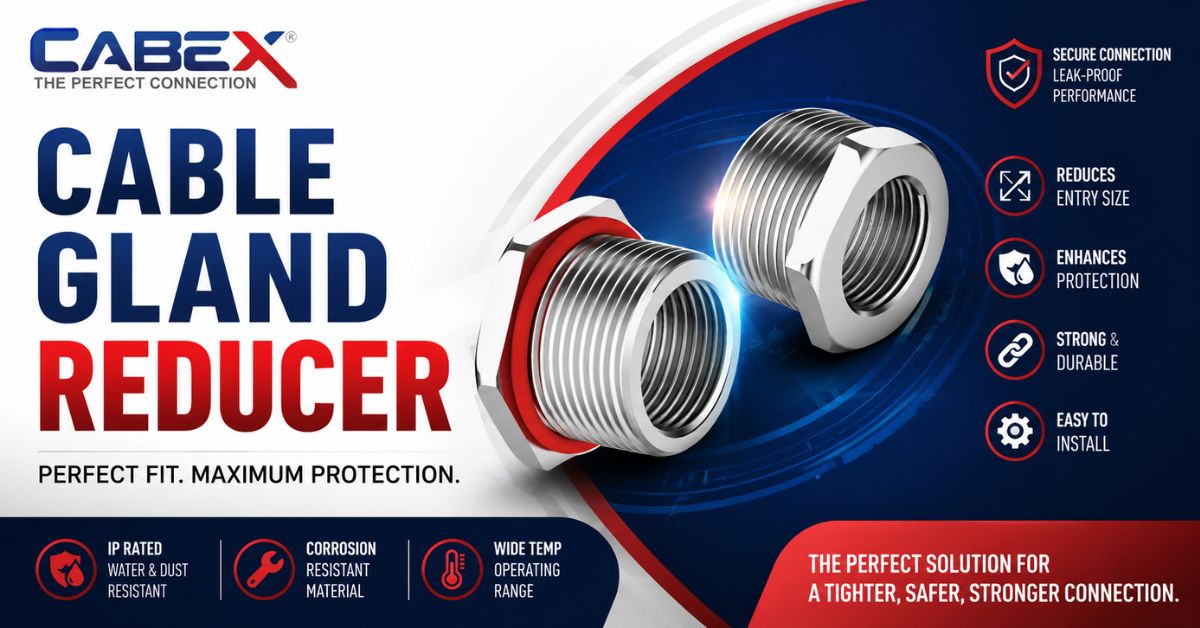
A cable gland reducer — also called a thread conversion reducer or Ex reducer — is a precision-engineered accessory that bridges the size or thread-type gap between a cable gland and the cable entry hole in an electrical enclosure. Rather than replacing costly equipment or cable glands, a reducer allows a larger threaded entry to accept a smaller-threaded cable gland, maintaining the installation’s integrity, ingress protection (IP) rating, and — crucially in hazardous areas — its explosion protection classification.
Used across industries from oil and gas to petrochemicals, mining, food processing, and marine environments, cable gland reducers are small but mission-critical components. Whether you are working with ISO Metric threads, NPT threads, or BSP threads, choosing the right reducer is fundamental to project safety and compliance.
In this comprehensive guide, we cover everything you need to know about cable gland reducers — from how they work and what types exist, to sizing tables, installation rules, certification requirements, and where to source the best products in India and globally.
How Does a Cable Gland Reducer Work?
A cable gland reducer has a male thread on the outside (which fits into the enclosure’s entry hole) and a female thread on the inside (which accepts the cable gland). The reducer effectively converts the enclosure’s larger thread to the smaller thread size of the cable gland, enabling a secure mechanical connection.
This is especially critical in hazardous area applications, where any gap or improper sealing can allow flammable gases or dust to enter the enclosure and potentially cause an explosion. A certified Ex reducer maintains the flameproof (Ex db), increased safety (Ex eb), or dust-ignition proof (Ex ta) protection concept of the equipment.
Key engineering rules apply:
- Only one reducer per cable entry is permitted in Ex d (flameproof) applications, per IEC 60079-1.
- A blanking plug must not be combined with a reducer on the same entry.
- A sealing washer is often required at the cable entry interface to maintain the IP rating.
Types of Cable Gland Reducers
Cable gland reducers are categorised by their application environment and thread configuration:
1. Industrial / General Purpose Reducers
Used in standard, non-hazardous industrial enclosures. Available in brass, nylon, and stainless steel. No special explosion-protection certification required.
2. Ex-Certified / Hazardous Area Reducers (Ex Reducers)
Designed and certified for use in explosive atmospheres. Must carry ATEX, IECEx, or equivalent certifications. Suitable for:
- Ex db – Flameproof enclosures
- Ex eb – Increased safety equipment
- Ex ta – Dust ignition-proof equipment (Group III)
3. Metric-to-NPT Reducers
Convert ISO metric threads (common in Europe and India) to NPT threads (common in the Americas), or vice versa, enabling global project compatibility.
4. Stainless Steel Reducers
Used in highly corrosive, offshore, or hygienic environments where brass would corrode or contaminate.
Cable Gland Reducer: Material Options Comparison
| Material | Key Properties | Best For | Temperature Range |
|---|---|---|---|
| Brass (CuZn39Pb3) | Excellent conductivity, corrosion-resistant, cost-effective | General industrial & hazardous areas | −40°C to +100°C |
| Brass Nickel Plated | Enhanced corrosion & oxidation resistance | Coastal, chemical, and offshore environments | −40°C to +100°C |
| Stainless Steel SS316 | Superior corrosion resistance, hygienic | Marine, food processing, aggressive chemicals | −55°C to +175°C |
| Stainless Steel SS316L | Low carbon variant, weld-resistant | Offshore platforms, high-stress installations | −55°C to +175°C |
Standard Thread Sizes: Metric and NPT
Understanding thread sizes is critical when selecting a cable gland reducer. The two dominant standards globally are ISO Metric (used in Europe, Asia, and India) and NPT — National Pipe Thread (used in the Americas and on certain industrial equipment worldwide).
Metric Cable Gland Reducer Dimensions (Selection Table A – Metric)
| Thread Size | Head Length (L) mm | Across Flat (A/F) mm | Across Corner (A/C) mm |
|---|---|---|---|
| M16 | 4.00 | 20.00 | 22.50 |
| M20 | 4.00 | 24.00 | 26.50 |
| M25 | 4.00 | 30.00 | 34.00 |
| M32 | 4.00 | 37.50 | 42.50 |
| M40 | 5.00 | 46.00 | 52.00 |
| M50 | 5.00 | 55.00 | 62.00 |
| M63 | 6.00 | 70.00 | 80.00 |
| M75 | 7.00 | 85.00 | 95.00 |
| M80 | 10.00 | 90.00 | 100.50 |
| M85 | 10.00 | 95.00 | 106.00 |
| M90 | 10.00 | 100.00 | 112.00 |
| M100 | 10.00 | 115.00 | 130.00 |
NPT Cable Gland Reducer Dimensions (Selection Table A – NPT)
| Thread Size | Head Length (L) mm | Across Flat (A/F) mm | Across Corner (A/C) mm |
|---|---|---|---|
| ½” NPT | 4.00 | 27.00 | 30.50 |
| ¾” NPT | 4.00 | 33.00 | 37.50 |
| 1″ NPT | 4.00 | 40.00 | 45.00 |
| 1¼” NPT | 5.00 | 48.00 | 54.30 |
| 1½” NPT | 5.00 | 55.00 | 62.00 |
| 2″ NPT | 6.00 | 65.00 | 74.00 |
| 2½” NPT | 8.00 | 80.00 | 91.00 |
| 3″ NPT | 10.00 | 100.00 | 110.00 |
| 3½” NPT | 10.00 | 115.00 | 130.00 |
| 4″ NPT | 10.00 | 128.00 | 141.00 |
All dimensions are in millimetres, except NPT thread sizes which are in inches.
Where Are Cable Gland Reducers Used?
Cable gland reducers find application across a wide spectrum of industries, wherever electrical enclosures and cable management systems must accommodate varying cable and thread sizes:
Oil & Gas: Offshore platforms and onshore processing facilities require Ex-certified reducers to maintain flameproof integrity in Zone 1 and Zone 2 classified areas.
Petrochemicals & Refineries: High-temperature environments demand reducers with wide operating temperature tolerances and corrosion-resistant materials like SS316.
Mining (Group I): Underground installations involve Group I gases (methane). Cable gland reducers certified for Group I ensure compliant cable entries in mining equipment.
Power Generation & Utilities: Large control panels and switchgear require reducers to standardise cable entries across mixed-size cable installations.
Marine & Shipbuilding: Stainless steel reducers withstand saltwater corrosion in bilge areas, engine rooms, and deck-mounted equipment.
Food & Pharmaceutical: Hygienic stainless steel reducers comply with cleanliness requirements while maintaining IP68 ingress protection.
Construction & Infrastructure: Reducers allow construction teams to complete electrical works efficiently when cable gland threads do not match pre-drilled enclosure entries.
How to Select the Right Cable Gland Reducer: Step-by-Step
Selecting the correct cable gland reducer is not complicated, but it demands a systematic approach to ensure compliance and safety.
Step 1 – Identify the enclosure’s cable entry thread size and type Check the equipment’s nameplate or drawings for the thread size (e.g., M40) and thread type (Metric, NPT, BSP).
Step 2 – Identify the cable gland thread size Your cable gland’s male thread is what will enter the reducer’s female end.
Step 3 – Determine the environment Is the installation in a general industrial area or a classified hazardous area (Zone 1, 2, 21, 22 or Group I mining)? Hazardous areas require Ex-certified reducers.
Step 4 – Select material Match the reducer material to the environment: brass for most industrial applications, stainless steel for corrosive or hygienic environments.
Step 5 – Verify certifications For ATEX-regulated areas (Europe), ensure the reducer is ATEX-certified. For IECEx regions or export projects, IECEx certification is essential. In India, PESO certification is required.
Step 6 – Check the IP rating requirement Ensure the reducer can achieve the required IP66 or IP68 rating when fitted with the appropriate O-ring or sealing washer.
Installation Guidelines for Ex Reducers
Correct installation of an Ex reducer is as important as correct selection. Follow these engineering best practices:
- Only one reducer may be used per cable entry point in Ex d flameproof applications.
- Do not use a blanking plug alongside a reducer on the same entry — this is non-compliant per IEC 60079-0/1.
- Always fit an O-ring or entry thread sealing washer to achieve the required IP66/IP68 rating.
- Use a calibrated torque wrench to avoid over- or under-tightening, which can compromise the seal.
- For Ex e (increased safety) equipment, always fit a sealing washer at the cable entry interface.
- Inspect the reducer for damage before installation — any cracks or thread damage renders the component non-compliant.
- After installation, verify the IP rating with a site inspection or test.
Why Cable Gland Reducers Are Critical in Hazardous Areas
In hazardous area installations classified under IEC 60079 (ATEX / IECEx), every component in the cable entry system — including the cable gland reducer — must be certified and correctly applied. An uncertified reducer, or a reducer used incorrectly (e.g., combined with a blanking element, or more than one reducer per entry), can invalidate the explosion protection concept of the entire enclosure.
The consequences of non-compliance include:
- Risk of ignition of flammable gases or combustible dust
- Failure of regulatory audit and loss of operating license
- Invalid insurance and liability in the event of an incident
- Costly retrofit or replacement of non-compliant components
This is why procurement managers, project engineers, and safety managers must insist on fully certified Ex reducers from reputable manufacturers — not unbranded or uncertified substitutes.
Cabex India Ex Reducer: Certified, Reliable, and Globally Approved
When it comes to sourcing a cable gland reducer that combines engineering excellence, global certification, and competitive pricing for Indian and international projects, Cabex India stands in a class of its own.
Cabex India, one of India’s leading manufacturers of cable glands and accessories, offers a comprehensive range of Ex Reducers (Thread Conversion Reducers) designed and certified for use in the most demanding hazardous area applications.
Cabex Ex Reducer: At a Glance
| Parameter | Cabex Ex Reducer Specification |
|---|---|
| Product Type | Ex Reducer (Thread Conversion Reducer) |
| Design Standard | BS 6121: Part 1:1989, IEC 62444:2010, EN 62444:2013 |
| Compliance Standard | EN/IEC 60079-0, IEC 60079-1, IEC 60079-7, IEC 60079-31 |
| ATEX Certificate | DNV 22ATEX16166X |
| IECEx Certificate | IECEx DNV 22.0003X |
| PESO Certificate | A/P/HQ/GJ/104/6055 (P568287) |
| Code of Protection (ATEX) | II M2 / II 2G 1D, IP66/IP68 |
| Code of Protection (IECEx) | Ex db Mb, Ex eb Mb, Ex db II C Gb, Ex eb II C Gb, Ex ta III C Da |
| Ex Protection Types | Ex db, Ex eb, Ex ta |
| Applicable Groups | Group I, Group II, Group III |
| Standard Thread Sizes | M12 to M100 (Metric); ½” NPT to 4″ NPT |
| Custom Sizes | Available on request |
| Standard Material | Brass (BS EN 12164 / Grade CuZn39Pb3) |
| Optional Materials | Brass Nickel Plated, SS316, SS316L |
| Enclosure Protection | IK10 to IEC 62262 (20 Joule) — Brass & Stainless Steel |
| Operating Temperature | −55°C to +175°C (Silicon O-Ring) / −40°C to +100°C (Nylon Washer) |
| Ingress Protection | IP66 / IP68 (tested at 30m depth for 7 days) |
| Standard Thread Types | ISO Metric / NPT |
Why Choose Cabex Ex Reducers?
Triple Certification: ATEX + IECEx + PESO While many competitors offer either ATEX or IECEx certification, Cabex Ex Reducers carry both ATEX (European) and IECEx (global) certifications — plus India’s mandatory PESO certificate. This makes them the ideal choice for projects that need to meet multiple regional compliance requirements simultaneously.
Widest Size Range in the Industry Cabex Ex Reducers are available from M12 to M100 for Metric threads and ½” NPT to 4″ NPT — covering virtually every standard cable entry size encountered in industrial projects. Custom sizes can also be produced on request, making Cabex the go-to partner for EPC contractors managing diverse cable schedules.
Exceptional Temperature Performance With an operating temperature range of −55°C to +175°C (with Silicon O-Ring), Cabex Ex Reducers outperform many competitors who typically offer only up to +100°C. This makes Cabex reducers suitable for high-temperature industrial processes, desert environments, and applications where thermal cycling is a factor.
Premium Materials, Precision Manufactured Standard reducers are manufactured from BS EN 12164 Brass (Grade CuZn39Pb3), with optional Nickel Plating, SS316, and SS316L for corrosive or marine applications. All materials are precision-manufactured to tight tolerances, ensuring repeatable sealing performance and thread engagement.
IP68 Tested at 30 Metres — Beyond Standard Cabex Ex Reducers achieve IP68 at 30 metres depth for 7 days — a performance standard that exceeds many competitors. Alternative depths and durations can be provided on request, giving project engineers confidence in demanding submersible or wash-down applications.
IK10 Impact Resistance Rated IK10 to IEC 62262 (20 Joule) in brass and stainless steel variants, Cabex reducers withstand mechanical impact in demanding industrial environments — from construction sites to offshore decks.
Backed by Cabex’s Global Credentials Cabex India is an approved supplier to some of the world’s most demanding end-users in oil and gas, power, and infrastructure. The company holds global certifications including ATEX (DNV), IECEx (DNV), and PESO, and is continually pursuing additional approvals including EAC, DNV GL, and ABS.
Ordering Cabex Ex Reducers
Cabex provides a structured, easy-to-follow selection process using their published Selection Tables (Table A and Table B):
- Identify the Male Thread Size (outside, entering the enclosure) from Table B.
- Identify the Female Thread Size (inside, accepting the cable gland) from Table B.
- Cross-reference in Table A to find the correct part reference.
- Specify material, thread type (Metric or NPT), and any optional features.
For installation, Cabex provides detailed installation instructions and an ordering chart available for download directly from the Cabex India website.
Ready to order or need technical support? Visit cabexindia.com or contact Cabex India directly:
Article Summary
What is a cable gland reducer?
An accessory that converts a larger threaded cable entry to accept a smaller cable gland thread size
Primary function
Thread conversion to resolve mismatches between cable glands and enclosure entry holes
Where it’s used
Hazardous areas (oil & gas, mining, chemical), marine, industrial, and infrastructure projects
Ex certification requirement
ATEX, IECEx certification mandatory in hazardous area applications; PESO required in India
Key selection criteria
Male/female thread size, environment (Ex vs industrial), material, IP rating, operating temperature
Installation rule (Ex d)
Maximum one reducer per cable entry; never combine with a blanking element
Cabex Ex Reducer advantage
ATEX + IECEx + PESO certified; M12–M100 and ½”–4″ NPT; −55°C to +175°C; IP68 at 30m/7 days
Frequently Asked Questions (FAQ)
Q1. What is the purpose of a cable gland reducer? A cable gland reducer is used to convert the thread size or type of a cable entry hole in an electrical enclosure so that a differently-threaded cable gland can be installed securely. This avoids the need to modify the enclosure or replace the cable gland, saving time and cost on construction projects.
Q2. Can I use any cable gland reducer in a hazardous area? No. In classified hazardous areas (ATEX Zones 1, 2, 21, 22, or Group I mining environments), you must use an Ex-certified reducer that carries the appropriate ATEX and/or IECEx certification for the specific explosion protection concept (Ex db, Ex eb, or Ex ta) of the equipment. Using an uncertified reducer in a hazardous area invalidates the enclosure’s explosion protection.
Q3. How many reducers can be used per cable entry in an Ex d (flameproof) enclosure? IEC 60079-1 permits only one reducer per cable entry in Ex d flameproof applications. Using two reducers in series on a single entry is non-compliant and unsafe.
Q4. Can a cable gland reducer be used with a blanking plug? No. A blanking plug must not be used in combination with a reducer on the same cable entry. This is explicitly prohibited under the applicable IEC standards and good engineering practice guidelines.
Q5. What thread types are available for cable gland reducers? Cable gland reducers are available in ISO Metric, NPT (National Pipe Thread), BSP (British Standard Pipe), and PG thread formats. The most common types for hazardous area applications are Metric and NPT. Cabex India offers both Metric (M12–M100) and NPT (½” to 4″) as standard.
Follow Us On : Twitter, Facebook