
Most procurement teams find out the hard way: not every cable gland on a supplier’s catalogue page actually works on their site. For instance, a gland built for indoor panel work will fail an offshore ingress test within months, and a gland certified for one hazardous zone can be the wrong choice for the zone right next to it. That’s why understanding the types of industrial cable glands — and matching each type to the exact environment, cable armor, and certification it needs — matters so much. Get it right, and the connection lasts fifteen years. Get it wrong, and it triggers a shutdown in fifteen months.
This guide by Cabex India breaks down every major category of industrial cable gland by material, sealing mechanism, and certification, including the specification detail most catalogues skip. It also explains why Gulf-based contractors consistently choose nickel-plated brass over standard brass for offshore rigs — a comparison almost nobody explains clearly online.
What Is an Industrial Cable Gland?
An industrial cable gland is a mechanical fitting that secures and seals a cable where it enters an enclosure, junction box, or piece of equipment. It grips the outer sheath, maintains strain relief, and blocks moisture, dust, and gas ingress at the entry point. In hazardous or offshore environments, the gland also forms part of the explosion-protection barrier, not just the weatherproofing. So, before ordering, most procurement teams need a working map of the different industrial cable gland types available and where each one applies.
Cable glands are not interchangeable parts. In fact, each type of industrial cable gland serves a specific combination of cable construction, environmental exposure, and certification zone. Choosing the wrong type does not usually cause an immediate failure — instead, it causes a slow one, which is why so many sites discover the problem during an audit rather than during installation.
💡 Key Insight: A gland that passes IP68 testing in a lab does not automatically pass it in the field. Torque during installation, cable ovality, and re-tightening after maintenance all affect real-world sealing performance. No catalogue rating captures that.
Types of Industrial Cable Glands by Material
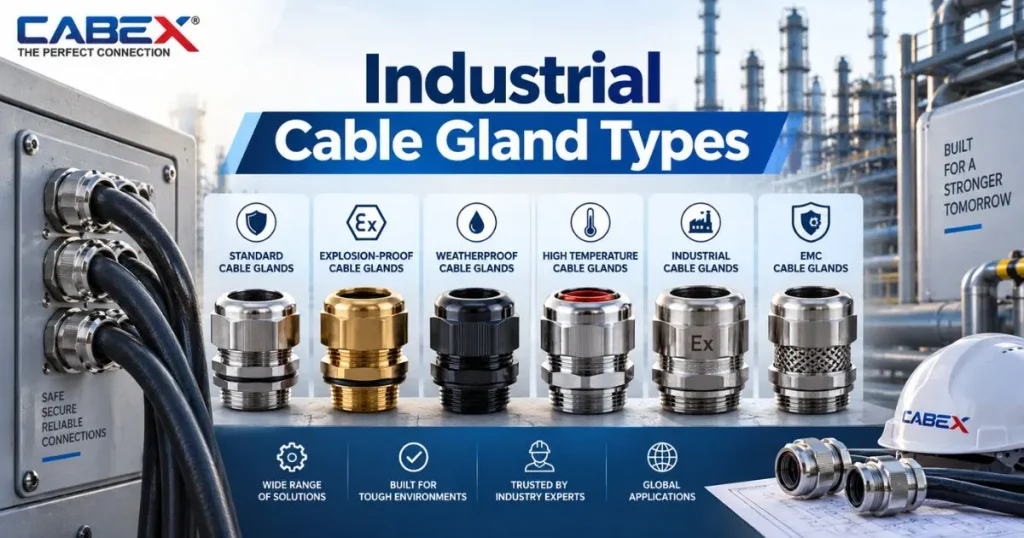
Material selection determines corrosion resistance, mechanical strength, and total service life. Among the types of industrial cable glands available today, four materials cover nearly every industrial and export project — and each solves a different problem.
Brass cable glands. The most widely specified type for general industrial use. Brass offers strong mechanical grip, good conductivity for earthing continuity, and moderate corrosion resistance. Standard brass performs well in indoor and mildly corrosive outdoor settings but is not the first choice for continuous salt-spray exposure.
Nickel-plated brass cable glands. A brass core with an electroplated nickel finish. Nickel plating adds a corrosion-resistant barrier without sacrificing the brass core’s strength. That’s why it is specified so often for coastal and offshore installations across the Gulf.
Stainless steel cable glands. Used where chemical exposure, extreme corrosion, or food and pharmaceutical hygiene standards apply. Stainless steel (typically grade 316) resists a wider range of corrosive agents than nickel-plated brass but costs more and is heavier to install at scale.
Polyamide (nylon) cable glands. A non-metallic, lightweight option used where electrical isolation matters or where galvanic corrosion between dissimilar metals is a concern. Polyamide glands are common in telecom cabinets and low-voltage panel work rather than heavy industrial or hazardous-area installations.
Types of Industrial Cable Glands by Sealing Mechanism
Beyond material, how a gland achieves its seal also defines its type — and this distinction matters as much as material choice for ingress protection.
| Sealing Type | How It Works | Best Suited For |
|---|---|---|
| Single-compression gland | One seal ring compresses around the cable outer sheath | Unarmored cables, indoor and light outdoor use |
| Double-compression gland | Two separate seal points — one on the sheath, one on the armor | Armored cables, offshore and hazardous areas |
| Barrier gland | An internal compound seals individual cores, blocking gas or fluid migration through the cable | Ex-d zones, subsea cable entries, gas-tight bulkheads |
| Displacement gland | Uses a deformable seal that displaces around irregular or multi-core cable shapes | Multi-core, non-standard diameter cables |
Double-compression types dominate export orders to the Gulf. That’s largely because most offshore and petrochemical cable runs use steel wire armored (SWA) cable, which needs a separate seal at the armor layer. This maintains both mechanical retention and ingress protection.
Types of Industrial Cable Glands by Hazardous Area Certification
For plants handling flammable gas, vapor, or dust, the certification type of the gland is not optional — it is the entry requirement for the zone. In other words, this is where the industrial cable gland types on a catalogue page diverge most sharply from what a hazardous-area audit will actually accept.
- Ex-d (flameproof) glands — Contain any internal explosion within the enclosure and prevent it from igniting the surrounding atmosphere. Required in Zone 1 and Zone 2 gas areas.
- Ex-e (increased safety) glands — Used where equipment does not generate sparks or high surface temperatures under normal operation, common for junction boxes and terminal enclosures.
- Ex-tb / Ex-tD (dust-ignition-proof) glands — Rated for combustible dust zones, common in grain handling, cement, and pharmaceutical processing.
- ATEX and IECEx dual-certified glands — Carry both European ATEX approval and the international IECEx scheme, which most Gulf and Middle East contractors require for cross-border project compliance without re-certification.
💡 Key Insight: ATEX certification alone is often insufficient for GCC tenders. In fact, most Gulf EPC contractors now specify IECEx as the baseline, with ATEX as a secondary reference — the reverse of what many suppliers assume.
Brass vs Nickel-Plated Brass — the Gulf Contractor’s Real Decision
Among all the types of industrial cable glands compared in this guide, this is the one comparison that decides more Gulf export orders than any certification detail — yet few suppliers explain it with real numbers.
| Factor | Standard Brass | Nickel-Plated Brass |
|---|---|---|
| Salt-spray corrosion resistance | Moderate — visible pitting typically within 12–18 months in coastal exposure | High — plating delays pitting onset well beyond 36 months in comparable exposure |
| Surface conductivity for earthing | Excellent | Slightly reduced by plating layer, still within earthing tolerance |
| Typical cost premium | Baseline | Roughly 15–25% above standard brass, depending on plating thickness |
| Common specification zone | Indoor panels, dry industrial sites | Offshore platforms, coastal petrochemical, marine terminals |
In practice, what we find with Gulf-based clients is that the decision is rarely about upfront cost — it’s about replacement frequency. After all, a gland that needs replacing every 12–18 months on an offshore platform costs more in labor, shutdown risk, and logistics than the plating premium ever will. That is why nickel-plated brass has become the default specification — not an upgrade — on most Gulf offshore and marine cable gland orders we handle.
IP66 vs IP68 — Which Ingress Rating Matches Which Type
IP66 and IP68 are the two ratings most often confused when specifying the types of industrial cable glands for a project. In practice, though, the difference is significant — not just on paper.
IP66 means the gland stays fully dust-tight and resists powerful water jets from any direction — the standard for outdoor industrial enclosures exposed to washdown or heavy rain. IP68 means the gland stays fully dust-tight and handles continuous or intermittent submersion beyond 1 meter — the standard for subsea, splash-zone, and below-grade cable entries.
The most common mistake we see is specifying IP68 glands purely as a “safer” default, without checking whether the installation actually sits underwater. As a result, IP68-rated glands often use additional internal sealing compound, which can make cable insertion and future maintenance more time-consuming — an unnecessary cost when IP66 already meets the actual exposure condition.
How to Choose the Right Cable Gland Type for Your Project
Use this sequence, in order, to narrow down the correct choice among the types of industrial cable glands for a given installation:
- Identify the cable construction. Armored (SWA/SWB) cables need double-compression or barrier glands; unarmored cables can use single-compression.
- Identify the hazardous area zone, if any. This determines whether Ex-d, Ex-e, or Ex-tb certification is mandatory.
- Identify the ingress exposure. Match IP66 for splash/washdown exposure or IP68 for submersion or subsea entries — not the reverse.
- Identify the corrosion environment. Coastal, offshore, and marine sites should default to nickel-plated brass or 316 stainless steel over standard brass.
- Confirm the certification scheme required by the contract. Gulf EPC tenders increasingly require IECEx as the baseline, with ATEX as a secondary reference.
💡 Key Insight: Most gland selection errors happen at step 1, not step 5. In fact, contractors often specify certification correctly but pair it with the wrong sealing mechanism for the cable construction actually in use on site.
Common Mistakes When Specifying Cable Gland Types
These are the mistakes we see most often when procurement teams shortlist industrial cable gland types without checking the installation conditions first.
- Assuming brass and nickel-plated brass are interchangeable on spec sheets. They are not — coastal exposure changes the calculation entirely.
- Over-specifying IP68 for non-submerged installations. This adds cost and installation time without a corresponding protection benefit.
- Treating ATEX as sufficient for Gulf tenders. Most GCC contracts now expect IECEx as the primary certification reference.
- Ignoring cable ovality during gland sizing. A gland matched to nominal cable diameter alone can under-seal on cables with irregular cross-sections.
- Reusing glands after cable replacement. Compression seals lose effectiveness after repeated tightening cycles, so replace them instead of reusing them at re-termination.
FAQs
What are the main types of industrial cable glands?
Industrial cable gland types fall into three categories: material (brass, nickel-plated brass, stainless steel, polyamide), sealing mechanism (single-compression, double-compression, barrier, displacement), and hazardous area certification (Ex-d, Ex-e, Ex-tb, ATEX/IECEx). Ultimately, selection depends on cable construction, environmental exposure, and the certification zone required for the installation.
Which cable gland type is best for offshore installations?
Nickel-plated brass double-compression glands with IP68 and IECEx certification are the standard choice for offshore platforms. Specifically, the nickel plating resists salt-spray corrosion, while the double-compression design seals both the cable sheath and the steel wire armor layer.
What is the difference between IP66 and IP68 cable glands?
IP66 protects against powerful water jets and suits outdoor washdown exposure. IP68 protects against continuous submersion beyond 1 meter and applies to subsea or below-grade cable entries. Specifying IP68 where IP66 is sufficient, however, adds unnecessary cost.
Do Gulf projects require ATEX or IECEx certification for cable glands?
Most Gulf and GCC EPC contractors now require IECEx certification as the primary standard, with ATEX referenced secondarily for cross-border compliance. As a result, dual-certified glands covering both schemes are increasingly the default request in Gulf tenders.
Can standard brass cable glands be used in coastal or offshore environments?
Standard brass works short-term but typically shows visible corrosion pitting within 12–18 months in coastal exposure. For offshore or marine installations, therefore, nickel-plated brass or 316 stainless steel is the recommended type due to significantly higher corrosion resistance.
Request a Cable Gland Spec Sheet — Reply Within 24 Hours — Match your project’s zone, cable type, and exposure to the right gland spec before you order.
Conclusion
Choosing among the types of industrial cable glands is not a catalogue exercise — it is a matching exercise between cable construction, hazardous zone, ingress exposure, and corrosion environment. Contractors who get this wrong do not usually see the failure immediately. Instead, they see it in a corroded gland during a routine audit or a certification gap flagged during a Gulf tender review. Get the material, sealing mechanism, and certification aligned from the start, and the gland stops being a maintenance line item for the next fifteen years. Ultimately, whichever industrial cable gland types your project specifies, matching them correctly the first time protects the installation for its full service life.