


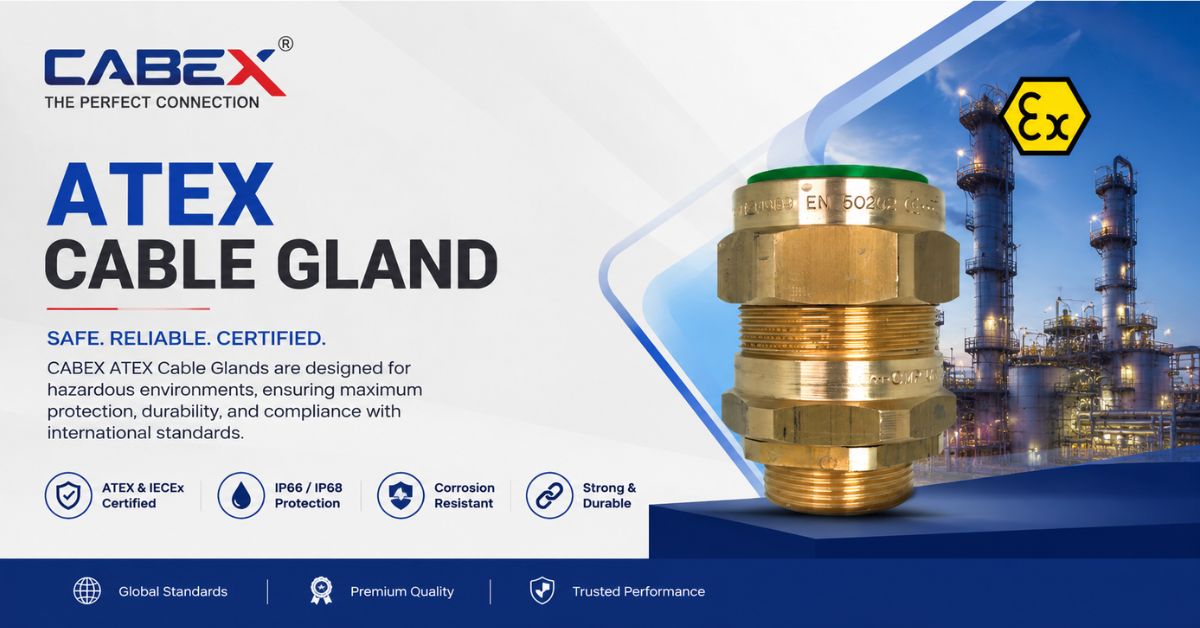
Article Summary This guide covers everything you need to know about ATEX cable glands: what they are, how ATEX certification works, the different types (Ex d, Ex e, Ex t, Ex nR), zone classification, material options, installation best practices, and how to choose the right gland for your application. Cabex India is highlighted as a trusted ATEX-certified manufacturer supplying hazardous area solutions across India and globally.
Introduction: Why ATEX Cable Glands Matter
In industries where flammable gases, vapours, dusts, or combustible fibres are present, a single spark can trigger a catastrophic explosion. This is why the choice of electrical components — including something as seemingly simple as a cable entry device — carries enormous responsibility. ATEX cable glands are the certified solution for safely sealing cable entries into electrical enclosures located in explosive atmospheres.
Whether you operate in the oil and gas sector, a chemical processing plant, a pharmaceutical facility, or an offshore platform, ATEX cable glands are not optional — they are a legal and safety requirement. Understanding them thoroughly helps engineers, procurement managers, and EPC contractors make informed decisions that protect lives, assets, and operations.
This comprehensive guide explains ATEX cable glands from the ground up — covering certification standards, protection types, zone classifications, material choices, installation guidelines, and how to select the right product for any application. We also introduce Cabex India, one of India’s most trusted manufacturers of ATEX-approved cable glands.
What Is an ATEX Cable Gland?
An ATEX cable gland is a cable entry device that has been certified under the ATEX Directive (Atmosphères Explosibles) to be used safely in potentially explosive environments. The directive — formally known as EU Directive 2014/34/EU — sets out the requirements for equipment and protective systems intended for use in explosive atmospheres within the European Union.
ATEX cable glands perform several critical functions simultaneously:
- They provide a secure, mechanically robust entry point for cables into electrical enclosures, junction boxes, motors, and control panels.
- They maintain the integrity of the enclosure’s explosion protection — whether flameproof, increased safety, dust ignition-proof, or non-sparking.
- They seal against the ingress of dust, water, gases, and other contaminants to prevent hazardous material from entering the enclosure.
- They provide cable strain relief, preventing mechanical stress from being transferred to internal connections.
- They ensure earthing and armour continuity where required.
In short, an ATEX cable gland is the critical interface between the cable and the protected equipment, and its failure can nullify the entire explosion protection system.
Understanding the ATEX Directive and IECEx Standards
The term “ATEX” comes from the French phrase Atmosphères Explosibles. The ATEX Directive covers two related EU directives: Directive 2014/34/EU (equipment for use in explosive atmospheres) and Directive 1999/92/EC (minimum requirements for improving health and safety protection of workers potentially at risk from explosive atmospheres).
For global markets, the IECEx (International Electrotechnical Commission System for Certification to Standards Relating to Equipment for Use in Explosive Atmospheres) system provides equivalent international certification. Products certified under ATEX and IECEx carry dual-certification, making them acceptable in virtually every major market worldwide.
Both certification systems mandate that cable glands comply with the following key IEC standards:
- IEC 60079-0 / EN 60079-0 – General requirements for explosive atmosphere equipment
- IEC 60079-1 / EN 60079-1 – Flameproof enclosures (Ex d)
- IEC 60079-7 / EN 60079-7 – Increased safety (Ex e)
- IEC 60079-31 / EN 60079-31 – Dust ignition protection by enclosure (Ex t)
- IEC 62444 – Cable glands for electrical installations (general requirements)
ATEX Zone Classification: Knowing Where You Are
Before selecting an ATEX cable gland, you must identify the hazardous zone in which it will be installed. ATEX zones are classified based on the frequency and duration of the presence of an explosive atmosphere.
ATEX Zone Classification for Gases, Vapours, and Dusts
| Zone | Type | Description | Frequency | Example Locations |
| Zone 0 | Gas/Vapour | Explosive gas atmosphere present continuously, for long periods or frequently | Continuous or long-term | Inside tanks, vessels, pipes |
| Zone 1 | Gas/Vapour | Explosive gas atmosphere likely in normal operation | Occasionally in normal operation | Areas around Zone 0, pump rooms |
| Zone 2 | Gas/Vapour | Explosive gas atmosphere not likely but may occur briefly | Rarely, only for short periods | Around flanged pipe joints, storage areas |
| Zone 20 | Dust | Explosive dust cloud present continuously, for long periods or frequently | Continuous or long-term | Inside dust containers, silos |
| Zone 21 | Dust | Explosive dust cloud likely in normal operation | Occasionally in normal operation | Areas near dust filling/emptying points |
| Zone 22 | Dust | Explosive dust cloud not likely but may occur briefly | Rarely, only for short periods | Areas near conveyor belts in dusty environments |
Types of ATEX Cable Glands: Protection Concepts Explained
ATEX cable glands are classified according to their type of protection, which determines the hazardous zones and group categories in which they can be used. Understanding these types is essential for correct product selection.
Ex d – Flameproof / Explosion-Proof Cable Glands
Ex d cable glands are designed so that any explosion occurring inside the enclosure cannot propagate to the surrounding explosive atmosphere. They feature precision-engineered flame paths and are constructed to withstand internal explosions without rupturing. These glands are suitable for Zone 1 and Zone 2 (gas) and Zone 21 and Zone 22 (dust) environments.
Ex e – Increased Safety Cable Glands
Ex e cable glands apply additional measures to prevent the occurrence of arcs, sparks, and excessive temperatures. They are used in Zone 1 and Zone 2 for gas, and Zone 21 and Zone 22 for dust. They rely on enhanced sealing and mechanical design to prevent ignition rather than containing an explosion.
Ex t – Dust Ignition Protection by Enclosure
Ex t cable glands are specifically designed for dusty environments (Zones 20, 21, and 22). They maintain a dust-tight seal and prevent external dust layers from causing dangerous surface temperatures that could ignite the surrounding atmosphere.
Ex nR – Non-Sparking (Restricted Breathing)
Ex nR cable glands are designed for Zone 2 applications only. They use restricted breathing techniques to prevent the ingress of the surrounding atmosphere under normal operating conditions, suitable for areas where explosive gas or vapour is only present under abnormal or fault conditions.
ATEX Cable Gland Protection Types – Quick Selection Guide
| Type | Protection Concept | Suitable Zones (Gas) | Suitable Zones (Dust) | Typical Applications |
| Ex d | Flameproof / Explosion-proof | Zone 1, Zone 2 | Zone 21, Zone 22 | Oil refineries, chemical plants, offshore platforms |
| Ex e | Increased Safety | Zone 1, Zone 2 | Zone 21, Zone 22 | Control rooms, motor terminal boxes, instrumentation |
| Ex t | Dust Ignition Protection | Not applicable | Zone 20, 21, Zone 22 | Grain silos, cement plants, sugar refineries |
| Ex nR | Non-Sparking (Restricted Breathing) | Zone 2 only | Zone 22 only | Large industrial plants, storage facilities |
| Ex i | Intrinsic Safety | Zone 0, 1, Zone 2 | Zone 20, 21, Zone 22 | Instrumentation, sensors, measurement devices |
Materials Used in ATEX Cable Glands
The choice of material directly impacts the gland’s durability, corrosion resistance, and suitability for specific chemical environments. ATEX cable glands are available in several materials, each with distinct advantages:
- Brass (Nickel-Plated): The most widely used material. Brass offers excellent corrosion resistance, good mechanical strength, and thermal conductivity. Nickel plating adds an additional layer of protection against corrosive environments. Ideal for general industrial, offshore, and petrochemical applications.
- Stainless Steel (SS316/SS316L): Superior resistance to harsh chemicals, seawater, and highly corrosive environments. The preferred choice for marine, offshore, food processing, and pharmaceutical applications where hygiene standards are critical.
- Aluminum Alloy: Lightweight with good corrosion resistance. Suitable for applications where weight is a critical factor. Used in aerospace, automotive, and portable equipment installations.
- Polyamide (PA6/PA6.6): Non-metallic option offering excellent chemical resistance and lightweight properties. Suitable for environments where metal glands could cause interference and for certain intrinsically safe (Ex i) installations.
Single Compression vs Double Compression: What’s the Difference?
Cable gland design — specifically whether it uses single or double compression — is a key selection criterion that directly affects sealing performance and cable retention.
Single compression glands use one sealing element to grip the cable outer sheath and provide an IP seal. They are typically used for unarmoured cables in less demanding applications. Double compression glands use two independent sealing elements: one grips the cable’s inner bedding/armor to provide mechanical retention and an inner IP seal, and the second seals around the outer sheath to provide an outer IP seal. Double compression glands offer superior cable retention, better ingress protection (often IP68 rated), and are the standard choice for armoured cables in Zone 1 environments.
Key Industries That Require ATEX Cable Glands
ATEX cable glands are mandatory across a wide range of industries operating in hazardous environments. Some of the most critical sectors include:
- Oil and Gas: Upstream, midstream, and downstream facilities — from drilling rigs and wellheads to refineries and gas distribution networks — operate in environments with continuous or frequent presence of flammable hydrocarbons.
- Petrochemical and Chemical Manufacturing: Plants handling solvents, acids, alkalis, and other reactive chemicals require certified cable entries throughout their electrical infrastructure.
- Pharmaceutical: Manufacturing environments with solvent-based processes, spray drying operations, and chemical synthesis areas require ATEX protection.
- Mining: Underground and surface mines contain explosive methane and coal dust, requiring certified equipment throughout.
- Paints, Varnishes, and Coatings: Facilities handling flammable solvents require hazardous area classifications across large production areas.
- Food and Beverage: Grain processing, sugar production, and flour milling operations generate explosive dust atmospheres.
- Power Generation: Gas turbine halls, fuel storage areas, and certain process areas require ATEX-certified cable entries.
ATEX Cable Gland Applications by Industry and Zone
| Industry | Typical Hazard | Applicable Zones | Recommended Gland Type |
| Oil & Gas (Onshore/Offshore) | Flammable gases & vapours | Zone 1 & 2 | Ex d / Ex e double compression, nickel-plated brass or SS316 |
| Chemical & Petrochemical | Flammable liquids & gases | Zone 1 & 2 | Ex d / Ex e, stainless steel for corrosive environments |
| Pharmaceutical | Flammable solvents & vapours | Zone 1 & 2 | Ex e, SS316L for hygiene compliance |
| Mining | Methane gas & coal dust | Zone 1, 2, 21 & 22 | Ex d / Ex e / Ex t, robust brass or SS construction |
| Food & Grain Processing | Explosive dust | Zone 21 & 22 | Ex t, food-grade SS316 or nickel-plated brass |
| Power Generation | Gas & fuel vapours | Zone 2 | Ex nR or Ex e, nickel-plated brass |
How to Select the Right ATEX Cable Gland
Selecting the correct ATEX cable gland requires a systematic approach. Rushing this step can lead to safety failures, costly rework, or certification non-compliance. Follow these steps for reliable selection:
Step 1: Identify the Hazardous Zone
Refer to the area classification document for the installation site. Determine whether the zone is 0, 1, 2 (gases/vapours) or 20, 21, 22 (dust). This immediately narrows down the applicable protection types.
Step 2: Determine the Cable Type
Is the cable armoured or unarmoured? What is the cable outer diameter? Is it a single-core or multi-core cable? Armoured cables require double compression glands with armour clamp features. Unarmoured cables can use either single or double compression depending on the IP rating required.
Step 3: Select the Protection Concept
Based on the zone, choose the appropriate protection concept: Ex d for Zones 1/2 and 21/22, Ex e for the same zones, Ex t for dust zones, Ex nR for Zone 2 only. The equipment’s own certification will often specify which type of cable gland must be used.
Step 4: Choose the Material
Consider the chemical environment, ambient temperature range, and any special requirements such as marine grade, food safe, or EMC shielding.
Step 5: Verify the Thread Form and Size
Confirm whether metric (M), NPT (National Pipe Thread), or PG thread form is required by the equipment entry. Select the gland size to match the thread and fit the cable diameter within the gland’s clamping range.
Step 6: Check the Certifications
Always verify that the gland carries the correct ATEX certificate for the zone of use. The certificate number, temperature class (T1–T6), and gas/dust group (IIA, IIB, IIC for gases; IIIA, IIIB, IIIC for dust) must be appropriate for the specific hazard present.
Cabex India: Your Trusted ATEX Cable Gland Manufacturer
When it comes to sourcing premium ATEX cable glands in India, Cabex India stands as one of the most trusted and experienced manufacturers in the country. With decades of manufacturing expertise and a commitment to global quality standards, Cabex India delivers certified hazardous area cable entry solutions that meet the most demanding industry requirements.
Why Choose Cabex India for ATEX Cable Glands?
- ATEX and IECEx Certified Products: Cabex India’s ATEX approved cable glands are rigorously tested and certified to comply with international explosive atmosphere standards, giving you full confidence in their safety performance in Zone 1, Zone 2, and dust zone applications.
- Comprehensive Range: Cabex India manufactures ATEX cable glands for all cable types — armoured, unarmoured, braided, and screened — across all standard thread forms including metric, NPT, and PG, and in sizes from M16 to M100.
- Premium Materials: Products are available in nickel-plated brass, stainless steel (SS316/SS316L), and aluminum alloy to suit diverse industrial environments from petrochemical plants to offshore platforms.
- State-of-the-Art Manufacturing: Cabex India operates modern manufacturing facilities equipped with precision CNC machining, stringent in-process quality control, and comprehensive testing infrastructure to ensure consistent dimensional accuracy and sealing performance.
- Industry-Recognized Quality: Cabex India’s quality management systems and product certifications are recognized by leading EPC contractors, oil and gas companies, and industrial projects across India and in international markets including the Middle East, South East Asia, and Europe.
- Technical Expertise: The Cabex India team provides detailed technical support for gland selection, installation guidance, and certification documentation to help customers achieve compliant, safe installations first time.
- Competitive Pricing and Fast Delivery: As a direct manufacturer with strong inventory management, Cabex India offers competitive pricing without compromising quality, with reliable delivery timelines to support your project schedules.
ATEX Cable Gland Installation Best Practices
Even a perfectly specified and certified ATEX cable gland can fail to provide the intended protection if it is incorrectly installed. Follow these critical installation guidelines:
- Always select the cable gland that closely matches the actual cable outer diameter — never use heat shrink tape or filler materials to artificially increase cable diameter to fit a larger gland.
- Route cables in a straight line from the gland entry to avoid lateral stress on the seal, which can cause seal distortion and loss of IP performance.
- Torque the gland to the manufacturer’s specified values — under-torquing will fail the seal; over-torquing can crack or distort the body.
- Ensure armour tails are correctly trimmed and seated in the armour clamp before tightening to achieve electrical continuity and mechanical retention.
- Install only in the zones and equipment types specified in the certificate — never install a Zone 2 gland in a Zone 1 application.
- Seal unused entry holes with certified stopping plugs of the same protection type as the enclosure.
- After installation, inspect the gland visually for correct assembly, verify the cable is held securely under strain relief, and confirm no damage has occurred to the cable sheath in the sealing zone.
ATEX Cable Gland vs Standard Cable Gland: Key Differences
Engineers new to hazardous area work sometimes question whether a standard industrial cable gland can be used in place of an ATEX-certified gland to save cost. The answer is definitively no — and understanding the differences explains why.
ATEX Cable Gland vs Standard Industrial Cable Gland
| Feature | ATEX Cable Gland | Standard Industrial Cable Gland |
| Certification | ATEX/IECEx certified by notified body; certificate number traceable | No explosion protection certification |
| Explosion Protection | Engineered to contain, prevent, or isolate ignition risk per Ex d/e/t/nR | No explosion protection capability |
| IP Rating | Typically IP66 minimum; often IP68 rated | Varies; often lower-rated for general use |
| Design Tolerances | Precision-engineered flame paths and sealing faces to micron-level tolerances | General manufacturing tolerances |
| Legal Compliance | Legally required in ATEX zones; use of non-certified glands is a statutory violation | Legal only in non-hazardous areas |
| Materials | Controlled alloy composition verified by certification test; material traceability required | Standard commercial grades without certified traceability |
| Testing | Third-party tested for temperature, pressure, vibration, corrosion, and ignition resistance | Manufacturer’s standard production testing only |
Frequently Asked Questions (FAQ)
Q1. What does ATEX stand for?
ATEX stands for Atmosphères Explosibles. It refers to the European Union directive (2014/34/EU) governing equipment and protective systems intended for use in potentially explosive atmospheres. The term is widely used to refer to certified explosion-safe equipment globally, even in non-EU markets.
Q2. Is ATEX certification the same as IECEx certification?
ATEX and IECEx are related but separate certification schemes. ATEX is the EU directive-based system, while IECEx is the international certification scheme administered by the International Electrotechnical Commission. Many products are dual-certified, which means they carry both ATEX and IECEx certificates and are accepted globally.
Q3. Can I use a Zone 2 rated ATEX cable gland in a Zone 1 area?
No. A cable gland certified only for Zone 2 must not be installed in Zone 1. Zone 1 requires a higher level of protection (Ex d or Ex e). Using an incorrectly rated gland in a more hazardous zone is both a safety risk and a legal violation.
Q4. What IP rating should an ATEX cable gland have?
Most ATEX cable glands are rated to at least IP66, which provides complete dust protection and protection against powerful water jets. For submersible or underground applications, IP68-rated glands (continuous immersion protection) are recommended. The required IP rating is typically specified by the equipment’s enclosure rating.
Q5. What is the difference between single and double compression ATEX glands?
Single compression glands use one seal to grip the cable outer sheath and provide ingress protection. Double compression glands use two independent sealing elements — one to grip and seal the inner bedding or armour layer, and one to seal the outer cable sheath. Double compression is the standard for armoured cables and offers superior IP performance and mechanical retention.
Q6. What materials are available for ATEX cable glands?
ATEX cable glands are available in nickel-plated brass (most common, general industrial use), stainless steel SS316/SS316L (marine, offshore, pharmaceutical), aluminum alloy (weight-sensitive applications), and polyamide (non-metallic, chemical resistance, intrinsically safe systems).
Q7. Do ATEX cable glands need periodic inspection?
Yes. IEC 60079-17 (Inspection and Maintenance of Electrical Installations in Explosive Atmospheres) requires periodic inspection of all ATEX equipment, including cable glands. Inspections should check for physical damage, corrosion, correct tightening, seal condition, cable sheath integrity, and the presence of appropriate documentation.
Q8. Can Cabex India supply ATEX cable glands for export?
Yes. Cabex India manufactures and supplies ATEX-certified cable glands for both domestic Indian markets and international export. Their products are used in projects across the Middle East, Southeast Asia, Africa, and Europe. Cabex India provides full certification documentation, material traceability, and technical datasheets to support export compliance.
Q9. How do I know if a cable gland is genuinely ATEX certified?
Genuine ATEX-certified cable glands will carry the Ex symbol, the CE marking, the ATEX certificate number (e.g., SIRA 20ATEX1234), the protection concept marking (e.g., II 2 G Ex d IIC T6 Gb), and the name or code of the issuing notified body. You can verify the certificate by contacting the notified body directly.
Q10. What should I do if the cable gland I need is not a standard size?
Cabex India offers a range of standard sizes from M16 to M100 across metric, NPT, and PG thread forms. For non-standard requirements, Cabex India’s engineering team can advise on the closest available certified solution or, for large volume requirements, discuss custom solutions that comply with the applicable ATEX certification scope.
Conclusion
ATEX cable glands are among the most safety-critical components in any hazardous area electrical installation. They are not a commodity — they are a certified protective device that stands between a normal electrical enclosure and a potentially explosive atmosphere. Choosing them correctly, installing them precisely, and maintaining them properly is essential for life safety, regulatory compliance, and operational continuity.
From understanding zone classifications and protection concepts to selecting the right material and thread type, this guide has equipped you with the knowledge to make confident, compliant decisions about ATEX cable glands.
For India’s leading hazardous area electrical projects, Cabex India delivers the quality, certification, technical expertise, and supply reliability that demanding applications require. Whether you are specifying for a new offshore platform, upgrading a refinery, or sourcing for an export project, Cabex India’s ATEX cable gland range is engineered to perform where it matters most.
Follow Us On : Twitter, Facebook
| Contact Cabex India for ATEX Cable Glands Website: cabexindia.com | Email: export@cabexindia.com | WhatsApp: +91 98252 22330 India’s Trusted Manufacturer of ATEX Approved & IECEx Certified Cable Glands |