


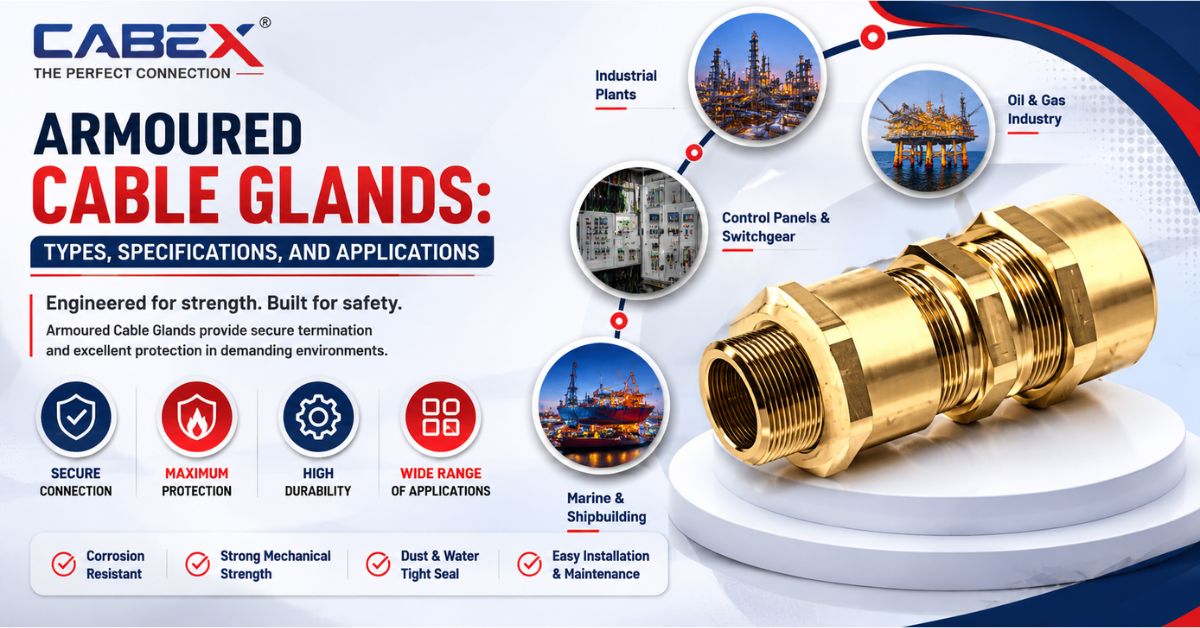
In the world of electrical installations, safety, dependability, and durability are not optional — they are non-negotiable. Armoured cable glands serve as the critical interface between cables and electrical enclosures, ensuring reliable mechanical protection, watertight sealing, and effective earthing. This comprehensive guide covers everything you need to know about armoured cable glands — from types and specifications to applications and selection criteria — drawing on the expertise of Cabex India International, a trusted manufacturer of high-quality electrical components.
What are Armoured Cable Glands?
Armoured cable glands, also called cable glands or cable fittings, are precision-engineered mechanical devices that fasten, seal, and terminate cables as they pass into electrical equipment, junction boxes, or enclosures. They are specifically designed for use with armoured cables such as Steel Wire Armoured (SWA) and Steel Tape Armoured (STA) cables.
Their core functions include:
- Environmental protection — shielding cables from moisture, dust, chemicals, and UV radiation.
- Mechanical strain relief — firmly anchoring the cable to prevent movement that could damage conductors or terminations.
- Earthing continuity — providing a secure electrical path for the armour, helping to dissipate fault currents and minimise shock risk.
- EMI/RFI shielding — in EMC variants, preventing electromagnetic interference from affecting sensitive equipment.
Benefits of Armoured Cable Glands
Choosing the right armoured cable gland delivers significant advantages for any electrical installation:
- Robust protection against abrasion, impact, and physical damage to cables.
- Extended service life due to materials resistant to corrosion, temperature extremes, and UV exposure.
- Improved safety — earthing arrangements and mechanical protection reduce the risk of electrical faults and accidents.
- Versatility — available across a wide range of cable sizes, thread types, and environmental ratings.
- Compliance — leading glands meet international standards such as BS 6121, IS 12943, and IEC 62444.
- Cost efficiency — proper cable termination prevents expensive faults, downtime, and rework.
Types of Armoured Cable Glands
Armoured cable glands come in several types, each engineered for specific cable constructions, environments, and performance requirements. The table below summarises the main types:
| Gland Type | Material | Best For | Key Feature |
| Brass Cable Glands | Brass (CW614N) | SWA / XLPE cables indoors & outdoors | Double compression, corrosion-resistant |
| Stainless Steel Glands | Stainless Steel 316 | Offshore, marine, harsh chemical environments | Superior rust & corrosion resistance |
| Nylon / Plastic Glands | PA66 Nylon | Indoor, low-corrosion environments | Lightweight, cost-effective, non-conductive |
| EMC Cable Glands | Brass / Nickel-plated | Data centres, sensitive electronics | EMI/RFI shielding for screened cables |
1. Brass Cable Glands
Brass cable glands are by far the most widely used type. Manufactured from high-grade brass (typically CW614N), they offer excellent corrosion resistance, good conductivity for earthing, and durability in both indoor and outdoor environments. Cabex India International’s double compression brass cable glands feature a dual sealing system that ensures a watertight connection even in demanding conditions — making them ideal for SWA and XLPE cables in industrial and commercial settings.
2. Stainless Steel Cable Glands
Where corrosion is a significant threat — such as offshore platforms, marine environments, chemical plants, and food processing facilities — stainless steel cable glands (typically 316 grade) are the preferred choice. They provide superior resistance to rust, aggressive chemicals, and extreme temperatures, outperforming brass in the most hostile conditions.
3. Nylon / Plastic Cable Glands
Nylon cable glands (PA66 material) offer a lightweight, non-conductive, and cost-effective solution for indoor applications where corrosion is not a primary concern. They are commonly used in control panels, light industrial machinery, and domestic installations.
4. EMC Cable Glands
Electromagnetic Compatibility (EMC) cable glands are designed for screened or shielded cables where interference control is critical. Typically brass or nickel-plated, they provide a 360-degree connection to the cable shield, ensuring effective EMI/RFI shielding — essential in data centres, telecommunications, and precision instrumentation.
Armoured Cable Gland Specifications
Selecting the correct gland requires careful attention to technical specifications. The table below covers the key parameters to consider:
| Specification Parameter | Details / Range | Significance |
| Cable Diameter Range | 6 mm – 120 mm (varies by size) | Ensures proper fit & seal |
| Thread Size (PG/Metric/NPT) | M16, M20, M25, M32, M40, M63 | Must match equipment entry thread |
| IP Rating | IP54 to IP68 | Determines environmental suitability |
| Material Grade | Brass CW614N / SS316 / PA66 | Corrosion & mechanical resistance |
| Operating Temperature | -20°C to +120°C | Suits industrial & outdoor use |
| Earthing / Bonding | Available on brass & SS glands | Fault current dissipation & safety |
| Standard / Certification | IS 12943, BS 6121, IEC 62444 | International quality compliance |
When specifying armoured cable glands for a project, always cross-reference the cable’s outer diameter, the equipment’s entry thread, and the required IP rating for the installation environment. Cabex India International provides glands across all standard thread sizes and cable diameter ranges, with full compliance to Indian and international standards.
Armoured Cable vs Unarmoured Cable
The choice between armoured and unarmoured cable — and the glands used to terminate them — depends on the installation’s environment, mechanical risks, and regulatory requirements. The comparison table below clarifies the key differences:
| Feature | Armoured Cable | Unarmoured Cable |
| Mechanical Protection | High — SWA / STA layers | Low — relies on conduit |
| Flexibility | Moderate | High |
| Installation Environment | Outdoor, underground, industrial | Indoor, low-risk areas |
| Water / Moisture Resistance | Good (with correct gland) | Poor without conduit |
| Rodent / Impact Resistance | Excellent | Poor |
| Cost | Higher | Lower |
| Typical Applications | Power distribution, oil & gas, mining | Office wiring, domestic use |
In general, armoured cables are the preferred solution for outdoor, underground, or any installation where the cable could be exposed to physical damage, moisture, or rodents. Unarmoured cables are suitable for protected indoor environments where these risks are minimal.
Applications of Armoured Cable Glands
Armoured cable glands are specified across a broad range of industries and applications:
- Power Distribution — connecting cables to transformers, switchgear, distribution boards, and substation equipment.
- Oil & Gas — providing explosion-proof and weatherproof cable terminations in refineries, offshore platforms, and pipeline infrastructure.
- Industrial Machinery — ensuring secure cable entry to motors, pumps, compressors, and control panels.
- Infrastructure & Construction — use in tunnels, bridges, railways, and public utilities where cable durability is paramount.
- Renewable Energy — wind turbines and solar farm installations where cables face UV, moisture, and mechanical stress.
- Marine & Offshore — stainless steel glands withstand saltwater, humidity, and vibration.
- Telecommunications & Data Centres — EMC glands protect signal integrity in high-density cable environments.
Are Armoured Cable Glands Waterproof?
Armoured cables themselves are not inherently waterproof — their steel armour provides mechanical protection but does not prevent water ingress on its own. However, when paired with a correctly rated cable gland, an armoured cable installation can achieve excellent moisture protection.
The Ingress Protection (IP) rating of the gland determines its waterproofing capability:
- IP54 — protected against dust and water splashing from any direction (suitable for most outdoor installations).
- IP65 — dust-tight and protected against low-pressure water jets (suitable for washdown areas).
- IP67 — dust-tight and protected against temporary immersion up to 1 metre for 30 minutes.
- IP68 — dust-tight and protected against continuous immersion beyond 1 metre (suitable for underwater cable runs and buried installations).
Cabex India International’s double compression brass cable glands achieve high IP ratings by using two independent sealing elements — one compressing against the cable outer sheath and one against the armour — ensuring a fully sealed, weatherproof termination.
Key Considerations When Installing Armoured Cable Glands
Correct installation is essential to achieving the rated performance of an armoured cable gland:
- Always strip back the cable outer sheath, armour, and inner sheath to the exact dimensions specified by the gland manufacturer.
- Ensure the armour wires or tapes are spread evenly around the cone/backnut to achieve uniform clamping and reliable earthing continuity.
- Tighten gland components to the manufacturer’s recommended torque — over-tightening can crack nylon glands or distort seals; under-tightening compromises the IP rating.
- Use a gland with an earth tag or earth continuity device when bonding to the equipment earth bar is required.
- In hazardous areas (ATEX/IECEx zones), only use cable glands certified for the relevant zone and gas group.
Summary
The table below provides a quick-reference summary of the key topics covered in this article:
| Topic | Key Takeaway |
| What are Armoured Cable Glands? | Mechanical devices that seal, secure, and earth cables entering electrical enclosures |
| Main Types | Brass, Stainless Steel, Nylon, EMC — each suited to different environments |
| Key Specifications | Cable diameter, thread size, IP rating, material, temperature rating, certifications |
| Armoured vs Unarmoured | Armoured = superior mechanical/environmental protection; Unarmoured = flexible, low-cost indoor use |
| Applications | Power distribution, oil & gas, industrial machinery, infrastructure, renewable energy |
| Are They Waterproof? | Not inherently, but IP-rated glands (IP67/IP68) provide excellent moisture protection |
| Cabex India Products | Double compression brass cable glands — quality, compliance, and durability assured |
Frequently Asked Questions (FAQs)
Q1. What is the difference between single compression and double compression cable glands?
A single compression gland uses one sealing element that clamps against the cable outer sheath. A double compression gland uses two sealing elements — one on the outer sheath and one on the armour — providing superior IP protection and more robust armour clamping. Cabex India International’s double compression brass cable glands are recommended for demanding outdoor and industrial applications.
Q2. Can I use a brass cable gland in a marine environment?
Standard brass glands offer reasonable corrosion resistance, but in marine or offshore environments where saltwater exposure is continuous, stainless steel (316 grade) cable glands are strongly recommended for long-term performance.
Q3. How do I select the correct thread size for my cable gland?
Match the thread size of the cable gland to the thread of the equipment’s cable entry hole. Common thread types include Metric (M16, M20, M25, M32), PG (Panzer-Gewinde), and NPT (US standard). Always check the equipment manufacturer’s documentation before ordering glands.
Q4. What IP rating should I specify for an outdoor installation?
For most outdoor above-ground installations, IP65 or IP66 is sufficient. For underground cable runs or any application with risk of immersion, specify IP67 or IP68 rated glands.
Q5. Are armoured cable glands required by electrical standards?
Yes. In most industrial, commercial, and infrastructure installations, relevant standards (such as IEE Wiring Regulations BS 7671, IS 732 in India, and IEC 60364) require that cable terminations are mechanically secured, sealed, and earthed — all functions provided by a correctly installed armoured cable gland.
Q6. Does Cabex India International supply cable glands for all cable sizes?
Yes. Cabex India International manufactures and supplies armoured cable glands across the full range of cable sizes, from small instrumentation cables to large power cables, in brass, stainless steel, and nylon variants to suit every application requirement.
Conclusion
Armoured cable glands are indispensable components in any robust electrical installation. They protect cables from environmental and mechanical threats, ensure reliable earthing continuity, and maintain the integrity of the enclosure’s IP rating. By understanding the different types — brass, stainless steel, nylon, and EMC — and the critical specifications such as IP rating, thread size, and material grade, electrical engineers and contractors can make well-informed decisions that improve safety, reliability, and longevity.
Cabex India International stands at the forefront of armoured cable gland manufacturing, supplying double compression brass cable glands and a full range of electrical components that meet the highest international quality standards. Whether your project involves power distribution, oil and gas, industrial machinery, or infrastructure, Cabex India International has the right gland solution to meet your needs.