


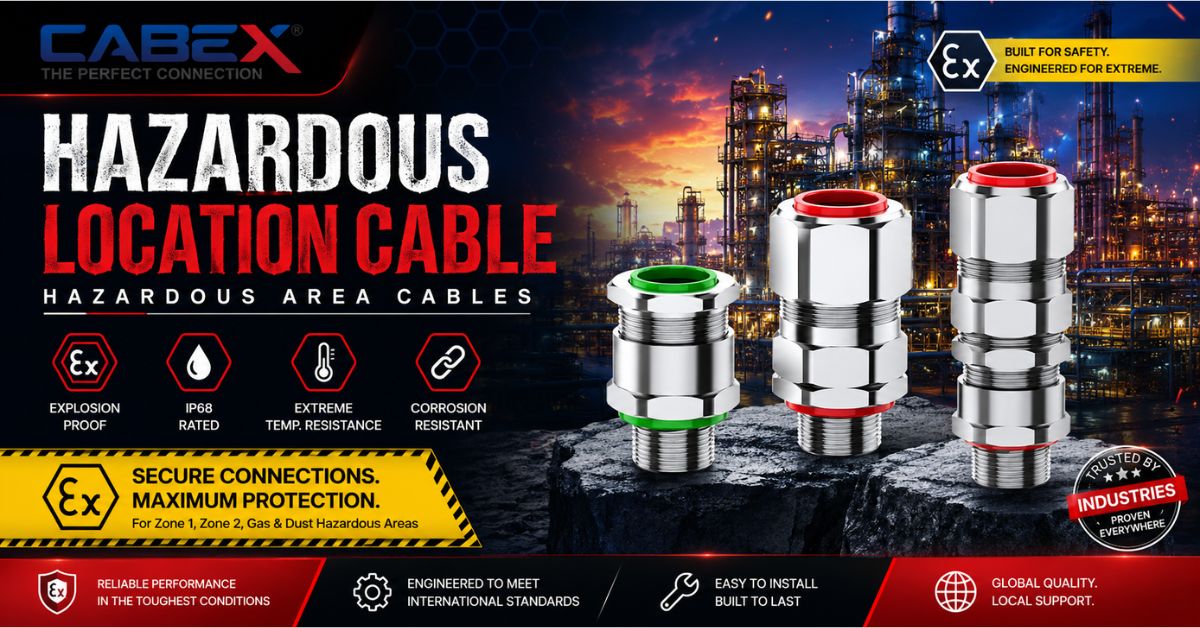
Article Summary: In any installation where flammable gases, vapours, mists, or combustible dusts may be present, the selection of the correct hazardous location cable and hazardous area cable gland is not a technical nicety — it is a life-safety requirement. This guide covers everything: how hazardous zones are classified, which hazardous area cables are correct for each zone, what makes a cable gland genuinely safe in explosive atmospheres, how ATEX and IECEx certification systems work, and why Cabex India is one of the most trusted manufacturers of certified hazardous area cable glands for global installations.
What Is a Hazardous Location? The Engineering Definition
A hazardous location — also called a hazardous area or explosive atmosphere — is any environment where flammable gases, vapours, mists, or combustible dusts are present in concentrations that could ignite and cause an explosion or fire if exposed to an ignition source such as an electrical spark, excessive heat, or an electrical arc.
The global hazardous area cable glands market alone was valued at USD 711 million in 2023 and is projected to reach USD 1.122 billion by 2030, growing at a CAGR of 6.7%. This growth directly reflects the expansion of the industries that operate in explosive atmospheres — oil and gas, LNG, petrochemical, mining, pharmaceutical, grain handling, and chemical processing — all of which require certified hazardous location cables and cable glands in every electrical installation.
These environments are found across a wider range of industries than most people realise. Oil refineries and petrochemical plants are the most obvious examples, but hazardous locations also include paint spray booths, flour mills, grain storage silos, pharmaceutical powder processing rooms, sewage treatment plants, battery charging stations, and offshore platforms. The common thread is the presence of a substance that can form an explosive mixture with air under normal or foreseeable operating conditions.
Safety Critical: A non-certified cable gland installed in a classified hazardous zone can cause catastrophic failure of the entire explosion protection system. Never use standard industrial glands in classified zones. Always verify ATEX or IECEx certification before installation.
Hazardous Zone Classification — Gas and Dust Zones Explained
Before selecting any hazardous location cable or hazardous area cable gland, the zone classification of the installation area must be established. Zone classification is determined by the plant operator in accordance with IEC 60079-10-1 (gas zones) and IEC 60079-10-2 (dust zones), and documented in the site’s Explosion Protection Document (required under ATEX User Directive 99/92/EC).
The classification determines the frequency and duration of explosive atmosphere presence, which in turn determines the protection concept required for every electrical component installed in that zone — including cables and hazardous area cable glands.
| Zone | Hazard Level | Explosive Atmosphere | Cable Gland Requirement |
| Zone 0 | Continuous (highest risk) | Gas, vapour, or mist — always present | Only intrinsically safe (Ex ia) equipment/glands. Barrier glands mandatory. Most restrictive certification required. |
| Zone 1 | Likely during normal operation | Gas or vapour likely in normal ops | ATEX/IECEx certified glands mandatory. Ex d (flameproof) or Ex e (increased safety). Barrier glands recommended. Cabex India Ex d/Ex e glands suitable. |
| Zone 2 | Unlikely, short duration only | Gas or vapour — rare and brief | ATEX/IECEx certified glands required. Ex e or Ex nA. Compression glands acceptable. Cabex India certified range applicable. |
| Zone 21 | Likely during normal operation | Combustible dust cloud — likely | IP6X minimum. Dust-tight glands with ATEX/IECEx Ex tb certification required. IP66/IP68 mandatory. |
| Zone 22 | Unlikely, short duration | Combustible dust — unlikely, brief | IP6X minimum. ATEX/IECEx Ex tc. IP65 absolute minimum. IP68 strongly recommended. |
| NEC Class I Div 1 | High risk (USA standard) | Flammable gases/vapours (USA/Canada) | UL/CSA certified explosion-proof glands. NPT thread standard. Equivalent to Zone 0/1 under ATEX. |
Table 1: Hazardous zone classification system under IEC 60079-10 (ATEX/IECEx) and NEC (USA/Canada). Zone classification must be established before any cable or cable gland selection is made. In North America, Class/Division classification is used alongside or instead of Zone classification depending on the applicable standard.
Cabex India | ATEX & IECEx Certified Hazardous Area Cable Glands | Ex d · Ex e · Barrier Glands · High Temperature | Zone 1 · Zone 2 · Zone 21 · Zone 22 | Global Exporter | cabexindia.com
Hazardous Location Cables — Types, Construction & Selection
Unlike cable glands, standard electrical cables used in hazardous locations do not require ATEX certification under European regulations. This is an important and frequently misunderstood point. According to IEC/EN 60079-14 — the standard governing electrical installations in explosive atmospheres — cables used in Ex zones must meet IEC standards for general safety, materials, and performance, but are not subject to ATEX conformity assessment because they do not have their own source of ignition.
The one important exception is intrinsically safe cables used in Ex ia circuits, which require specific electrical properties (controlled capacitance and inductance) and must be handled separately from non-IS cables throughout the installation.
However — and this is the critical point — while the hazardous area cable itself may not require ATEX certification, the hazardous area cable gland used to terminate it into Ex-rated equipment absolutely does. The gland is part of the explosion protection system and must be certified to match the equipment’s protection concept. An improperly selected or non-certified gland breaks the integrity of the entire Ex system.
Key Hazardous Location Cable Requirements per IEC 60079-14
- Cable design must prevent gas or vapour migration along the cable between conductors and into safe-area enclosures
- Separate cables must be run to individual field devices — no shared multi-core cables unless specifically designed for the purpose
- Cables for intrinsically safe circuits must be shielded and must be physically separated from non-IS cables throughout their runs
- Cables must be protected against mechanical damage, corrosion, UV radiation, and chemical exposure appropriate to the installation environment
- Excessive bundling or grouping of cables must be avoided — overloading or bundling increases operating temperature, which may create an ignition source in the hazardous zone
- All cable installations must be documented in the plant’s Explosion Protection Document
Hazardous Area Cable Types — The Complete Reference Table
The table below covers the six primary types of hazardous area cables, their construction, temperature performance, and specific application in explosive atmosphere installations:
| Cable Type | Construction | Temperature Range | Key Use in Hazardous Locations |
| SWA (Steel Wire Armoured) | PVC/XLPE insulated, SWA, PVC outer | -40°C to +90°C | Primary power and control cable in Zone 1/2 installations. Armour provides mechanical protection and earth continuity through Ex d glands. |
| SY Cable (Steel Braid) | PVC insulated, steel braid, PVC outer | -30°C to +70°C | Most widely used hazardous location cable in onshore energy and industry. Flexible braid suits temporary and moveable installations in Zone 1/2. |
| XLPE/SWA (Cross-Linked Polyethylene) | XLPE insulated, SWA, HDPE/PVC outer | -40°C to +90°C | High-performance power transmission in high-temperature hazardous areas. Superior thermal and chemical resistance to PVC. |
| Intrinsically Safe (IS) Cable | Low capacitance, shielded, blue outer | -40°C to +85°C | Used exclusively in Ex ia intrinsically safe circuits in Zone 0/1/2. Low capacitance and inductance prevent energy storage. Must be separated from non-IS cables. |
| H07RN-F Rubber Cable | Rubber insulated, rubber outer, flexible | -30°C to +60°C | Flexible hazardous location cable for temporary lighting, portable equipment in Zone 1/2. Chemical, mechanical, and thermal resistance. |
| LSOH/LSZH Armoured Cable | Low smoke zero halogen sheath, SWA | -40°C to +90°C | Hazardous areas requiring fire safety compliance (tunnels, offshore, public buildings). Produces minimal smoke and no toxic halogens in fire. |
Table 2: Hazardous location cable types with construction, operating temperature range, and application in classified hazardous zones. Cable type selection must consider zone classification, circuit type (power/control/IS), mechanical environment, and operating temperature. Refer to IEC 60079-14 for complete selection requirements.
SWA Cable — The Workhorse of Hazardous Locations
Steel Wire Armoured (SWA) cable is the dominant hazardous location cable type for fixed power and control installations in Zone 1 and Zone 2 classified areas. The steel wire armour layer serves dual functions: it provides excellent mechanical protection against impact, crushing, and rodent damage in industrial environments; and it provides the earth path for earth continuity through the hazardous area cable gland — a critical safety function in SWA termination into Ex d equipment.
When an SWA hazardous location cable is terminated using a Cabex India double-compression Ex d or Ex e brass cable gland, the gland’s compression cone grips the armour wires positively, creating a low-impedance earth connection between the cable armour and the enclosure body. This earth continuity is a specific requirement of IEC 60079-14 and BS 7671 for armoured cable terminations in hazardous areas.
SY Cable — Flexibility for Hazardous Location Installations
SY cable, with its PVC outer sheath and steel wire braid armour, is the most widely used hazardous area cable in onshore energy and industrial sectors for temporary and semi-permanent installations. The braided armour construction offers greater flexibility than SWA, making SY cable ideal for installations involving moveable equipment, temporary hazardous area lighting, and connections to vibrating machinery. The standard SY cable temperature range of -30°C to +70°C covers the majority of onshore hazardous area applications.
Intrinsically Safe Cables — The Zone 0 Solution
Intrinsically safe (IS) cables are the only cable type that can be used in Zone 0 — the highest-risk classification where explosive gases are continuously present. IS cables are designed to limit the electrical energy that can be transmitted through them below the ignition energy of the surrounding explosive atmosphere, making an ignition event physically impossible even under fault conditions. They are characterised by low capacitance, controlled inductance, shielding against electromagnetic interference, and the distinctive blue outer sheath colour that enables immediate identification during installation and inspection.
IS cables must be used in a complete intrinsically safe system — matched with certified IS field instruments, certified safety barriers or galvanic isolators, and documented in the site’s IS loop drawings. They cannot be mixed with non-IS cables in the same tray or conduit without specific physical separation measures.
Hazardous Area Cable Glands — Why They Are the Critical Safety Component
While hazardous area cables carry the current, the hazardous area cable gland is the component that determines whether the entire explosion protection system works as intended. A hazardous area cable gland must simultaneously achieve five safety-critical functions that standard industrial cable glands cannot be relied upon to deliver:
- Maintain the flameproof (Ex d) or increased safety (Ex e) integrity of the enclosure at the cable entry point
- Provide a reliable, low-impedance earth continuity path through the armour or braid of armoured hazardous area cables
- Seal against moisture and dust ingress to maintain the IP66 or IP68 rating of the Ex enclosure
- Prevent gas or vapour migration along the cable cores from the hazardous zone into the safe area (barrier function)
- Provide mechanical strain relief and cable retention against pullout forces
Every one of these functions must be achieved and maintained across the service life of the installation, across the full temperature range, through vibration and thermal cycling, and without degradation that would compromise the explosion protection. This is why ATEX and IECEx certification of hazardous area cable glands is mandatory — it is the only way to verify that all five functions have been tested and confirmed by an accredited body under standardised test conditions.
Cabex India Hazardous Area Cable Gland Range — ATEX & IECEx Certified
Cabex India manufactures a comprehensive range of hazardous area cable glands certified to ATEX and IECEx standards, covering the full range of protection concepts, zone classifications, and cable types encountered in industrial explosive atmosphere installations.
| Gland Type | Protection Concept | Zone | IP Rating | Typical Application |
| Ex d Flameproof Brass Gland | Ex d (IEC 60079-1) | Zone 1 & 2 | IP66/IP68 | Oil & gas, chemical plants, refineries, offshore platforms |
| Ex e Increased Safety Brass Gland | Ex e (IEC 60079-7) | Zone 1 & 2 | IP65/IP66 | Instrumentation, control panels, junction boxes in ATEX zones |
| Ex tb Dust Gland | Ex tb (IEC 60079-31) | Zone 21 & 22 | IP66/IP68 | Grain handling, wood processing, pharmaceutical, cement plants |
| High Temperature Ex Brass Gland | Ex d / Ex e | Zone 1 & 2 | IP66/IP68 | High-temp hazardous processes: furnaces, steam, hot plant areas |
| Barrier Gland (Gas-Stop) | Ex d / Ex e + gas seal | Zone 0, 1 & 2 | IP68 | LNG terminals, Zone 0 classified areas, multi-core cable entries |
| Nickel-Plated Ex Brass Gland | Ex d / Ex e | Zone 1 & 2 | IP66/IP68 | Offshore, marine, coastal, chemical-wash hazardous environments |
Table 3: Cabex India hazardous area cable gland product range. All Ex d and Ex e glands carry ATEX certification under Directive 2014/34/EU and IECEx certification. All glands are manufactured in brass as standard; nickel-plated brass variants available for corrosive environments. Custom specifications available for volume orders.
Ex d Flameproof Cable Glands — Zone 1 and Zone 2 Gas Applications
Cabex India’s Ex d flameproof brass cable glands are the correct choice for terminating hazardous area cables into flameproof (Ex d) enclosures in Zone 1 and Zone 2 classified gas hazardous areas. The flameproof protection concept requires that the gland body and its joints be machined to specific tolerances defined in IEC 60079-1, ensuring that any internal ignition event is contained within the enclosure and that flame cannot propagate through the gland to the external explosive atmosphere.
These glands are manufactured from high-grade brass to the dimensional tolerances required by the relevant third-party certification body, with each machined surface inspected against the certified drawings before assembly. The certification documentation for each Cabex India Ex d gland includes the maximum cable outer diameter, minimum insertion depth, and thread engagement specifications that must be observed during installation to maintain certification validity.
Barrier Glands — Preventing Zone Entrainment
Zone entrainment is one of the most dangerous and most overlooked failure modes in hazardous area electrical installations. It occurs when explosive gases or vapours from a Zone 1 or Zone 2 classified area migrate along the interstitial spaces between cable cores and emerge inside a safe-area enclosure that contains non-Ex-rated equipment. The result can be a catastrophic explosion triggered by equipment that was never intended or certified for hazardous area use.
Barrier glands prevent zone entrainment by filling the cable entry point with a sealing compound or resin that penetrates the interstitial spaces between cable cores and sets as a gas-tight barrier. Cabex India’s barrier glands are required wherever hazardous area cables enter or exit the classified zone boundary, and wherever cables are routed from Zone 1 or Zone 0 areas into safe-area control rooms, motor control centres, or relay panels.
High Temperature Hazardous Area Cable Glands
Standard elastomeric seals in hazardous area cable glands are typically rated for continuous operation at temperatures up to +100°C for EPDM seals or +250°C for silicone seals. In high-temperature hazardous area processes — such as cable entries near furnaces, heat exchangers, steam systems, or high-ambient-temperature process environments in refineries — standard seals may degrade prematurely, compromising both the IP rating and the ATEX certification integrity.
Cabex India supplies high temperature variants of its Ex d and Ex e hazardous area cable gland range, with specially selected high-temperature sealing materials and body configurations that maintain full ATEX/IECEx certification at continuous elevated operating temperatures. Detailed temperature ratings are provided in the product-specific data sheets and must be verified against the actual installation conditions before specification.
How to Select the Right Hazardous Area Cable Gland — Step-by-Step
The selection of a hazardous area cable gland requires a systematic process that verifies compliance across six independent parameters. Skipping any one of them can result in a non-compliant installation.
- Confirm the zone classification: Zone 0, 1, 2, 21, or 22 from the site’s Explosion Protection Document.
- Identify the equipment’s protection concept: Ex d (flameproof), Ex e (increased safety), or Ex tb (dust). The cable gland must match the equipment certificate.
- Identify the cable construction: SWA, SY braid, unarmoured, or intrinsically safe. Double compression glands for armoured cables; single compression for unarmoured.
- Measure the cable outer diameter: Must fall within the gland’s certified cable range — using a gland outside its certified cable range invalidates the ATEX certification.
- Confirm thread type and size: Metric, NPT, BSP, or PG — must match the entry thread in the enclosure.
- Verify certification validity: Check the ATEX/IECEx certificate number on the IECEx certificate portal. Never rely on CE markings alone for hazardous area compliance.
Why Choose Cabex India for Hazardous Area Cable Glands
In the hazardous area cable gland market, certification credibility is everything. A manufacturer that self-declares ATEX compliance or provides unverifiable certification documentation is a liability in any installation. Cabex India’s hazardous area cable glands stand on verifiable, third-party ATEX and IECEx certifications issued by accredited bodies — certificates that can be confirmed in the IECEx public certificate database.
- Genuine third-party ATEX & IECEx certification: All Cabex India hazardous area cable gland certificates are issued by accredited certification bodies, not self-declared. Verifiable in the IECEx certificate database.
- Complete protection concept coverage: Ex d flameproof, Ex e increased safety, Ex tb dust, high temperature, barrier glands — Cabex India covers every hazardous area cable gland requirement from a single manufacturer.
- Full thread standard coverage: Metric, NPT, BSP, and PG thread forms allow Cabex India to serve international hazardous area projects under any installation standard.
- Global export capability: Certified for use in the UK (ATEX), internationally (IECEx), India (PESO/ISI), and exportable worldwide. Direct export to oil and gas projects in the Middle East, Australia, and Europe.
- Material options: Standard brass for most hazardous area applications; nickel-plated brass for coastal, offshore, and corrosive chemical environments; all to the same ATEX certification.
- Technical support: Cabex India’s technical team supports zone-specific gland selection, certificate verification, and custom specification for project-specific hazardous area requirements.
Conclusion — Compliance Is Not Optional in Explosive Atmospheres
Every electrical component installed in a hazardous location carries a safety obligation. The hazardous location cable carries electrical energy through a potentially explosive environment. The hazardous area cable gland seals the entry point and maintains the explosion protection integrity of everything it connects to. And the certification that backs both — ATEX, IECEx, and the standards of IEC 60079 — is the engineering proof that these components have been tested to do their job under the most demanding conditions.
Selecting the wrong hazardous area cable type, the wrong protection concept, or a non-certified hazardous area cable gland does not just create a compliance failure on paper — it creates a genuine risk of catastrophic explosion in environments where people work every day. The cost of getting it right — verified certification, correct zone matching, correct cable construction — is always lower than the cost of getting it wrong.
Cabex India manufactures certified hazardous area cable glands for Zone 1, Zone 2, Zone 21, and Zone 22 installations — with genuine ATEX and IECEx certification, full thread type coverage, and global export capability. For installations ranging from onshore refineries in India to offshore platforms in the Middle East and industrial plants in the UK, Cabex India provides the certified product and the technical support to back it.
Contact Cabex India | Hazardous Area Cable Gland Manufacturer | ATEX & IECEx Certified | Ex d · Ex e · Barrier · High Temperature | Zone 1 · Zone 2 · Zone 21 · Zone 22 | cabexindia.com | +91 9825222330
Frequently Asked Questions — Hazardous Location Cables & Hazardous Area Cable Glands
The table below answers the most frequently searched questions by electrical engineers, project managers, and procurement professionals working on hazardous area installations:
| Frequently Asked Question | Answer |
| What is a hazardous location cable? | A hazardous location cable is an electrical cable specifically selected and installed for use in environments where flammable gases, vapours, dusts, or fibres may be present in concentrations that could ignite. The most common types include SWA (Steel Wire Armoured), SY (steel braid), XLPE armoured, intrinsically safe (IS), and H07RN-F rubber cables. These cables are selected based on the zone classification, operating temperature, mechanical environment, and circuit type (power, control, or intrinsically safe). |
| Do hazardous area cables need ATEX certification? | Under ATEX Directive 2014/34/EU, standard cables do not require ATEX certification because they do not have their own source of ignition. However, intrinsically safe cables used in Ex ia circuits require careful selection per EN 60079-14. Cable glands used to terminate cables in hazardous areas DO require ATEX/IECEx certification, as they directly influence the explosion protection integrity of the enclosure. Always pair the correct cable type with a properly certified hazardous area cable gland. |
| What is the difference between Ex d and Ex e cable glands? | Ex d (flameproof) cable glands are designed to contain any internal ignition within the gland/enclosure without allowing flame propagation to the external explosive atmosphere. They are used with flameproof (Ex d) enclosures in Zone 1 and Zone 2. Ex e (increased safety) cable glands prevent ignition by enhanced design — tighter tolerances, better sealing, and no internal sparking components. Used with increased safety (Ex e) equipment in Zone 1 and Zone 2. The equipment certificate specifies which protection concept is required. |
| What certifications do Cabex India hazardous area cable glands carry? | Cabex India hazardous area cable glands carry ATEX certification under Directive 2014/34/EU (for Zone 1 and Zone 2 hazardous areas in Europe) and IECEx certification under the IECEx scheme (for international hazardous area installations in Australia, Middle East, India, and globally). All certifications are issued by accredited third-party certification bodies and are verifiable in the IECEx certificate database. Products also conform to IEC 60079 series and IEC 62444 standards. |
| Can I use a standard cable gland in a hazardous area? | No. Using a standard, uncertified cable gland in a classified hazardous area (Zone 0, 1, 2, 21, or 22) is both illegal under ATEX/IECEx regulations and genuinely dangerous. The cable gland is part of the explosion protection system — it must be certified to the same protection concept as the enclosure it is installed in. A standard gland installed in a Zone 1 Ex d enclosure breaks the flameproof integrity of the entire enclosure, potentially allowing flame propagation in an explosion event. |
| What is a barrier gland and when must it be used? | A barrier gland is a type of hazardous area cable gland that uses a compound or resin fill to prevent gas or vapour migration along the cable cores from the hazardous area into the safe area through the cable itself. Barrier glands are required when cables cross from a Zone 1 or Zone 0 hazardous area into a safe area (a risk called ‘zone entrainment’). Without a barrier gland, flammable gas can travel along the interstices between cable cores and emerge in the safe-area enclosure, creating an explosion risk far from the actual hazardous zone. |
| Does Cabex India supply hazardous area cable glands for export? | Yes. Cabex India exports ATEX and IECEx certified hazardous area cable glands to the United Kingdom, Europe, Australia, the Middle East, and the Far East. All exported products meet the destination market’s applicable hazardous area certification requirements. Custom specifications including high-temperature variants, special materials, and specific zone/gas group combinations are available for volume export orders. Contact Cabex India at cabexindia.com or +91 9825222330. |
Conclusion — Compliance Is Not Optional in Explosive Atmospheres
Every electrical component installed in a hazardous location carries a safety obligation. The hazardous location cable carries electrical energy through a potentially explosive environment. The hazardous area cable gland seals the entry point and maintains the explosion protection integrity of everything it connects to. And the certification that backs both — ATEX, IECEx, and the standards of IEC 60079 — is the engineering proof that these components have been tested to do their job under the most demanding conditions.
Selecting the wrong hazardous area cable type, the wrong protection concept, or a non-certified hazardous area cable gland does not just create a compliance failure on paper — it creates a genuine risk of catastrophic explosion in environments where people work every day. The cost of getting it right — verified certification, correct zone matching, correct cable construction — is always lower than the cost of getting it wrong.
Cabex India manufactures certified hazardous area cable glands for Zone 1, Zone 2, Zone 21, and Zone 22 installations — with genuine ATEX and IECEx certification, full thread type coverage, and global export capability. For installations ranging from onshore refineries in India to offshore platforms in the Middle East and industrial plants in the UK, Cabex India provides the certified product and the technical support to back it.
Contact Cabex India | Hazardous Area Cable Gland Manufacturer | ATEX & IECEx Certified | Ex d · Ex e · Barrier · High Temperature | Zone 1 · Zone 2 · Zone 21 · Zone 22 | cabexindia.com | +91 9825222330
Frequently Asked Questions — Hazardous Location Cables & Hazardous Area Cable Glands
The table below answers the most frequently searched questions by electrical engineers, project managers, and procurement professionals working on hazardous area installations:
| Frequently Asked Question | Answer |
| What is a hazardous location cable? | A hazardous location cable is an electrical cable specifically selected and installed for use in environments where flammable gases, vapours, dusts, or fibres may be present in concentrations that could ignite. The most common types include SWA (Steel Wire Armoured), SY (steel braid), XLPE armoured, intrinsically safe (IS), and H07RN-F rubber cables. These cables are selected based on the zone classification, operating temperature, mechanical environment, and circuit type (power, control, or intrinsically safe). |
| Do hazardous area cables need ATEX certification? | Under ATEX Directive 2014/34/EU, standard cables do not require ATEX certification because they do not have their own source of ignition. However, intrinsically safe cables used in Ex ia circuits require careful selection per EN 60079-14. Cable glands used to terminate cables in hazardous areas DO require ATEX/IECEx certification, as they directly influence the explosion protection integrity of the enclosure. Always pair the correct cable type with a properly certified hazardous area cable gland. |
| What is the difference between Ex d and Ex e cable glands? | Ex d (flameproof) cable glands are designed to contain any internal ignition within the gland/enclosure without allowing flame propagation to the external explosive atmosphere. They are used with flameproof (Ex d) enclosures in Zone 1 and Zone 2. Ex e (increased safety) cable glands prevent ignition by enhanced design — tighter tolerances, better sealing, and no internal sparking components. Used with increased safety (Ex e) equipment in Zone 1 and Zone 2. The equipment certificate specifies which protection concept is required. |
| What certifications do Cabex India hazardous area cable glands carry? | Cabex India hazardous area cable glands carry ATEX certification under Directive 2014/34/EU (for Zone 1 and Zone 2 hazardous areas in Europe) and IECEx certification under the IECEx scheme (for international hazardous area installations in Australia, Middle East, India, and globally). All certifications are issued by accredited third-party certification bodies and are verifiable in the IECEx certificate database. Products also conform to IEC 60079 series and IEC 62444 standards. |
| Can I use a standard cable gland in a hazardous area? | No. Using a standard, uncertified cable gland in a classified hazardous area (Zone 0, 1, 2, 21, or 22) is both illegal under ATEX/IECEx regulations and genuinely dangerous. The cable gland is part of the explosion protection system — it must be certified to the same protection concept as the enclosure it is installed in. A standard gland installed in a Zone 1 Ex d enclosure breaks the flameproof integrity of the entire enclosure, potentially allowing flame propagation in an explosion event. |
| What is a barrier gland and when must it be used? | A barrier gland is a type of hazardous area cable gland that uses a compound or resin fill to prevent gas or vapour migration along the cable cores from the hazardous area into the safe area through the cable itself. Barrier glands are required when cables cross from a Zone 1 or Zone 0 hazardous area into a safe area (a risk called ‘zone entrainment’). Without a barrier gland, flammable gas can travel along the interstices between cable cores and emerge in the safe-area enclosure, creating an explosion risk far from the actual hazardous zone. |
| Does Cabex India supply hazardous area cable glands for export? | Yes. Cabex India exports ATEX and IECEx certified hazardous area cable glands to the United Kingdom, Europe, Australia, the Middle East, and the Far East. All exported products meet the destination market’s applicable hazardous area certification requirements. Custom specifications including high-temperature variants, special materials, and specific zone/gas group combinations are available for volume export orders. Contact Cabex India at cabexindia.com or +91 9825222330. |