
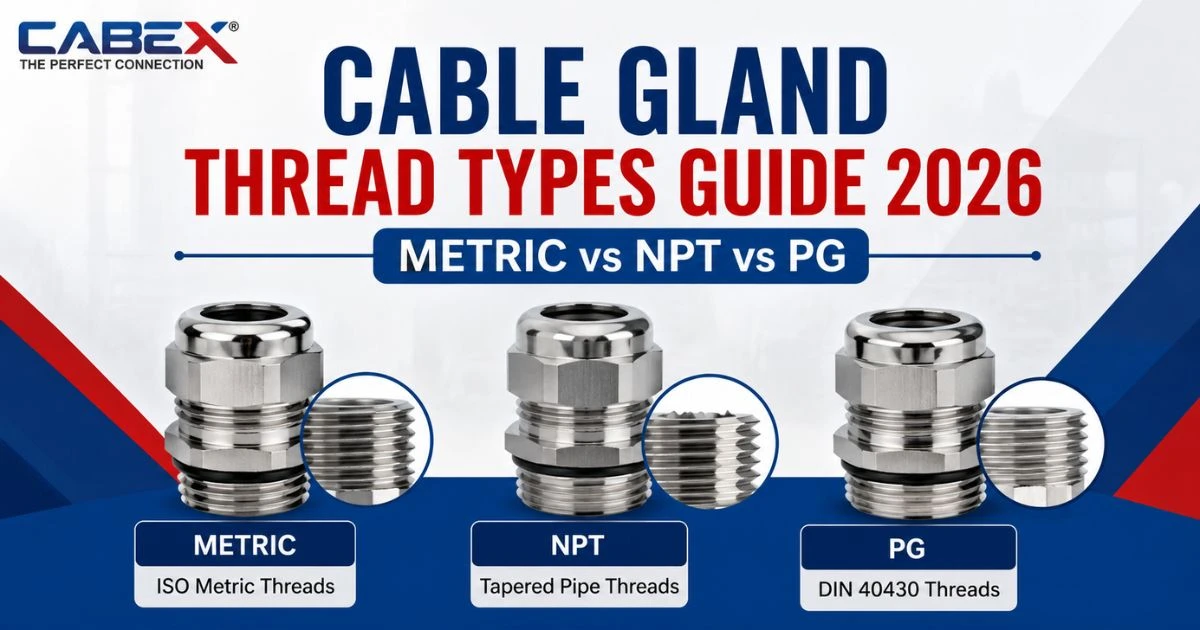
Cable glands come in three primary thread standards — Metric (M-thread), PG (Panzergewinde), and NPT (National Pipe Thread) — plus the less common BSP/G thread. Each standard uses its own thread angle, pitch, and sealing method. These standards are not interchangeable. Choosing the correct cable gland thread types matters most in gland specification, because a mismatched thread won’t seal properly. This directly compromises the enclosure’s Ingress Protection (IP) rating.
At Cabex India, we manufacture and export brass cable glands across all major thread standards for industrial, marine, oil & gas, and hazardous-area applications. We primarily serve procurement teams across the Gulf, Europe, and Southeast Asia. This guide breaks down every major cable gland thread types. It also shows you how to identify what you have on hand and how to choose correctly the first time — so you avoid costly re-orders and installation delays.
What Is a Cable Gland Thread Types?
A cable gland thread types is the standardized thread profile machined onto the gland body. It determines how the gland screws into an enclosure, junction box, or panel. Three standards dominate global use today: Metric (M), PG, and NPT. Each falls under a different national or international body.
In practice, the thread type stays completely separate from the gland’s clamping range or IP rating. Two glands can share the same M20 thread but have entirely different cable diameter ranges. This trips up many first-time buyers. It’s also why a size chart alone isn’t enough — you need both the thread standard and the clamping range specified together.
What Is a Metric Thread Cable Gland?
A metric thread cable gland uses a straight, fine-pitch thread. The international standard IEC 60423 defines it (Europe adopted it as EN 60423). You can identify it by the “M” prefix followed by the outer diameter in millimeters — for example, M20, M25, or M32. This remains the most widely used cable gland thread types in modern industrial installations worldwide.
The standard covers fourteen outer diameters, ranging from M6 to M110. Each diameter pairs with a specific thread pitch, and manufacturers must state this pitch in the designation. So a correctly specified metric gland reads “M20 × 1.5,” not just “M20.” The permissible tolerance on the mounting hole diameter also scales with size. It runs from roughly 0.2 mm at M6 up to 0.5 mm at M110 — a detail that matters when a panel fabricator drills entry holes to spec.
Metric threads seal through an O-ring or rubber seal at the gland shoulder, not through thread interference alone. This is why manufacturers almost always ship metric-threaded glands with a captive sealing washer.
Where you’ll find it: Europe, India, Australia, and most IEC-aligned markets specify metric-thread glands by default for new panel and enclosure builds.
Visit for This – Cabex India Products Range
What Is a PG Thread Cable Gland?
A PG thread (Panzergewinde, or “armored thread”) cable gland uses a parallel thread with a distinctly flatter 80-degree angle. Germany originally standardized this format, and the industry now considers it legacy. PG threads won’t fit metric-threaded holes because the thread profiles differ, so retrofitting one for the other always needs a conversion adaptor.
German national standards formally phased out PG threads in 2000 in favor of the metric system. However, they still show up on older switch cabinets, control panels, and legacy machinery across Europe and parts of Asia. That’s exactly why any serious cable gland thread types chart still includes PG sizing — plant maintenance teams frequently need a PG gland to match equipment that predates the metric transition.
Common PG designations: PG7, PG9, PG11, PG13.5, PG16, PG21, PG29, PG36, PG42, and PG48 remain the most-ordered sizes for spare-parts and maintenance procurement.
Where you’ll find it: Legacy European industrial equipment, older German-engineered machinery, and maintenance or replacement orders rather than new builds.
What Is an NPT Thread Cable Gland?
An NPT (National Pipe Thread) cable gland uses a tapered thread. ANSI/ASME B1.20.1 standardizes it, and it serves as the default cable gland thread types across North America. Metric and PG threads run parallel, but NPT threads seal through mechanical interference instead. As you tighten the tapered male and female threads together, they wedge into a tight, self-sealing connection rather than relying mainly on an external O-ring.
Manufacturers express NPT sizes in fractional inches — 1/2″ NPT, 3/4″ NPT, 1″ NPT. These refer to the nominal pipe size, not the actual outer diameter of the thread, which confuses many buyers converting from metric drawings. The taper itself runs at a 1/16 ratio, narrowing gradually along the thread’s length. This taper lets the flanks seal effectively once torqued down.
Where you’ll find it: United States, Canada, and any facility built to NEC (National Electrical Code) wiring practices. Exporters shipping to North America must specify NPT explicitly. A metric gland won’t thread into an NPT-tapped enclosure without an adaptor.
What Is a BSP (G-Thread) Cable Gland?
A BSP (British Standard Pipe) or “G-thread” cable gland uses a parallel thread standard. The UK and Commonwealth markets have used it historically, often marking it with a “G” prefix (e.g., G3/4). The UK still actively uses both Metric and BSP thread cable glands today. SWA (steel wire armoured) cable glands typically follow BS-specific sizing that stays broadly metric-compatible.
BSP threads run parallel, like metric and PG. However, their thread angle and pitch differ. So, like PG, a BSP gland won’t thread directly into a metric-tapped enclosure.
Where you’ll find it: UK electrical installations, particularly armoured cable (SWA) systems and legacy British-standard panels.
Metric vs. PG vs. NPT vs. BSP: Full Comparison Table
| Thread Type | Governing Standard | Thread Profile | Sealing Method | Typical Region | Status |
|---|---|---|---|---|---|
| Metric (M) | IEC 60423 / EN 60423 | Parallel, fine pitch | O-ring/washer at shoulder | Europe, India, IEC markets | Current standard |
| PG | Legacy DIN 40430 | Parallel, 80° angle | O-ring/washer at shoulder | Legacy European equipment | Phased out, still serviced |
| NPT | ANSI/ASME B1.20.1 | Tapered, 1/16 taper | Thread interference + sealant | North America | Current standard |
| BSP (G) | BS 21 / ISO 228 | Parallel | O-ring/washer | UK, Commonwealth | Active alongside Metric |
Metric Thread Size Chart (Common Sizes)
| Metric Size | Thread Pitch | Typical Cable OD Range | Common Application |
|---|---|---|---|
| M12 | 1.5 mm | 3–7 mm | Small sensors, instrumentation |
| M16 | 1.5 mm | 5–10 mm | Control panels |
| M20 | 1.5 mm | 7–13 mm | General industrial |
| M25 | 1.5 mm | 9–17 mm | Motor connections |
| M32 | 1.5 mm | 14–24 mm | Multi-core power cables |
| M40 | 1.5 mm | 19–32 mm | Heavy industrial power feeders |
This table answers: “What cable diameter fits which metric gland size?” Always confirm the exact clamping range against the manufacturer’s datasheet. Ranges vary slightly between brands even at the same nominal size.
How Do I Identify the Thread Type on My Existing Enclosure?
Check the equipment’s technical documentation first to identify an unknown cable gland thread types. If that’s unavailable, measure the entry hole’s outer diameter and thread pitch directly. When you genuinely can’t determine the standard, measuring against a reference chart remains the reliable fallback method.
A few practical identification cues from the field:
- Parallel threads with a rounded profile and metric pitch (1.5 mm) almost always indicate metric (M-series).
- Parallel threads with a noticeably flatter, wider profile typically indicate PG, especially on equipment made before 2000.
- Visibly tapered threads that narrow toward the tip indicate NPT.
- Fractional-inch nominal sizing on an equipment nameplate (1/2″, 3/4″) strongly signals NPT or BSP rather than metric.
When in doubt, use a thread pitch gauge. It takes under two minutes and saves you from ordering the wrong stock.
Why Does Cable Gland Thread Types Matter for IP Rating?
A mismatched or improperly seated thread breaks the mechanical seal path. This lets dust or moisture bypass the gland regardless of its rated IP class. IEC 60529 defines IP ratings for cable glands, describing protection against both solid particle ingress and liquid ingress through a two-digit code. That rating only holds up if you thread and torque the gland correctly into a matching entry hole.
In practice, we’ve seen IP68-rated glands fail moisture testing purely because installers force-fitted them into a mismatched thread, using excess PTFE tape or sealant to compensate. The gland itself was never at fault. This failure mode keeps recurring in field installations, particularly on retrofit projects where nobody verified the original enclosure thread standard before ordering.
Do Hazardous Area (ATEX/IECEx) Installations Require a Specific Thread Type?
No single cable gland thread types is mandatory for hazardous area installations. Instead, you need a gland separately certified for the zone, regardless of thread type. Cable glands for ATEX/IECEx zones must also meet requirements under DIN EN IEC 60079-0 and DIN EN IEC 60079-7. These standards govern general explosion-protection requirements and increased-safety “Ex-e” construction respectively.
In Gulf refinery and petrochemical projects specifically, we routinely see specifications call for Ex-d (flameproof) metric-thread brass glands rated IP66/IP68. Most regional plant infrastructure — particularly in Saudi Arabia, the UAE, and Qatar — follows IEC-aligned metric standards rather than NPT.
What Cable Gland Thread Types Does India Use?
India uses the metric thread type (M-series) as its standard for cable glands. This aligns with IEC 62444, which the country has adopted for new electrical installations nationwide. Manufacturers building IS-standard electrical installations in India typically use metric threading in line with IEC 62444, now the standard specification for new work. General commercial installations also reference IS 6947 for brass fitting compliance.
For manufacturers exporting from India — including to Gulf, European, and Southeast Asian markets — this means metric serves as the default production thread. Producers make NPT and BSP variants specifically against export order specifications rather than keeping them as standard stock.
Metric-to-NPT-to-PG Conversion Reference
| Metric Size | Nearest PG Equivalent | Nearest NPT Equivalent |
|---|---|---|
| M12 | PG7 | — |
| M16 | PG11 | 1/2″ NPT (approx.) |
| M20 | PG13.5 | 1/2″–3/4″ NPT (approx.) |
| M25 | PG16 | 3/4″ NPT (approx.) |
| M32 | PG21 | 1″ NPT (approx.) |
| M40 | PG29 | 1¼” NPT (approx.) |
This table answers: “What is the NPT or PG equivalent of my metric gland size?” Note that these standards don’t convert on a strict 1:1 basis. Treat this table as a practical substitution guide, not an exact dimensional match, and use adaptors wherever you need a precision fit.
Can I Use an Adaptor to Convert Between Thread Types?
Yes, you can convert between cable gland thread types using a dedicated thread adaptor. Just make sure the adaptor itself carries the correct size and IP rating for your application. Installers routinely use adaptors for PG-to-metric retrofits and metric-to-NPT export conversions. But every adaptor adds another seal interface, so the overall assembly’s IP rating only matches its weakest joint.
For hazardous-area or marine-grade projects, we generally recommend sourcing the gland pre-manufactured in the exact required thread rather than stacking an adaptor. Certification bodies often require testing the gland-to-enclosure connection as a single certified assembly.
Need the Right Thread Type for Your Next Project?
Not sure which thread standard your panel, export shipment, or hazardous-area installation needs? Cabex India’s technical team can confirm the correct metric, PG, NPT, or BSP specification against your enclosure drawings before you place an order. This includes Ex-d/Ex-e certified brass glands for Gulf and IECEx-region projects.
Conclusion
Cable gland thread types don’t interchange, and each of the three main standards — Metric, PG, and NPT, plus the regionally relevant BSP — needs a matching enclosure thread to hold a reliable seal and IP rating. Getting this specification right before you order prevents failed installations, compromised ingress protection, and unnecessary rework. When in doubt, measure the thread pitch directly or ask your gland manufacturer’s technical team rather than guessing from a generic size chart.
Frequently Asked Questions
What is the most common cable gland thread types worldwide?
Metric thread (M-series), standardized under IEC 60423, is the most widely used cable gland thread types globally, particularly across Europe, India, and other IEC-aligned markets.
Can a metric cable gland fit an NPT-tapped enclosure?
No, a metric cable gland cannot fit an NPT-tapped enclosure directly; the thread profiles and sealing mechanisms don’t match, so you need a certified thread adaptor.
Is PG thread still manufactured for new equipment?
Manufacturers rarely produce PG thread for new equipment today, since German standards phased it out in 2000, but it still gets made for maintenance and retrofit orders on legacy machinery.
How do I know if my enclosure uses BSP or metric thread?
Check the equipment nameplate for fractional-inch sizing (BSP) versus millimeter “M” sizing (metric), or measure the thread pitch directly with a gauge.
Does thread type affect a cable gland’s IP68 rating?
Yes, thread type directly affects whether a cable gland can hold its rated IP68 protection, because a mismatched or poorly seated thread breaks the mechanical seal path regardless of the gland’s individual certification.