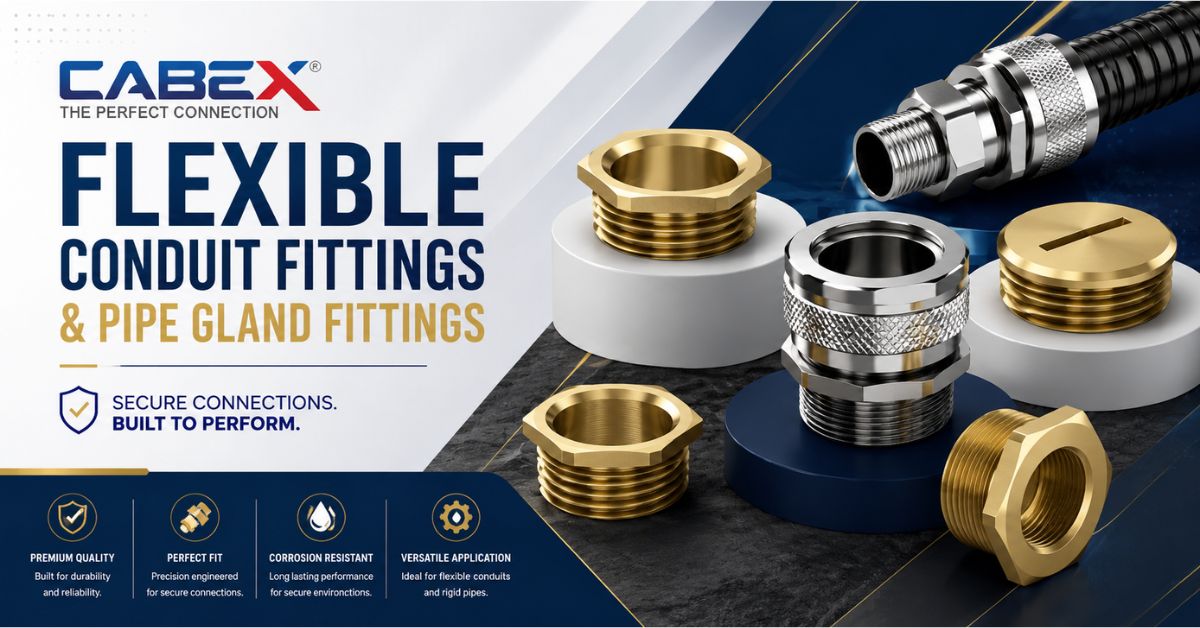
Whether you are wiring a petrochemical plant, setting up industrial automation, or running cables through a commercial building, one thing remains non-negotiable — the reliability of your flexible conduit fittings and pipe gland fittings. These small yet mission-critical components are the unsung heroes of every electrical installation, keeping cables protected, connections sealed, and systems compliant with national and international standards.
This comprehensive guide walks you through everything — from understanding what flexible conduit fittings are, the various types of pipe gland fittings available, to choosing the right material for your specific environment. We also highlight why Cabex India continues to be the benchmark for quality, compliance, and variety in this product segment.
Key Takeaway: The global conduit fittings market is projected to grow significantly through 2030, driven by rapid industrialisation, smart infrastructure, and stringent safety mandates. Selecting the right flexible conduit fittings from day one reduces maintenance costs, downtime, and compliance risks.
What Are Flexible Conduit Fittings?
Flexible conduit fittings — also known as flexible conduit connectors, conduit gland adapters, or flexible conduit accessories — are precision-engineered mechanical components used to terminate, connect, and seal flexible conduits at enclosures, junction boxes, control panels, or electrical equipment. Unlike fittings designed for rigid conduit systems, flexible conduit fittings accommodate bending, vibration, thermal expansion, and movement, making them indispensable in dynamic industrial environments.
A typical flexible conduit fitting assembly consists of the following parts:
Gland Nut / Clamping Nut
Locks the sealing ring firmly against the conduit jacket to create a secure grip.
Sealing Ring
A polymer ring that conforms to the conduit profile, creating a watertight seal.
Ferrule / Ground Ferrule
Fits into the conduit convolutions for a firm mechanical grip and liquid-tight seal.
Fitting Body
Houses the sealing ring and interfaces with the enclosure or panel knockout.
Lock Nut
Secures the fitting to the enclosure wall, resisting loosening from vibration.
Insulated Throat
Polymer insert that prevents wire insulation from chafing on metal edges.
When paired with quality pipe gland fittings, these components form a complete cable entry and protection system capable of meeting IP66, IP67, and IP68 ingress protection ratings, as well as ATEX requirements for hazardous areas.
Types of Flexible Conduit Fittings
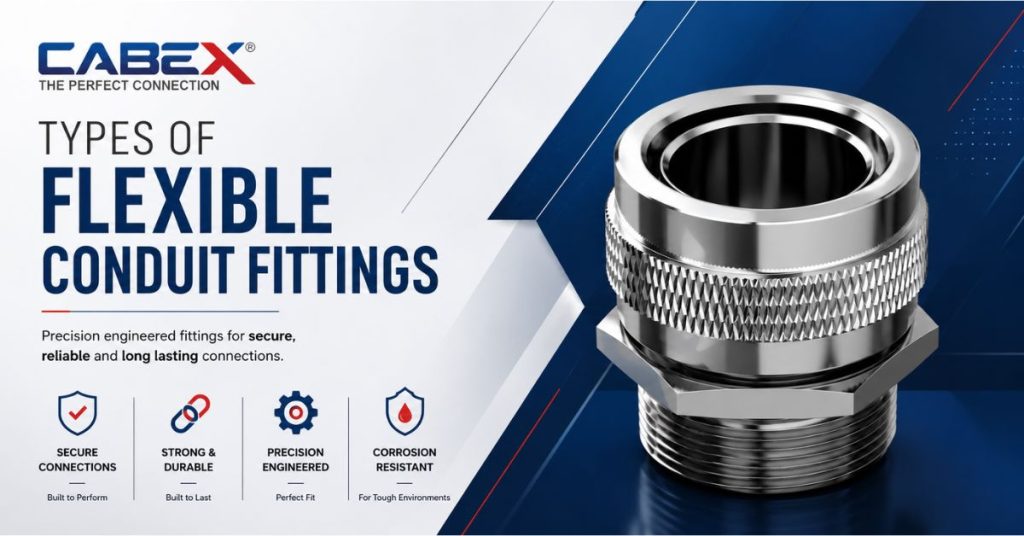
Choosing the right type of flexible conduit fitting depends on your conduit material, installation environment, and the level of ingress protection required. Below is a detailed breakdown of the most common types used across industrial, commercial, and residential applications.
| Fitting Type | Compatible Conduit | Material Options | IP Rating | Typical Application |
|---|---|---|---|---|
| Liquid-Tight Fittings (LTFMC) | Liquid-tight flexible metallic conduit | Zinc die-cast, Brass, Stainless Steel | IP67 | Outdoor installations, wet areas, HVAC |
| Flexible Metal Conduit (FMC) Fittings | Interlock spiral steel conduit | Steel, Zinc, Aluminum | IP44 | Machinery connections, panel wiring |
| PVC / Nylon Conduit Fittings | Flexible PVC, ENT conduit | Polyamide (PA6/PA66), PVC | IP68 | Corrosive areas, food processing, marine |
| Straight Connectors | All flexible conduit types | Brass, Steel, Nylon | IP54–IP67 | Panel entry, junction box connections |
| 90° / 45° Angle Fittings | Flexible metallic & PVC conduit | Zinc die-cast, Brass | IP54 | Tight spaces, conduit direction changes |
| Reducing Adapters / Bush Fittings | All types | Nylon, Brass, Steel | IP40–IP54 | Diameter transitions between conduits |
| Split Fittings | Liquid-tight flexible conduit | Brass, Stainless Steel | IP67 | Retrofit installations, pre-wired cables |
* IP ratings may vary depending on manufacturer specifications and installation conditions.
Metallic vs. Non-Metallic Flexible Conduit Fittings
Metallic Fittings — Advantages
- Superior mechanical strength & impact resistance
- Provides EMI/RFI shielding for sensitive equipment
- Suitable for high-temperature applications
- Continuous grounding path for safety
- Long service life in industrial environments
Non-Metallic Fittings — Advantages
- Excellent corrosion & chemical resistance
- Lightweight — ideal for overhead installations
- Non-conductive — eliminates galvanic corrosion
- Cost-effective for large-volume installations
- UV-resistant grades available for outdoor use
What Are Pipe Gland Fittings?
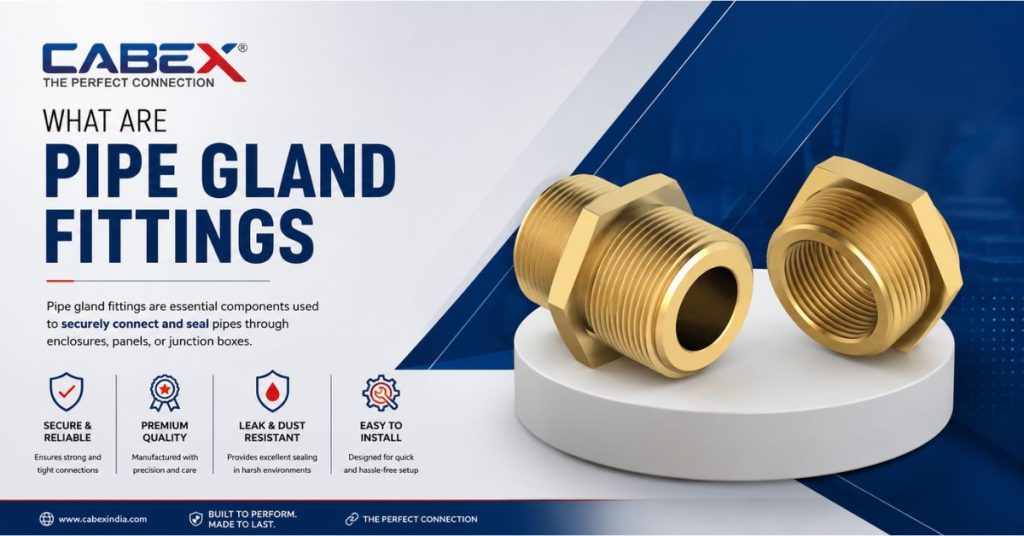
Pipe gland fittings — frequently referred to as conduit cable glands, screw couplings, or conduit gland adapters — are specialised connectors designed to seal and anchor flexible or rigid conduit at the point of entry into an enclosure or equipment. They differ from standard cable glands in that their primary purpose is to connect and seal the conduit system itself, rather than grip an individual cable.
As defined by industry standards, a pipe gland fitting typically features two distinct thread ends: one end matches the conduit thread (metric, PG, or NPT), while the other interfaces with the equipment’s entry hole or knockout. Cabex India’s range of pipe gland fittings includes both metallic and polyamide variants, covering PG 9 through PG 48 thread sizes and metric equivalents.
Key Components of a Pipe Gland Fitting
| Component | Function | Common Material | Critical Specification |
|---|---|---|---|
| Gland Body | Primary structural housing; interfaces with enclosure wall | Brass, Nickel-Plated Brass, PA6 | Thread form: PG, Metric, NPT, BSP |
| Clamping Nut | Compresses sealing elements onto the conduit OD | Brass, Zinc, Nylon | Torque range: 2–15 Nm depending on size |
| Sealing Insert / O-Ring | Provides IP-rated seal against moisture & dust | EPDM, Neoprene, NBR, Silicone | Temperature range: -40°C to +120°C |
| Backnut / Locknut | Secures the gland body firmly to the enclosure | Brass, Nickel-Plated Brass, Nylon | Anti-vibration torque locking design |
| Earth Tag / Earth Ring | Provides continuous electrical bonding to the conduit | Tinned Copper, Brass | Required for metallic conduit grounding |
| Shroud / Sealing Cap | Protects unused gland ports from ingress | PVC, Polyamide | Rated to same IP as the gland body |
Material Selection Guide for Flexible Conduit & Pipe Gland Fittings
Selecting the correct material for your flexible conduit fittings and pipe gland fittings is critical to long-term system integrity. The wrong choice can lead to corrosion, seal failure, or non-compliance with safety standards.
| Material | Corrosion Resistance | Mechanical Strength | Temperature Range | Best For | Standards |
|---|---|---|---|---|---|
| Brass (Natural) | Good | Excellent | -40°C to +300°C | General industrial, panel wiring | BS 6121, IEC 61386 |
| Nickel-Plated Brass | Excellent | Excellent | -40°C to +300°C | Marine, offshore, coastal environments | IP68, ATEX, IECEx |
| Stainless Steel (SS316) | Superior | Superior | -60°C to +500°C | Chemical plants, food & pharma, offshore | IP69K, ATEX Zone 1/2 |
| Polyamide / Nylon (PA6/PA66) | Excellent | Good | -40°C to +100°C | Light industrial, automation, data centres | UL Listed, IP68 |
| Zinc Die-Cast | Moderate | Good | -25°C to +80°C | General electrical, commercial buildings | UL 514B, CSA |
| PVC / Thermoplastic | Excellent | Moderate | -10°C to +70°C | Domestic, light commercial, conduit protection | IEC 61386-1 |
Material comparison — Always confirm final selection with your safety engineer or consult Cabex India’s technical team.
Pro Tip from Cabex India: For installations in hazardous areas (ATEX Zone 1 and Zone 2), always opt for certified brass or stainless steel pipe gland fittings with a confirmed ATEX/IECEx certificate. Never substitute with non-certified alternatives, regardless of cost savings.
Industrial Applications of Flexible Conduit Fittings & Pipe Gland Fittings
The versatility of flexible conduit fittings and pipe gland fittings makes them essential across virtually every sector of modern industry. Here is a closer look at where these components deliver the most value:
1. Oil, Gas & Petrochemical
Explosive atmospheres demand the highest-rated conduit accessories. Stainless steel and certified brass pipe gland fittings with ATEX/IECEx certification prevent ignition risks while ensuring liquid-tight and dust-tight protection in Zone 1 and Zone 2 classified areas. Flexible metallic conduit fittings accommodate the vibration from rotating machinery and thermal cycling in refineries.
2. Manufacturing & Industrial Automation
Robots, CNC machines, and conveyor systems generate constant movement and vibration. Flexible conduit fittings for liquid-tight and standard FMC conduit keep cables secure and protected without restricting machine movement. Quick-connect and swivel-type fittings are especially popular in high-throughput automation lines.
3. Infrastructure & Construction
From high-rise commercial buildings to underground civil infrastructure, PVC and polyamide flexible conduit fittings are used extensively for routing power, data, and control cables. Their corrosion resistance and ease of installation reduce both material and labour costs significantly.
4. Marine & Offshore
Salt spray, humidity, and UV exposure require nickel-plated brass or SS316 pipe gland fittings rated to IP68 or IP69K. Cabex India’s marine-grade conduit fittings are tested to over 500 hours of salt spray per ISO 9227, making them a trusted choice for vessel wiring and offshore platform installations.
5. Food & Pharmaceutical Processing
Hygiene, chemical wash-down resistance, and non-contamination requirements drive the use of stainless steel and hygienic-grade nylon conduit fittings. Pipe gland fittings in these environments must maintain their seal integrity after repeated high-pressure steam cleaning cycles.
6. Renewable Energy & Solar
UV-stabilised nylon and weatherproof flexible conduit fittings are increasingly specified for solar farm DC wiring, wind turbine installations, and battery energy storage systems (BESS), where outdoor durability over 25+ years is non-negotiable.
Why Industry Leaders Choose Cabex India
Cabex India is a certified manufacturer and global exporter of industrial cable glands, flexible conduit fittings, and pipe gland fittings. With a presence in Europe, the UK, Australia, the Middle East, and India, Cabex delivers precision-engineered products that meet BS 6121, IEC 61386, ATEX, IECEx, and IP68 standards. Every fitting is rigorously tested before dispatch — ensuring zero-compromise protection for your cables and installations.🔗 Explore Conduit Fittings Range Visit Cabex India
Step-by-Step Installation Guide for Flexible Conduit Fittings
Correct installation of flexible conduit fittings and pipe gland fittings is essential to achieving the rated IP protection and mechanical performance. Follow these steps for a compliant, long-lasting installation:
Select the Correct Fitting Size & Type — Match the conduit OD and thread size to the fitting specification. Use the manufacturer’s sizing chart (available on the Cabex India product page). Confirm the IP rating and material suit your environment.
Prepare the Conduit End — Cut the flexible conduit cleanly using a sharp conduit cutter or hacksaw. Deburr the cut end thoroughly to prevent wire insulation damage. For metallic conduit, ensure the spiral interlocking is undamaged.
Thread the Fitting onto the Conduit — Slide the clamping nut and sealing ring onto the conduit (open end first). Push the ferrule / ground ferrule onto the conduit end, engaging it fully with the internal convolutions for a proper grip.
Insert into the Fitting Body — Push the conduit with the ferrule fully into the fitting body. Hand-tighten the clamping nut onto the fitting body, ensuring the sealing ring is correctly seated without rolling or twisting.
Torque to Specification — Using the appropriate spanner, tighten the clamping nut to the manufacturer’s recommended torque value. Over-tightening can crack nylon fittings; under-tightening compromises the IP seal. Refer to Cabex India’s installation datasheet for exact torque figures.
Mount the Pipe Gland Fitting to the Enclosure — Thread the fitting body through the enclosure knockout. Apply the sealing washer and locknut on the inside, tightening firmly to form a panel seal. Ensure the earth tag (if fitted) makes solid contact with the enclosure metalwork.
Test & Inspect — Verify the conduit cannot be pulled out with hand force. Check that the sealing ring is uniformly compressed. For IP67/IP68 rated installations, conduct a water ingress test as per IEC 60529 before final commissioning.
Standards & Certifications for Conduit Fittings
Purchasing certified flexible conduit fittings and pipe gland fittings is not merely a best practice — in many jurisdictions, it is a legal requirement. Here is a reference guide to the most important standards:
| Standard / Certification | Issuing Body | Scope | Market Applicability |
|---|---|---|---|
| IEC 61386-1 | International Electrotechnical Commission | General requirements for conduit systems for cable management | Global |
| BS 6121 | BSI Standards | Mechanical cable glands for metallic cable — dimensioning & performance | UK, India, Middle East, Australia |
| UL 514B | Underwriters Laboratories (UL) | Conduit, tubing, and cable fittings — North American standard | USA, Canada, export markets |
| IEC 60529 (IP Code) | IEC | Degrees of protection provided by enclosures (IP ratings: IP44 to IP69K) | Global |
| ATEX Directive (2014/34/EU) | European Commission | Equipment and protective systems for explosive atmospheres | Europe, ATEX-required territories |
| IECEx | IEC | International certification for equipment used in explosive atmospheres | Global (non-EU hazardous area markets) |
| IS 5133 (BIS) | Bureau of Indian Standards | Specification for boxes for enclosure of electrical accessories (India) | India |
For a full list of certifications held by Cabex India, visit cabexindia.com. External reference: International Electrotechnical Commission (IEC).
Buying Guide: How to Choose the Right Flexible Conduit Fittings
With hundreds of variants available, selecting the right flexible conduit fitting or pipe gland fitting for your project can feel overwhelming. Use this checklist as your decision-making framework:
The 7-Point Conduit Fitting Selection Checklist
- Conduit Type & Size — Confirm whether you’re using FMC, LFMC, PVC, or ENT and match the fitting accordingly.
- Thread Standard — PG, Metric (M), BSP, or NPT? Mismatched threads are the #1 cause of seal failures.
- Environment & IP Rating — Indoor/dry needs IP44; outdoor/wet needs IP65+; submersible needs IP68.
- Temperature Range — Verify that the fitting material and sealing elastomer suit the operating temperature extremes.
- Chemical Exposure — Check compatibility with oils, acids, solvents, and cleaning agents at your site.
- Hazardous Area Classification — If ATEX or IECEx zones are present, only use certified explosion-proof fittings.
- Certifications & Traceability — Always purchase from manufacturers like Cabex India that provide full certification documentation and batch traceability.
Cabex India’s technical sales team can assist with product selection, custom specifications, and compliance documentation for any project worldwide. Their flexible conduit fittings and pipe gland fittings are rigorously quality-tested and are available in standard as well as customised configurations. Learn more about conduit fitting types on their blog.
Article Summary
Here is a quick recap of the key points covered in this guide on flexible conduit fittings and pipe gland fittings:
- Flexible conduit fittings are mechanical connectors that terminate and seal flexible conduit at enclosures, accommodating vibration, movement, and thermal expansion.
- Pipe gland fittings (conduit cable glands) create a sealed, mechanically secure conduit-to-enclosure interface, available in a range of thread standards and IP ratings.
- Material selection — brass, nickel-plated brass, stainless steel, polyamide, or zinc die-cast — depends on environmental conditions, temperature, and required certifications.
- Key standards include IEC 61386-1, BS 6121, UL 514B, ATEX, IECEx, and IEC 60529 (IP ratings).
- Applications span oil & gas, automation, marine, food processing, infrastructure, and renewable energy.
- Proper installation requires correct sizing, careful torquing, and post-installation ingress testing.
- Cabex India is a certified global manufacturer offering a comprehensive range of flexible conduit fittings, pipe gland fittings, cable glands, and conduit accessories for industrial, hazardous, and standard environments.
Conclusion
Flexible conduit fittings and pipe gland fittings may be small components in a larger electrical system, but their impact on safety, longevity, and compliance is enormous. Selecting the wrong fitting — whether due to incorrect sizing, unsuitable materials, or lack of certification — can lead to insulation damage, water ingress, arc flash risks, and costly system failures.
The smartest approach is to partner with a manufacturer who understands both the product and the application. Cabex India brings decades of manufacturing expertise, international certifications (BS 6121, IEC 61386, ATEX, IECEx), and a global supply chain to every project. Whether you need standard polyamide fittings for a commercial building or explosion-proof brass pipe gland fittings for a Zone 1 hazardous area, Cabex India has the right solution — tested, certified, and ready to ship.
Take the next step: Browse the full Cabex India Conduit Fittings & Accessories catalogue , or contact their technical team for project-specific guidance.
Frequently Asked Questions (FAQ)
Below are the most commonly asked questions about flexible conduit fittings and pipe gland fittings:
What is the difference between a flexible conduit fitting and a pipe gland fitting?
A flexible conduit fitting is used to connect and terminate a flexible conduit (FMC, LFMC, PVC) at a panel or enclosure. A pipe gland fitting specifically seals the conduit entry point into an enclosure — acting as both a mechanical anchor and an environmental seal. In practice, pipe gland fittings are a specialised subset of conduit fittings designed with enhanced sealing and locking features.
What IP rating do I need for outdoor flexible conduit fittings?
For general outdoor applications, a minimum of IP65 (dust-tight + low-pressure water jet) is recommended. For applications near standing or flowing water, specify IP67 (temporary immersion to 1m). For permanently submerged installations, specify IP68. Always check with your project specification, as local codes may mandate higher ratings.
Can I use nylon/polyamide flexible conduit fittings in hazardous areas?
Generally, non-metallic nylon fittings are not suitable for ATEX/IECEx Zone 1 or Zone 2 hazardous areas unless they carry explicit ATEX certification. For explosive atmospheres, certified brass or stainless steel pipe gland fittings with group and category markings must be used. Cabex India supplies ATEX-certified metallic conduit fittings for hazardous area applications.
What thread standards are used for pipe gland fittings in India?
In India, the most common thread standards for pipe gland fittings are PG (Panzer Gewinde) threads (e.g., PG 13.5, PG 16, PG 21, PG 29), Metric (M) threads (M16, M20, M25, M32), and BSP (British Standard Pipe) threads for legacy and export installations. Cabex India offers fittings across all these thread standards. View the full range here.
How do I know if my flexible conduit fitting is correctly installed?
A correctly installed flexible conduit fitting should: (1) resist being pulled out by hand, (2) show uniformly compressed sealing rings with no visible gaps, (3) have the locknut firmly tightened against the enclosure wall, and (4) show no deformation of the conduit jacket. For IP67/IP68 systems, conduct an immersion test as per IEC 60529. Consult Cabex India’s installation guide for torque specifications.