
What Is an Armoured Cable Gland?
In every major power installation, manufacturing plant, and outdoor electrical infrastructure, armoured cable glands form the critical last connection — the point where a cable meets equipment, and where safety is either secured or compromised.
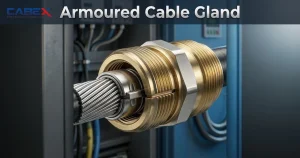
An armoured cable gland is a precision-engineered mechanical fitting used to attach, seal, and terminate Steel Wire Armoured (SWA) or Aluminium Wire Armoured (AWA) cables where they enter electrical enclosures, junction boxes, motors, switchgear, or industrial equipment. Unlike standard cable glands that grip only the outer sheath, armoured cable glands are specifically designed to clamp the metallic armour layer of the cable — providing mechanical retention, strain relief, and critically important electrical earthing continuity.
The armoured cable gland holds the cable firmly against pull-out forces, maintains the enclosure’s IP (Ingress Protection) rating, and creates a safe, reliable termination point that meets the stringent demands of both indoor industrial and harsh outdoor environments. For SWA cables, which are the backbone of industrial power distribution in India and globally, selecting and fitting the correct gland is not optional — it is a fundamental safety and compliance requirement under IS 12943, BS 6121, and IEC 60079-14.
Key Parts of an Armoured Cable Gland: The main components are the gland body (threaded housing), armour clamping cone (grips the steel or aluminium wire armour), compression nut (applies sealing pressure), inner seal / bedding ring (seals the inner bedding over armour), outer seal / rubber ring (seals outer cable sheath), lock nut (secures from inside enclosure), earth tag (provides armour grounding), and protective shroud (guards outer entry against ingress).
Why Correct Armoured Cable Gland Selection Matters
A cable gland that is undersized, incorrectly typed, or improperly fitted creates serious risks: cable pull-out under mechanical stress, moisture and dust ingress that degrades insulation, loss of electrical earthing continuity through the armour, and failure to maintain IP ratings — all of which can result in equipment damage, electrical faults, or safety incidents.
For industrial installations across India — in oil refineries, power plants, chemical factories, manufacturing units, and outdoor infrastructure — armoured cable glands must comply with relevant standards and be correctly matched to the cable’s outer diameter (OD), armour type, thread entry size, and environmental exposure. This is precisely why an accurate armoured cable gland size chart is an essential reference tool for every electrical engineer and installation team.
Pro Tip: Never select a cable gland by cable core size alone. Always measure the actual outer diameter (OD) of the cable after laying with a calibrated micrometer. Cable OD can vary between manufacturers even for the same core/conductor specification, making direct measurement the only reliable sizing method.
Armoured Cable Gland Types — Complete Comparison
Choosing the right type is just as critical as choosing the right size. The two primary armoured cable gland types are single compression and double compression — but there are several specialised variants for specific applications.
Single Compression vs. Double Compression
Single compression armoured cable glands apply sealing pressure at one point — typically the outer cable sheath. They are suitable for indoor or semi-protected environments where exposure to moisture, dust, and aggressive chemicals is minimal. They are simpler to install but provide less mechanical retention and IP protection compared to double compression types.
Double compression armoured cable glands apply compression at two points simultaneously — both on the inner bedding layer (below the armour) and on the outer cable sheath. This dual compression provides superior IP66/IP67 sealing, excellent mechanical retention, and reliable armour clamping for robust electrical earthing. Double compression glands are the standard choice for outdoor installations, industrial environments, and any application requiring high ingress protection.
Armoured Cable Gland Types: Comparative Overview
| Gland Type | Compression Points | IP Rating | Cable Types | Typical Environment | Standard |
|---|---|---|---|---|---|
| Single Compression (BW) | 1 — outer sheath only | IP54 | SWA, AWA armoured | Indoor, low exposure | BS 6121 / IS 12943 |
| Double Compression (CW) | 2 — inner bedding + outer sheath | IP66 / IP67 | SWA, AWA, SWBA armoured | Outdoor, industrial, harsh | BS 6121 / IS 12943 |
| EMC Double Compression | 2 + 360° shield contact | IP66 / IP67 | Screened / instrumentation | High EMI environments | IEC 61000 / BS 6121 |
| Ex d / Ex e (Flameproof) | 2 + gas seal / barrier compound | IP66 / IP68 | SWA armoured (all) | Hazardous / explosive areas | IEC 60079 / ATEX / IECEx |
| High Temperature | 2 — silicone/fluorosilicone seals | IP66 / IP67 | XLPE, silicone-sheathed | Furnaces, refineries, reactors | IEC 60079-0 (T1–T6) |
| Stainless Steel Armoured | 2 — 316L SS body | IP66 / IP68 | SWA, AWA armoured | Marine, offshore, chemical | BS 6121 / IS 12943 |
Armoured Cable Gland Size Chart
The armoured cable gland size chart below is the most critical reference for electrical engineers during design and procurement. Gland sizes are matched to the cable’s outer diameter (OD) — the measurement of the complete cable after all layers. Always measure OD with a micrometer; nominal cable sizes can vary by manufacturer.
How to Read This Chart: First measure your cable’s actual outer diameter (OD) in mm. Find the OD range in Column 2 that covers your measurement. The corresponding Gland Size (metric thread) and Entry Thread Size confirm what to order. When the OD falls at the boundary of two ranges, always select the larger gland size.
Armoured Cable Gland Size Chart (Metric Thread · Double Compression)
| Gland Size | Cable OD Range (mm) | Entry Thread (Metric) | Typical Cable (SWA) | Application | IP Rating |
|---|---|---|---|---|---|
| 20S | 7.0 – 12.0 | M20 × 1.5 | 2C × 1.5mm², 3C × 1.5mm² | Control cables, instrumentation | IP66 |
| 20L | 11.5 – 16.5 | M20 × 1.5 | 4C × 1.5mm², 3C × 2.5mm² | Lighting, small power | IP66 |
| 25S | 15.0 – 20.0 | M25 × 1.5 | 4C × 4mm², 3C × 6mm² | Motor feeders, panel boards | IP66 |
| 25L | 19.0 – 24.5 | M25 × 1.5 | 4C × 10mm², 3.5C × 10mm² | Sub-distribution, motor circuits | IP66 |
| 32S | 23.0 – 29.0 | M32 × 1.5 | 4C × 16mm², 3.5C × 25mm² | Distribution boards, feeders | IP66 |
| 32L | 28.0 – 34.5 | M32 × 1.5 | 4C × 35mm², 3.5C × 35mm² | Main distribution feeders | IP66 |
| 40S | 33.0 – 40.0 | M40 × 1.5 | 4C × 50mm², 3.5C × 50mm² | HV panels, large motors | IP66 |
| 40L | 39.0 – 47.0 | M40 × 1.5 | 4C × 70mm², 3.5C × 70mm² | Main switchgear, transformers | IP66 |
| 50S | 45.0 – 54.0 | M50 × 1.5 | 3.5C × 95mm², 3C × 120mm² | Incoming feeders, substations | IP66 |
| 50L | 53.0 – 62.0 | M50 × 1.5 | 3.5C × 150mm², 3C × 185mm² | Power substations, industrial | IP66 |
| 63S | 60.0 – 71.0 | M63 × 1.5 | 3.5C × 185mm², 3C × 240mm² | HV infrastructure, grid cables | IP66 |
| 63L | 70.0 – 82.0 | M63 × 1.5 | 3.5C × 240mm², 3C × 300mm² | Grid substations, utilities | IP66 |
Note: Cable OD values depend on manufacturer and construction. Always verify against actual cable OD measurement and the specific gland supplier’s datasheet before procurement. Cabex India provides complete size charts with exact clamping ranges for all their gland series.
Understanding Armoured Cable Gland Sizes & Thread Forms
Armoured cable gland sizes are defined by two dimensions: the cable entry clamping range (OD min–max in mm) and the equipment entry thread size. Getting both correct is essential — the clamping range must accommodate the cable’s OD, and the thread must match the equipment’s cable entry hole.
Thread Forms Available
- Metric (M20, M25, M32, M40, M50, M63, M75): Standard across Indian and European installations. The most common thread form for industrial panel boards and equipment.
- PG (Panzergewinde) — PG9 to PG48: Older German standard thread form still found on legacy equipment. Gradually being replaced by metric across Indian industry.
- NPT (National Pipe Thread — 1/2″, 3/4″, 1″): Used on North American and export equipment, and some process industry instrumentation in India.
- G/BSP (British Standard Pipe): Found on some UK-origin or legacy equipment in Indian installations.
Size Selection Rule: Gland size ≠ cable size. A 4-core 25mm² cable may have a different OD than a 3.5-core 25mm² cable from a different manufacturer. Always size by actual cable OD, not conductor cross-section.
Material Selection Guide for Armoured Cable Glands
Armoured Cable Gland Material Selection by Environment
| Material | Corrosion Resistance | Best For | Typical Environments | Cost Level | Conductivity |
|---|---|---|---|---|---|
| Nickel-Plated Brass | Good | General industrial, most armoured cable jobs | Factories, control panels, motor terminals, utilities | 💰 Moderate | Excellent |
| 316L Stainless Steel | Excellent | Marine, offshore, chemical, food processing | Offshore platforms, chlorine zones, coastal installations | 💰💰 Higher | Good |
| Aluminium Alloy | Moderate | Weight-critical applications | Aerospace, portable equipment, lightweight panels | 💰 Moderate | Good |
| Zinc Die-Cast | Moderate | Economy indoor applications | Light industrial, commercial buildings | 💰 Low | Good |
| Polyamide (PA66 Nylon) | Good | Non-metallic / non-sparking / lightweight | Food & pharma, Ex e zones, chemical splash areas | 💰 Low | Non-Conductive |
For the majority of Indian industrial installations — power plants, manufacturing, infrastructure — nickel-plated brass is the optimal balance of performance, earthing conductivity, and cost. For offshore, petrochemical, and coastal projects, 316L stainless steel provides maximum corrosion resistance and service life.
Armoured Cable Gland Uses — Industry Applications
The uses of armoured cable glands span virtually every sector of Indian industry where SWA or AWA cables are used for power distribution, control, instrumentation, or communications. Below are the most important application areas and what each demands from the cable gland.
Power Generation & Utilities
Thermal, hydro, nuclear, and renewable energy plants use large-section SWA cables (95mm² to 300mm² and above) for main power distribution. Armoured cable glands here must handle high mechanical pull forces, maintain IP66 rating in wet plant conditions, and provide reliable armour earthing for fault current protection. Double compression glands in M50 to M75 thread sizes are standard for this sector.
Oil, Gas & Petrochemical
In refineries, LPG storage facilities, and offshore platforms, armoured cable glands must additionally meet ATEX/IECEx or PESO certification requirements for potentially explosive atmospheres. Ex d (flameproof) or Ex e (increased safety) armoured cable glands are mandatory in Zone 1 and Zone 2 classified areas. Stainless steel or nickel-plated brass bodies with high-performance seals are essential.
Manufacturing & Heavy Industry
Steel plants, automobile manufacturing, cement factories, and heavy engineering facilities use armoured cable glands extensively for motor feeders, control panels, and power distribution boards. Double compression brass glands in M20 to M40 sizes cover the majority of these applications. Vibration resistance and mechanical robustness are key selection criteria.
Infrastructure & Construction
Highways, airports, metro rail systems, commercial buildings, and data centres use SWA cables for underground power distribution and fire-resistant circuits. Armoured cable glands must provide IP66 or higher ratings, be suitable for concrete or conduit embedment in some cases, and conform to local electrical regulations and IS standards.
Pharmaceutical & Food Processing
In these highly regulated sectors, stainless steel or polyamide armoured cable glands are preferred to prevent contamination risk, handle regular washdown procedures, and comply with GMP requirements. Smooth external profiles that resist bacterial accumulation are increasingly specified.
Armoured Cable Gland Fitting: Step-by-Step Guide
Correct armoured cable gland fitting is as important as selecting the right product. Even a premium, correctly sized gland will fail to perform if it is incorrectly installed. Follow these steps for double compression armoured cable gland installation:
- Preparation: Isolate and lock off the cable circuit. Confirm the gland type, size, and thread form match the cable and equipment entry specifications.
- Cable preparation: Cut the cable square. Remove the outer sheath (PVC oversheath) to the correct stripping length — typically 40–60mm depending on gland size. Expose but do not cut the armour wires. Remove the inner bedding (PVC bedding) over the armour to approximately 10–15mm from the end of the outer sheath.
- Gland disassembly: Unscrew and separate all gland components — outer nut, outer seal, armour cone, inner seal, and lock nut.
- Thread onto cable: Slide components onto the cable in correct order: lock nut (threads first), gland body, inner seal, armour cone, outer seal, outer nut.
- Armour cone positioning: Push the armour cone up firmly between the inner bedding and the armour wires so the wires splay outward evenly over the cone. This is the most critical step — poor cone engagement is the number one cause of armoured cable gland failure.
- Assemble the gland: Slide the gland body down and engage threads. Hand-tighten first to confirm alignment, then apply torque per manufacturer specification using a calibrated torque wrench.
- Thread into equipment: Apply appropriate thread sealant if required for the IP rating, then tighten the gland body into the equipment entry to the specified torque.
- Lock nut: Secure the lock nut from inside the enclosure. Apply manufacturer-specified torque.
- Shroud fitment: If using a PVC shroud for additional outdoor protection, slide it over the installed gland and secure to the outer sheath.
- Earth continuity check: Use a calibrated earth continuity tester to verify the armour is correctly earthed through the gland body to the enclosure. This is mandatory per IEC 60079-14 for armoured cable installations.
Common Fitting Mistakes to Avoid: Insufficient armour cone engagement (leads to poor earthing and mechanical failure), incorrect torque on gland body (under-tightening allows ingress; over-tightening can crack the seal), using incompatible thread sealants that degrade rubber seals, and installing without verifying cable OD is within the gland’s clamping range.
Essential Armoured Cable Gland Accessories
A complete armoured cable installation requires several accessories alongside the gland itself. Using the correct accessories from the same manufacturer ensures dimensional compatibility and maintains certification validity.
- PVC Shrouds: Protective sleeve over the gland entry that prevents dust and water ingress around the outer seal. Essential for outdoor CW (double compression) gland installations.
- Lock Nuts: Secure the gland from inside the panel or enclosure. Must match gland thread size exactly.
- Serrated / Earthing Washers: Bite into paint or coated surfaces to ensure positive earth continuity between gland and enclosure.
- Reducers & Adaptors: Allow use of a gland thread in a larger equipment entry hole, or convert between thread forms (metric to NPT, etc.).
- Stopping Plugs: Seal unused cable entry holes in hazardous area and standard equipment. Must be certified for Ex use in hazardous locations.
- Cable Gland Plates: Pre-punched or blank plates for mounting multiple glands on a panel or enclosure.
🏆 Cabex India — India’s Premier Manufacturer of Armoured Cable Glands
When projects demand precision, reliability, and full compliance with Indian and international standards, India’s leading EPC contractors, electrical engineers, and procurement teams choose Cabex India (Cabex Electrical Components) — a name synonymous with quality armoured cable glands for over two decades.
📐 Complete Size Range – Armoured cable glands from M20 to M75 thread sizes — single and double compression — covering 1.5mm² to 300mm² SWA & AWA cable applications.
🔩 All Thread Forms – Available in Metric (M20–M75), PG, NPT, and BSP thread forms to match any industrial equipment entry specification in India and globally.
✅ IS / IEC / ATEX Certified – Full compliance with IS 12943, BS 6121, IEC 60079 — plus ATEX and IECEx certifications for hazardous area armoured cable gland applications.
🔬 Premium Materials – Nickel-plated brass, 316L stainless steel, and aluminium alloy options — with NBR, EPDM, and silicone seals for standard and high-temperature service.
🏭 Made for Indian Industry – Designed and tested for India’s diverse industrial environments — power plants, refineries, chemical plants, pharma, infrastructure, and manufacturing.
🌐 Full Accessories Range – Complete range of shrouds, lock nuts, reducers, stopping plugs, cable gland plates, earthing accessories, and conduit fittings — all from one trusted source.
Cabex India’s armoured cable glands are installed across India’s most critical infrastructure — from NTPC power plants to major petrochemical complexes, from metro rail systems to pharmaceutical facilities. With a dedicated R&D facility, rigorous quality testing aligned with IS and IEC standards, and a nationwide distribution network, Cabex delivers engineered reliability at every cable termination point.
Whether you need standard double compression brass glands for a panel board installation, stainless steel glands for an offshore project, or certified Ex glands for a refinery Zone 1 area — Cabex India has the product, the certification, and the technical support to get your project right.🔗 Explore Cabex Armoured Cable Glands →
Article Summary
- An armoured cable gland is a mechanical fitting designed to terminate SWA/AWA cables — providing strain relief, IP sealing, and critical armour earthing continuity.
- The two primary armoured cable gland types are single compression (BW — indoor, IP54) and double compression (CW — outdoor/industrial, IP66/67). Always specify double compression for exposed or industrial environments.
- Armoured cable gland sizes are defined by cable OD range and equipment entry thread — never select by cable conductor cross-section alone; always measure actual cable OD.
- Common metric armoured cable gland sizes range from M20 (7–16.5mm OD cables) through M63 (60–82mm OD cables), covering 1.5mm² to 300mm² SWA cables.
- Material choice depends on the environment: nickel-plated brass for general industrial, 316L stainless steel for marine/offshore/chemical, polyamide for non-metallic/food applications.
- Armoured cable gland uses span power generation, oil & gas, manufacturing, infrastructure, pharmaceutical, and food processing sectors across India and globally.
- Correct armoured cable gland fitting requires careful armour cone engagement, correct torque application, and mandatory earth continuity testing after installation.
- Cabex India is India’s leading manufacturer offering a complete range of IS/IEC/ATEX-certified armoured cable glands in all sizes, types, thread forms, and materials.
Frequently Asked Questions (FAQ)
The most common questions from engineers, project managers, and procurement teams about armoured cable glands.
What is the difference between a BW and CW armoured cable gland?
BW (single compression) glands apply sealing pressure at one point on the outer sheath only. They are suitable for dry indoor environments and rated to IP54. CW (double compression) glands apply compression at two points — both the inner bedding and the outer sheath — providing IP66/IP67 protection for outdoor and industrial environments. For armoured cable installations in India, CW double compression glands are the standard specification for any outdoor or plant environment.
How do I select the correct armoured cable gland size?
Measure the actual outer diameter (OD) of the finished cable using a calibrated micrometer or vernier calliper. Match this OD to the cable OD range column in the armoured cable gland size chart. Select the gland whose OD range encompasses your cable’s actual measurement. Then confirm the gland’s entry thread matches your equipment’s cable entry hole. Never select a gland based solely on conductor cross-section (e.g., 4mm² or 25mm²) because different cable constructions and manufacturers produce different ODs for the same conductor size.
Can I use an armoured cable gland for unarmoured cable?
No, this is not recommended and may not be possible. Armoured cable glands are specifically designed with an armour clamping cone that grips and retains the armour wires. Without armour, the cone has nothing to engage, and the gland will not clamp the cable correctly, provide proper IP sealing, or pass electrical continuity through the armour. For unarmoured cables, use a standard compression cable gland designed for the specific sheath type.
What IP rating do armoured cable glands provide?
Single compression (BW) armoured cable glands typically provide IP54 protection — suitable for indoor locations where limited water splash and dust may occur. Double compression (CW) armoured cable glands provide IP66 (dust-tight, strong water jet resistant) or IP67 (temporary immersion) protection, making them suitable for outdoor, industrial, and wet environments. For continuously submerged or below-grade cable routes, IP68-rated armoured glands are available. Cabex India’s double compression armoured glands are rated IP66 as standard, with IP67/68 variants available for specialist applications.
What is the armoured cable gland size for a 4-core 10mm² SWA cable?
A 4-core 10mm² SWA cable typically has an outer diameter in the range of 19–23mm depending on the manufacturer. This falls within the 25L gland size range (19.0–24.5mm OD) with an M25 × 1.5 entry thread in the standard double compression size chart. However, always verify by measuring the actual cable OD — some manufacturers produce 4C × 10mm² cables with ODs outside this typical range. Cabex India’s technical team can advise on the correct size for specific cable constructions on request.