


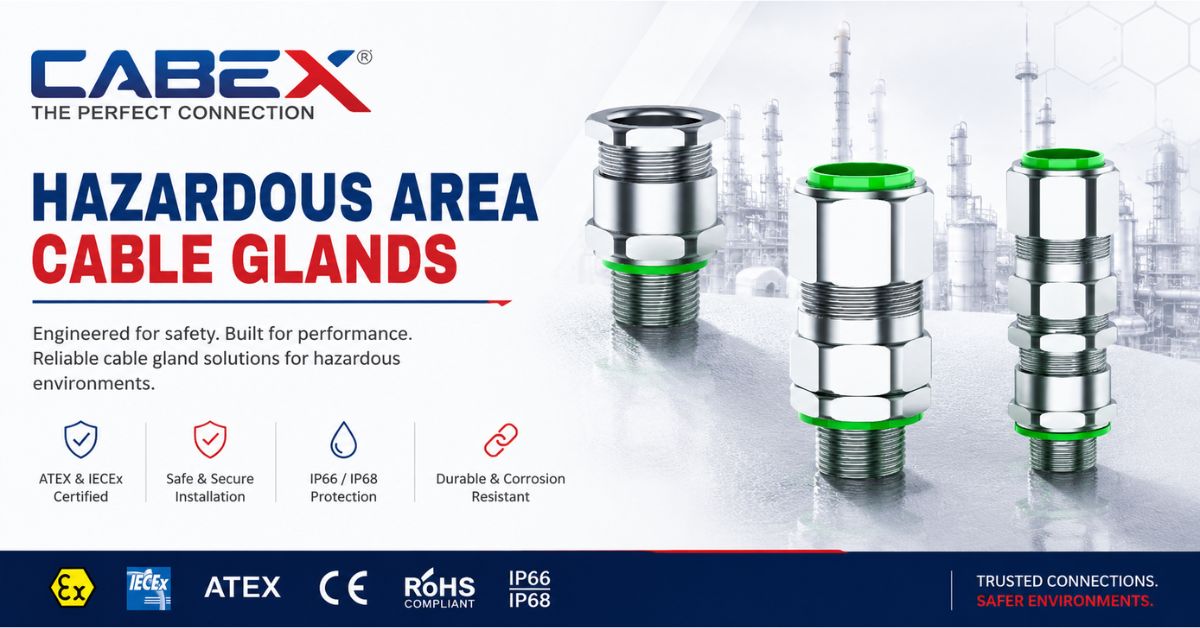
Cabex delivers precision-engineered hazardous location cable glands for explosive atmospheres — certified globally for oil & gas, petrochemical, mining and marine environments.
ATEX ApprovedIECEx CertifiedPESO / CCO ApprovedZone 1 & Zone 2Ex d · Ex e · Ex nRIP66 / IP68
What Are Hazardous Area Cable Glands?
Hazardous area cable glands — also known as Ex cable glands, explosion proof cable glands, or hazardous location cable glands — are specialised cable entry devices designed to provide a safe, mechanically secure, and environmentally sealed connection between electrical cables and equipment enclosures in potentially explosive atmospheres.
Unlike standard industrial cable glands, hazardous area cable glands must maintain the explosion protection properties of the enclosure into which they are installed. This means they must prevent the ignition of flammable gases, vapours, dusts or fibres from reaching internal electrical components — and, in flameproof (Ex d) applications, must also withstand and contain any internal explosion without transmitting flame to the surrounding atmosphere.
At Cabex, every hazardous area cable gland we manufacture is designed, tested, and certified to meet the most demanding international standards — giving engineers and procurement managers confidence in both safety and compliance, from the oil fields of the Middle East to chemical plants in India.
Why certification matters
Using an uncertified or incorrectly specified cable gland in a hazardous zone is not just a compliance failure — it is a potential source of catastrophic ignition. Every Cabex Ex cable gland ships with full certification documentation and traceability.
40+ Years of Manufacturing
50+ Countries Exported
100% Certified Products
Applicable Standards at a Glance
| Standard | Scope | Cabex Status |
|---|---|---|
| ATEX Directive IEC 60079 Series | Europe & global ATEX zones (Zone 0–2, Zone 20–22) | Certified |
| IECEx IEC 60079-0 / 60079-1 / 60079-7 | International Ex equipment certification scheme | Certified |
| CCO-PESO India / CCOE | Petroleum, chemicals & explosives safety in India | Approved |
| IS/IEC 60079-1 | Flameproof enclosures — Ex d construction | Compliant |
| IS/IEC 60079-7 | Increased safety — Ex e construction | Compliant |
| IP66 / IP67 / IP68 IEC 60529 | Ingress protection against dust & water | Achieved |
Zone Classification
Understanding Hazardous Zone Classifications
Before selecting a hazardous area cable gland, engineers must correctly identify the zone classification of the installation area. Zone classification is defined by the frequency and duration for which an explosive atmosphere is present, and directly determines the type and temperature class of Ex equipment required.
Zone 1
GAS / VAPOUR — HIGH RISK
An explosive atmosphere in the form of a cloud of flammable gas or vapour is likely to occur occasionally in normal operation. Requires Ex d (flameproof) or Ex e (increased safety) cable glands as a minimum.
Zone 2
GAS / VAPOUR — LOWER RISK
An explosive gas atmosphere is not likely to occur in normal operation but may occasionally exist for a short period. Ex nR or Ex e cable glands are commonly specified here.
Zone 21
COMBUSTIBLE DUST
A cloud of flammable dust is likely to occur occasionally in normal operation. Requires Ex t (dust-ignition proof) cable glands with a minimum IP6X rating for dust exclusion.
Note: Zone 0 (gas) and Zone 20 (dust) represent the most extreme classifications and require Ex ia (intrinsically safe) or equivalent cable solutions. Cabex technical specialists can assist with zone-specific product selection for any project.
Product Range
Cabex Hazardous Area Cable Gland Range
Cabex manufactures a comprehensive range of hazardous location cable glands to address every type of explosive atmosphere, cable construction, and environmental condition. Each gland in the range is available in multiple materials and thread configurations.
Flameproof Cable Glands (Ex d)
Designed for Zone 1 and Zone 2 environments. These glands contain any internal ignition and prevent flame propagation to the external atmosphere.
- ATEX & IECEx certified Ex d IIC
- Suitable for SWA, AWA, armoured cables
- IP66 & IP68 rated options
- Brass, aluminium & stainless steel
- M20 to M100 metric thread range
Increased Safety Glands (Ex e)
Widely used in Zone 1 and Zone 2 gas-hazardous areas where the equipment requires enhanced safety measures to prevent sparks and arcs.
- Ex e IIC compliant
- Suitable for unarmoured & braided cables
- EMC screened variants available
- Double compression sealing
- NPT & BSPP thread options
High Temperature Cable Glands
Engineered for hazardous areas where ambient temperatures exceed standard ranges — ideal for furnaces, kilns, turbine enclosures and smelting plants.
- Operating range: -60°C to +200°C
- Silicone & PTFE seal materials
- Stainless steel 316 construction
- T-class rated for temperature groups
- Suitable for Zone 1, Zone 2 & Zone 21
Barrier / Compound-Fill Glands
For applications requiring an inner sealing barrier — particularly where cable transit through a bulkhead or wall must be gas and liquid tight.
- Inner compound-filled barrier seal
- Prevents gas migration along cable
- ATEX Exd IIC / Ex e IIC
- Suitable for lead sheathed cables
- Marine & offshore rated versions
Type n Restricted Breathing (Ex nR)
Specifically designed for Zone 2 locations where cost-effective, non-sparking cable entry is required without the full flameproof specification.
- Ex nR IIC Gc protection level
- Suitable for armoured & unarmoured
- Cost-effective Zone 2 solution
- Metric & NPT thread options
- IP66 dust and water ingress protection
Marine & Offshore Cable Glands
Built to the toughest offshore and marine specifications — Cabex marine hazardous area cable glands are type-approved for use on FPSO vessels, platforms and rigs.
- ABS, BV, DNV-GL, Lloyd’s type approved
- ATEX & IECEx dual certified
- Deluge and jet-wash resistant
- Hastelloy & Inconel options
- Vibration-resistant locking systems
Selection Guide
Hazardous Area Cable Gland Selection Matrix
Use this matrix to identify the correct Cabex cable gland type for your application zone, cable type, and protection method.
| Hazardous Zone | Protection Type | Cable Gland Category | IP Rating | Recommended Material | Cabex Availability |
|---|---|---|---|---|---|
| Zone 1 (Gas) | Ex d IIC — Flameproof | Armoured SWA / AWA | IP66 / IP68 | Nickel-plated Brass | In Stock |
| Zone 1 (Gas) | Ex e IIC — Increased Safety | Unarmoured / Braided | IP66 | Brass / SS316 | In Stock |
| Zone 2 (Gas) | Ex nR IIC — Restricted Breathing | Unarmoured / Armoured | IP66 | Nickel-plated Brass | In Stock |
| Zone 21 (Dust) | Ex tb IIIC — Dust Ignition Proof | Armoured / Unarmoured | IP66 / IP67 | Stainless Steel 316 | In Stock |
| Zone 22 (Dust) | Ex tc IIIC | Unarmoured | IP66 | Brass / Aluminium | In Stock |
| High Temp Zone 1 | Ex d / Ex e — HT rated | SWA / Unarmoured | IP66 | SS316 with PTFE seals | In Stock |
| Marine / Offshore Zone 1 | Ex d IIC + Marine Approval | Armoured (SWA/BWA) | IP66 / IP68 | SS316 / Hastelloy | On Request |
Technical Data
Technical Specifications — Cabex Ex Cable Glands
The following table summarises the key technical parameters for Cabex hazardous area cable glands across material grades and thread configurations.
| Parameter | Brass (Standard) | Nickel-Plated Brass | Stainless Steel 316 | Aluminium Alloy |
|---|---|---|---|---|
| Operating Temperature | -20°C to +80°C | -20°C to +80°C | -60°C to +200°C | -20°C to +80°C |
| Ingress Protection | IP66 | IP66 / IP68 | IP66 / IP68 | IP66 |
| Thread Options | Metric (M20–M100) | Metric / NPT / BSPP | Metric / NPT / BSPP | Metric (M20–M75) |
| Ex Protection | Ex e / Ex nR | Ex d / Ex e / Ex nR | Ex d / Ex e / HT | Ex e / Ex nR |
| Sealing Material | EPDM / Neoprene | EPDM / Neoprene | Silicone / PTFE / EPDM | EPDM |
| Finish | Natural Brass | Electroless Nickel | Passivated / Polished | Epoxy Painted |
| Corrosion Resistance | Moderate | Good | Excellent | Good |
| ATEX / IECEx Cert. | Yes | Yes | Yes | Yes |
Applications
Industries That Rely on Hazardous Area Cable Glands
Cabex hazardous location cable glands are trusted by leading EPC contractors, OEMs and asset owners across the world’s most demanding industries. Wherever flammable gases, vapours or combustible dust are present, our certified cable glands ensure that electrical installations remain safe, compliant and productive.
- Oil & Gas — Upstream
- Petrochemical Plants
- Mining & Minerals
- Marine & Offshore
- Pharmaceutical
- Grain & Flour Mills
- Battery & Chemical Storage
- LNG / LPG Terminals
- Paint & Coatings Plants
- Water Treatment
Installation Environments
Cabex hazardous area cable glands are regularly specified for outdoor and indoor plant installations across tropical, arctic, desert and marine environments. Our product ranges account for UV exposure, salt-spray corrosion, thermal cycling, and mechanical vibration — meaning engineers can rely on a single certified solution from project design through decades of operational life.
Our high temperature cable glands are particularly suited for installations near furnaces, turbines, steam lines and process vessels, where cable entry points are exposed to sustained radiant heat. With operating temperatures up to 200°C, Cabex’s stainless steel high-temperature glands eliminate the need for costly thermal barriers or derating measures.
Why Cabex
6 Reasons Engineers Choose Cabex for Ex Cable Glands
1. Global Multi-Certification
Every Cabex Ex cable gland carries ATEX, IECEx and CCO-PESO approvals as standard — with additional marine approvals (ABS, BV, DNV-GL) available — giving you one globally compliant gland for international projects.
2. Manufactured in India, Tested Globally
Cabex products are manufactured at our state-of-the-art facility in India and tested against the latest editions of IEC 60079-0, IEC 60079-1 and IEC 60079-7, ensuring both quality and cost competitiveness for global projects.
3. Complete Size Range
From M16 to M110 metric, and M10 to 4″ NPT, Cabex offers one of the widest size ranges available — ensuring every cable diameter and enclosure entry is covered by a certified, off-the-shelf gland.
4. Expert Technical Support
Our engineering team provides zone-specific selection guidance, cable compatibility checks, and full ITP (Inspection and Test Plan) documentation — reducing project risk and procurement lead times.
5. Stock Availability & Fast Delivery
With extensive finished goods stock held across multiple size and material combinations, Cabex supports urgent project timelines and shutdown maintenance schedules with fast order turnaround and worldwide export capability.
6. Full Accessories Range
Cabex supplies a complete range of hazardous area cable gland accessories — including locknuts, reducers, earth tags, shrouds, and sealing washers — ensuring a single-source supply for all cable termination requirements.
Technical Guidance
Installation Best Practices for Hazardous Area Cable Glands
Even the best-certified hazardous area cable gland can be rendered ineffective by incorrect installation. The following best practices are aligned with IEC 60079-14 (the international standard for electrical installations design in explosive atmospheres) and are strongly recommended for all Ex cable gland installations:
1. Correct Zone and Cable Matching
Always verify that the cable gland’s Zone classification matches or exceeds the classification of the installation area. An Ex e cable gland, for example, must never be installed in a Zone 0 location. Similarly, cable outer diameter and armour type must fall within the cable gland’s specified cable diameter range to achieve the rated IP seal.
2. Thread Compatibility and Sealing
Confirm thread form compatibility between the cable gland and the equipment enclosure entry. Never use PTFE tape alone on Ex d (flameproof) glands — the thread engagement length must be sufficient to maintain the flameproof path. Cabex flameproof glands include a clearly defined minimum thread engagement specification on each product data sheet.
3. Earth Continuity
For armoured cables, ensure that the cable armour is correctly clamped and earth continuity is maintained through the gland body to the equipment enclosure. Where additional external earth bonding is required, Cabex supplies earth tag accessories that are certified for use with our Ex cable gland range.
4. Torque and Mechanical Retention
Over-tightening cable glands can damage sealing elements and reduce IP performance. Under-tightening compromises both the mechanical cable retention and the explosion protection seal. Cabex product data sheets specify the torque values for each gland size and material. Always use the correct tooling.
5. Certification Mark Verification
Before installation, verify that the ATEX or IECEx marking on the gland matches the required protection concept for the zone. The marking must include the Ex symbol (⑇), the equipment group (II or I), the category (2G, 3G, 2D, etc.), the protection type (d, e, nR), and the gas/dust group (IIC, IIB, IIIC).
Frequently Asked Questions — Hazardous Area Cable Glands
Our team answers the most common questions from engineers, procurement managers, and EPC contractors about hazardous area cable glands.
What is a hazardous area cable gland and how is it different from a standard cable gland?
A hazardous area cable gland (also called an Ex cable gland or explosion proof cable gland) is specifically certified to maintain the explosion protection of an electrical enclosure in environments containing flammable gases, vapours, or combustible dust. Unlike standard industrial cable glands, they must pass rigorous third-party testing under IEC 60079-0 and related standards, and carry approved certification markings (ATEX, IECEx, etc.) before they can be legally installed in a hazardous zone. Standard cable glands have no such certification and cannot be used in classified hazardous areas.Which certifications should a hazardous area cable gland carry for use in India?
Which certifications should a hazardous area cable gland carry for use in India?
For hazardous area installations in India, cable glands should carry PESO (Petroleum and Explosives Safety Organisation) approval under the CCO-PESO scheme, which references IS/IEC 60079 standards. In addition to PESO, ATEX and IECEx certifications are widely accepted in India for projects with international specifications. All Cabex Ex cable glands carry ATEX, IECEx, and CCO-PESO approvals, making them compliant for both domestic Indian projects and international export projects.What is the difference between Ex d (flameproof) and Ex e (increased safety) cable glands?
What is the difference between Ex d (flameproof) and Ex e (increased safety) cable glands?
Ex d (flameproof) cable glands are designed so that any internal ignition is contained within the enclosure and cannot propagate flame to the external explosive atmosphere. The flameproof path is formed by precisely machined thread engagement between the gland and enclosure. Ex e (increased safety) cable glands, by contrast, achieve safety by enhanced mechanical and electrical construction that prevents arcs, sparks, or excessive temperatures — they do not rely on containing an explosion. Ex d is typically required for Zone 1 with flameproof enclosures, while Ex e is used with increased safety enclosures in Zone 1 and Zone 2.Can a single Cabex cable gland be used across multiple hazardous zone types?
Can a single Cabex cable gland be used across multiple hazardous zone types?
Yes. Many Cabex Ex cable glands carry multi-protection method certification — for example, Ex d IIC / Ex e IIC / Ex nR IIC — allowing the same physical gland to be installed in Zone 1 or Zone 2 gas hazardous areas depending on the enclosure type. Multi-certified glands simplify procurement, reduce stock SKUs, and are particularly advantageous for large EPC projects with mixed zone classifications. Contact our technical team for zone-specific selection advice.What cable types are compatible with Cabex hazardous area cable glands?
What cable types are compatible with Cabex hazardous area cable glands?
Cabex’s Ex cable gland range covers the full spectrum of cable constructions used in hazardous installations, including: Single Wire Armour (SWA), Aluminium Wire Armour (AWA), Pliable Wire Armour (PWA), Steel Tape Armour (STA), Wire Braid (CY/SY EMC cables), unarmoured cables, and lead-sheathed cables. The correct gland type is determined by cable OD, armour type, and bedding material. Cabex product data sheets include cable compatibility tables for each gland series.What IP rating should I specify for an outdoor hazardous area cable gland?
Get in Touch
Request a Quote for Hazardous Area Cable Glands
Whether you need standard stock items or project-specific certified cable glands, the Cabex team is ready to support your requirements — from single enquiries to bulk export orders.Enquire Now View Accessories
© 2025 Cabex Electrical Components. All Rights Reserved.📧 export@cabexindia.com | 📞 +91 98252 22330