Introduction
In a world rapidly shifting towards smart manufacturing, industrial automation, and advanced infrastructure, one component remains indispensable at every electrical installation site — the double compression brass cable gland. Whether you’re managing a petrochemical plant, commissioning an offshore platform, or wiring a pharmaceutical facility, the integrity of your cable entry point is non-negotiable.
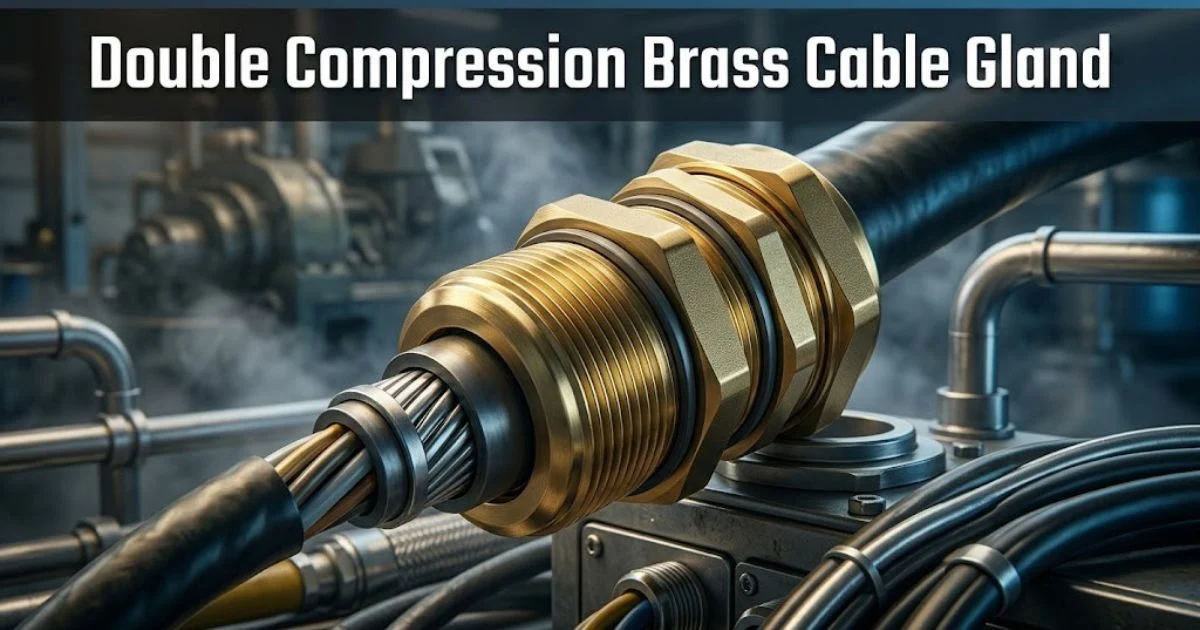
A double compression brass cable gland provides two distinct sealing actions: one on the cable outer sheath and one on the cable armour (or inner sheath). This dual-grip mechanism makes it extraordinarily effective at preventing moisture ingress, maintaining IP ratings, and ensuring mechanical stability under vibration, temperature fluctuations, and chemical exposure.
In 2026, with updated international compliance frameworks, evolving hazardous zone standards, and rising demand from India’s expanding industrial base, sourcing a high-quality double compression brass cable gland has never been more strategically important. That’s where Cabex India steps in — a name synonymous with precision, reliability, and uncompromising quality in cable management solutions.
What is a Double Compression Brass Cable Gland?
A double compression brass cable gland is a mechanical cable entry device manufactured from high-grade brass. It is specifically engineered to terminate and seal armoured and braided cables at the point of entry into electrical enclosures, junction boxes, motors, and control panels.
The term “double compression” refers to the two independent compression points:
- First Compression (Armour/Braid Grip): The inner compression ring grips firmly around the cable’s armour or metallic braid, providing a secure mechanical and electrical continuity to the enclosure.
- Second Compression (Outer Sheath Seal): The outer compression nut seals tightly against the cable’s outer sheath, preventing moisture, dust, and contaminants from entering the enclosure.
This two-point sealing design is what distinguishes the double compression brass cable gland from single compression variants, making it the preferred choice for hazardous, demanding, and outdoor environments.
Cabex India manufactures its range of double compression brass cable glands using CW614N/CW617N brass alloys with precision CNC machining, ensuring consistent dimensional accuracy, superior corrosion resistance, and compliance with international standards.
Key Components of a Double Compression Brass Cable Gland
Understanding the anatomy of a double compression brass cable gland helps engineers and procurement teams make informed decisions. Below is a detailed breakdown:
| Component | Material | Function |
|---|---|---|
| Gland Body | Brass (CW614N / CW617N) | Main structural housing; threaded for enclosure entry |
| Outer Compression Nut | Brass / Nickel-plated Brass | Compresses outer sealing ring against cable outer sheath |
| Outer Sealing Ring (O-Ring) | Neoprene / EPDM / Silicone | Creates IP-rated seal on cable outer sheath |
| Armour Cone / Inner Clamp | Brass | Grips cable armour (SWA/STA/BWA) for mechanical hold |
| Inner Compression Ring | Brass | Applies compression force on armour/braid |
| Locknut | Brass / Nickel-Plated | Secures gland body to enclosure wall |
| Earth Tag (optional) | Copper / Tinned Copper | Provides additional earthing continuity |
Each component in a Cabex India double compression brass cable gland is precision-engineered to guarantee dimensional stability and long-term performance even in the most aggressive industrial environments.
Types of Double Compression Brass Cable Glands Available in 2026
The market in 2026 offers a refined portfolio of double compression brass cable gland variants, each designed for specific cable constructions and environmental conditions.
| Type | Cable Compatibility | Typical Application | IP Rating |
|---|---|---|---|
| Type A2 (Standard) | SWA (Steel Wire Armoured) | General industrial, commercial panels | IP68 |
| Type A2F (Flameproof) | SWA / STA | ATEX/IECEx Zone 1 & 2 hazardous areas | IP66/IP68 |
| Type BW (Braided Wire) | Braided / Screened cables | Instrumentation, signal cables | IP66 |
| Type CW (Steel Tape Armoured) | STA cables | Heavy industry, mining, utilities | IP68 |
| Type E1W (Outdoor) | SWA / XLPE with outer sheath | Outdoor substations, renewable energy | IP68 |
| Type LSF/LSZH (Low Smoke) | LSZH-sheathed cables | Tunnels, public buildings, rail | IP66 |
Cabex India supplies all the above variants with full traceability documentation, RoHS compliance, and CE/ATEX certifications available on request.
Technical Specifications: Double Compression Brass Cable Gland (2026 Standard Range)
For engineers and procurement professionals, precise technical data is critical for correct gland selection. The table below reflects the standard technical specifications for Cabex India’s 2026 double compression brass cable gland range:
| Parameter | Specification |
|---|---|
| Body Material | Brass CW614N / CW617N (to BS EN 12164) |
| Surface Finish | Natural Brass / Nickel Electroplated |
| Thread Type | Metric (M16 to M110) / PG / NPT available |
| Cable Outer Diameter Range | 4 mm to 120 mm (varies by size) |
| Temperature Range | -20°C to +80°C (standard); up to +120°C (HT grade) |
| IP Rating | IP66 / IP67 / IP68 (up to 10 m / 7 days) |
| Armour Type Supported | SWA, STA, AWA, Copper Wire Braid (CWB) |
| Standards Compliance | BS 6121, IEC 62444, ATEX Directive 2014/34/EU, IECEx |
| Flammability | UL 94 V-0 (sealing elements) |
| RoHS Compliant | Yes |
| Country of Manufacture | India (Cabex India, ISO 9001:2015 Certified) |
Industry Standards and Certifications Governing Double Compression Brass Cable Glands in 2026
Compliance with current industry standards is not optional — it is a contractual and safety obligation. Here is what applies to double compression brass cable glands in 2026:
- BS 6121: The Core British Standard – BS 6121 remains the foundational standard for cable gland classification, performance testing, and dimensional requirements. Parts 1 through 5 cover mechanical performance, IP testing, and armoured cable termination.
- IEC 62444: The International Framework – IEC 62444 specifies requirements for cable glands used with electrical equipment and ensures global interoperability. Cabex India’s double compression brass cable glands are designed and tested in alignment with IEC 62444.
- ATEX Directive 2014/34/EU and IECEx – For hazardous area installations, double compression brass cable glands must carry ATEX (Europe) or IECEx (international) certification. Cabex India’s Ex-rated range meets Equipment Category 2G and 2D, suitable for Zone 1, Zone 2, Zone 21, and Zone 22 environments.
- IS Standards (Bureau of Indian Standards) – For projects under Indian government specifications, Cabex India’s double compression brass cable glands also comply with applicable BIS standards, including IS 12943, ensuring acceptance across PSU and government contracts.
Why Double Compression Brass Cable Glands Outperform Single Compression Variants
The industrial buyer of 2026 is well-informed, and the question often arises: why pay more for a double compression brass cable gland when single compression options are cheaper?
The answer is both safety and longevity:
- Mechanical Security: Double compression provides a positive armour grip that single compression simply cannot match. In high-vibration environments — such as compressor rooms, marine decks, and heavy machinery — single compression glands can loosen over time, compromising both mechanical integrity and earthing continuity.
- Superior IP Ratings: The outer sealing ring in a double compression design ensures an independent seal around the cable outer sheath. This makes IP68 ratings achievable with greater reliability than single compression alternatives.
- Electrical Earthing Continuity: The inner armour clamp in double compression brass cable glands ensures consistent low-impedance electrical continuity between the cable armour and the enclosure — a critical requirement for fault protection.
- Longer Service Life: The two independent sealing mechanisms reduce stress on each individual seal. With Cabex India’s high-quality elastomer O-rings and precision brass hardware, service intervals are significantly extended even in chemically aggressive environments.
- Compliance Confidence: Specifications for projects in oil & gas, petrochemicals, power utilities, and defence typically mandate double compression cable glands. Using the correct type ensures zero non-conformance during inspections.
Double Compression Brass Cable Gland: Key Industry Applications in 2026
The double compression brass cable gland serves across a vast range of industries. Here is a detailed look at where and how they are deployed:
Oil & Gas and Petrochemical
Refineries, wellheads, offshore platforms, and pipeline stations demand ATEX/IECEx-certified double compression brass cable glands for every cable entry in Zone 1 and Zone 2 classified areas. The combination of explosion protection, IP68 sealing, and corrosion resistance in salt-laden environments makes nickel-plated double compression glands the standard specification.
Power Generation and Utilities
Thermal power plants, hydro stations, and grid substations route thousands of armoured cables through switchgear rooms, cable basements, and outdoor marshalling kiosks. Double compression brass cable glands provide the necessary mechanical clamping, earthing continuity, and ingress protection to safeguard these critical connections.
Renewable Energy (Solar and Wind)
India’s rapidly growing renewable energy sector — targeting 500 GW of installed capacity by 2030 — relies heavily on outdoor-rated double compression brass cable glands for solar string combiner boxes, inverter stations, and wind turbine nacelle wiring. The IP68 rating and UV-stable sealing rings are essential for outdoor longevity.
Pharmaceuticals and Food Processing
Clean room environments and food-grade facilities require glands that resist cleaning agents, steam, and chemical splashing. EPDM-sealed double compression brass cable glands with electroless nickel plating meet FDA-compliant hygiene standards.
Marine and Offshore
Marine-grade double compression brass cable glands with WRAS-approved elastomers and brass alloys rated for seawater immersion are critical for vessel electrical systems and offshore platforms.
Tunnels, Rail, and Metro Infrastructure
India’s expanding metro rail and tunnel projects require LSZH-compatible double compression brass cable glands that emit minimal toxic smoke in fire scenarios, complying with EN 45545-2 for railway fire safety.
Cabex India serves all these sectors from its manufacturing facility, with a dedicated team to assist with project-specific specifications, material certifications (MTC), and third-party inspection support.
How to Select the Right Double Compression Brass Cable Gland
Selecting the correct double compression brass cable gland requires a structured approach. The following checklist is recommended for 2026 projects:
Step 1 — Identify the Cable Construction Is it SWA, STA, AWA, or braided? This determines whether you need a Type A2, CW, or BW gland.
Step 2 — Measure Cable Outer Diameter Measure both the minimum and maximum cable outer diameter to select the correct gland size. Cabex India provides detailed cable OD range tables for each gland size.
Step 3 — Determine Thread Type and Enclosure Entry Size Metric (M-series), PG, or NPT threads must match the enclosure’s tapped entry. Cabex India offers full conversion and adaptor options.
Step 4 — Define Environmental Classification Is the installation indoors, outdoors, submerged, or in a hazardous area? This defines the IP rating and whether ATEX certification is required.
Step 5 — Check Surface Finish Requirements Natural brass is suitable for general industrial use. Nickel-plated glands offer superior corrosion resistance for marine, coastal, and chemical environments.
Step 6 — Confirm Standards and Approvals Cross-check your project specification against the applicable standard (BS 6121, IEC 62444, ATEX, IS 12943) and confirm Cabex India can provide the required documentation.
Installation Best Practices for Double Compression Brass Cable Glands
Correct installation is as important as selecting the right double compression brass cable gland. Follow these 2026 best practices:
- Strip the cable correctly — Use armour-cutting tools to strip the outer sheath and armour back to the precise lengths specified in the gland’s installation instructions.
- Clean the armour wires — Remove burrs and ensure armour wires are uniform in length before inserting into the armour cone.
- Do not over-tighten — Apply the correct torque value as specified. Over-tightening can damage the sealing ring and reduce IP performance.
- Check earth continuity — After installation, verify low-resistance continuity between cable armour and enclosure using a calibrated earth tester.
- Inspect O-ring condition — Before assembly, check that the O-ring is free from damage. Replace if necessary.
- Apply anti-galling compound — On stainless-enclosure installations, apply thread-locking compound to prevent galling on the brass thread.
- Record installation — For projects requiring as-built documentation, record gland size, cable reference, and installation date for traceability.
Why Choose Cabex India for Your Double Compression Brass Cable Gland Requirements?
Cabex India has established itself as one of India’s premier manufacturers and suppliers of cable management solutions, with the double compression brass cable gland forming a cornerstone of its product portfolio.
Here is what sets Cabex India apart:
- ISO 9001:2015 Certified Manufacturing: Every double compression brass cable gland from Cabex India is produced under a rigorous quality management system.
- In-House CNC Machining: Precision CNC turning and threading ensures dimensional consistency across high-volume production runs.
- Wide Size Range: From M12 to M110 and PG/NPT equivalents, Cabex India covers small instrument cables to large power cable installations.
- Export Capability: Cabex India exports double compression brass cable glands across Asia, the Middle East, Africa, and Europe, with full documentation support including MTC, CoC, and third-party inspection.
- Fast Lead Times: With maintained finished goods inventory and a responsive supply chain, Cabex India supports urgent project requirements without compromising quality.
- Technical Support: The Cabex India engineering team provides specification support, cable gland schedules, and on-site technical assistance for large infrastructure projects.
- Sustainability: Cabex India’s brass cable glands are manufactured with recyclable materials, and the company maintains an active programme to reduce manufacturing waste and energy consumption in line with India’s green industrial goals.
For project quotations, technical datasheets, material certificates, or to discuss a custom double compression brass cable gland requirement, visit Cabex India or contact the sales team directly.
Comparison: Double Compression vs Single Compression Brass Cable Glands
| Feature | Double Compression Brass Cable Gland | Single Compression Brass Cable Gland |
|---|---|---|
| Number of Sealing Points | 2 (armour + outer sheath) | 1 (armour or outer sheath) |
| IP Rating Achievable | Up to IP68 | Up to IP54 (typically) |
| Armour Grip Reliability | High – positive mechanical lock | Moderate |
| Vibration Resistance | Excellent | Good |
| Hazardous Area Suitability | Yes (ATEX/IECEx versions available) | Generally not recommended |
| Earthing Continuity | Excellent | Moderate |
| Cost | Moderate to high | Low to moderate |
| Recommended Use | Demanding, outdoor, ATEX, marine | Light industrial, indoor, dry areas |
Conclusion
The double compression brass cable gland is not merely a hardware component — it is a critical safety and performance element in every industrial electrical installation. In 2026, with increasingly stringent compliance requirements, more demanding environments, and India’s infrastructure boom driving unprecedented project volumes, the importance of selecting a quality-assured, standards-compliant double compression brass cable gland cannot be overstated.
Whether you are an electrical contractor, a project engineer, or a procurement professional, understanding the construction, classification, and correct application of double compression brass cable glands empowers you to make better decisions — decisions that protect assets, ensure compliance, and deliver long-term reliability.
Cabex India stands ready to be your trusted partner in this journey, delivering precision-engineered double compression brass cable glands backed by technical expertise, robust quality systems, and a genuine commitment to your project’s success.
Contact Cabex India today for your double compression brass cable gland requirements — and experience the difference that engineering excellence makes.
Frequently Asked Questions (FAQs)
Q1. What is a double compression brass cable gland?
Ans. A double compression brass cable gland is a cable entry device that seals and secures armoured cables at two independent compression points — one on the armour and one on the outer cable sheath.
Q2. What is the difference between a double compression and single compression cable gland?
Ans. A double compression cable gland has two sealing points for superior IP protection and armour grip, while a single compression gland has only one, making it suitable only for lighter-duty applications.
Q3. Which IP rating does a double compression brass cable gland achieve?
Ans. A quality double compression brass cable gland can achieve up to IP68, meaning it is fully dust-tight and can withstand continuous water immersion under defined conditions.
Q4. Are double compression brass cable glands suitable for ATEX hazardous areas?
Ans. Yes, ATEX and IECEx certified double compression brass cable glands are specifically designed and approved for use in Zone 1, Zone 2, Zone 21, and Zone 22 hazardous locations.
Q5. Why should I choose Cabex India for double compression brass cable glands?
Ans. Cabex India offers ISO 9001:2015 certified, precision-CNC-machined double compression brass cable glands with full standards compliance, export documentation, and dedicated technical support for every project.