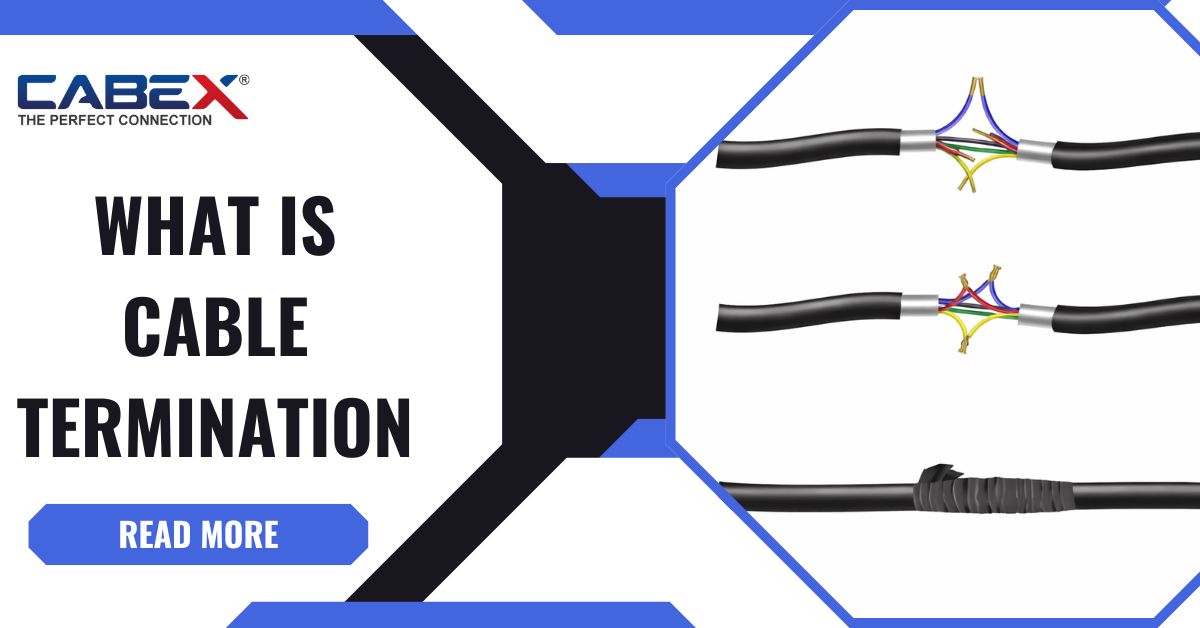
Article Summary: Cable termination is the process of connecting the end of a cable to a device, connector, or another cable to complete an electrical or data circuit. This guide covers every major termination type — crimping, soldering, compression, IDC, wire wrap, and cage clamp — along with proven methods, tools, industry standards (IEC 60352), common mistakes, and a full best practices checklist. Whether you work in data networking, industrial power, or electronics, this article gives you everything you need to terminate cables correctly, safely, and reliably.
What Is Cable Termination?
Cable termination is the process of connecting the end of a cable — whether copper, fibre optic, or coaxial — to a terminal, connector, device, or piece of equipment so that electrical or data signals can flow reliably between points.
It sounds straightforward. In practice, it is one of the most technically demanding steps in any electrical or network installation. According to industry research cited by Security Sales & Integration, improper cable termination is the single biggest cause of failure in system installations — accounting for the majority of faults, signal losses, and connectivity problems in both new and legacy systems.
A correctly terminated cable delivers low resistance, strong mechanical retention, and long-term signal integrity. A poorly terminated cable introduces resistance, crosstalk, signal reflection, and in worst cases, arcing or fire hazard in power systems.
This guide covers what cable termination is, why it matters, every major termination type, step-by-step methods, the most common errors, and a practical best practices checklist you can use on-site today.
Why Cable Termination Matters — The Engineering Reality
Before diving into types, it is important to understand exactly what goes wrong when cable termination is done poorly. This helps you appreciate why each best practice exists.
- Signal degradation: Excess untwisting of twisted pairs in Cat5e/Cat6 UTP cable destroys the crosstalk cancellation built into the cable’s geometry. ANSI/TIA-568 specifies a maximum of 13 mm (0.5 inches) of untwisted pair at any termination point. Exceeding this reduces data throughput and causes intermittent failures.
- Increased resistance: A cold solder joint or under-crimped ferrule raises the contact resistance at the termination point. In power cables, this generates heat under load — a leading cause of electrical fires in industrial settings.
- Mechanical failure: Without proper strain relief or cable glanding, mechanical stress transfers directly to the termination. Over time, even small repeated movements cause conductor fatigue and eventual open-circuit failure.
- Corrosion: In outdoor or humid environments, an improperly sealed termination allows moisture ingress. Oxidation raises contact resistance steadily until the connection fails entirely.
Understanding these failure modes makes every step of the termination process make practical sense rather than feeling like unnecessary procedural overhead.
Types of Cable: What You Are Working With
Cable termination technique depends first on the cable type. The two fundamental conductor constructions are:
Solid Core Cable
Solid core cable contains a single, solid conductor per wire. It is stiffer, typically cheaper, and easier to terminate to punch-down blocks and screw terminals. It is the standard choice for structured cabling runs inside walls and conduits where bending after installation is minimal. The solid core terminates cleanly to IDC connectors without the risk of stray strands.
Stranded Cable
Stranded cable contains multiple fine conductor strands twisted together within each wire. This construction provides flexibility for patch cords, equipment leads, and any application where the cable will be bent or moved repeatedly during service. Stranded cable is the correct choice for crimp terminations, as the crimping process compresses the bundle into a gas-tight cold-welded joint. When terminating stranded cable to screw terminals, always use a ferrule to prevent stray strands causing short circuits to adjacent terminals.
The 6 Main Cable Termination Types Explained
The table below summarises all major cable termination types, their strengths, and where they are used. Detailed explanations follow.
| Termination Type | Cable Suitability | Key Strength | Typical Application |
| Crimping | Stranded copper, coaxial, RJ45 | Gas-tight, vibration-resistant joint | Automotive wiring, Ethernet, power distribution |
| Soldering | Fine-gauge copper, PCB leads | Strong mechanical bond, low resistance | PCB assemblies, prototype electronics, audio |
| Compression | Large cross-section, high-voltage power | Excellent conductivity, reusable | HV substations, busbars, industrial switchgear |
| IDC (Insulation Displacement) | Flat/ribbon, solid or stranded UTP | No stripping needed, fast installation | Telecom patch panels, Cat5/6 keystone jacks |
| Wire Wrap | Solid core, small-gauge conductors | Reliable, tool-based, no solder needed | Backplane wiring, rapid prototyping, IoT dev |
| Cage Clamp / Spring Clamp | Flexible and solid, 0.5–35 mm² | Tool-free, high vibration tolerance | Industrial PLCs, energy storage, robotics |
Table 1: Overview of the six main cable termination types, their cable compatibility, key strengths, and typical application areas.
1. Crimping
Crimping is the most widely used cable termination method across industry, networking, and automotive sectors. A dedicated crimping tool compresses a metal sleeve, ferrule, or connector body around the stripped conductor under precisely controlled pressure. This compression achieves what engineers call a gas-tight cold weld — a metal-to-metal bond with virtually no air gap, making it highly resistant to oxidation, vibration, and pull-out forces.
The technical requirements for crimp terminations are standardised under IEC 60352-2. HARTING, a leading connector manufacturer, describes the process as producing a joint that ‘virtually produces a cold weld, ensuring optimum resistance to ageing and mechanical stress from shock and vibration.’ Crimping was introduced in the 1950s as a solderless alternative to hand soldering, and today it is the dominant method for high-volume wire harness assembly in automotive, aerospace, and power distribution applications.
Key rule: always match the crimping tool die precisely to the conductor cross-section in mm² and the specific terminal type. Using the wrong die produces an inconsistent joint that may pass initial testing but fail under vibration or thermal cycling.
2. Soldering
Soldering uses a heated metal alloy (tin-lead or lead-free solder) to create an electrically conductive, mechanically bonded joint between the conductor and a terminal, pad, or connector pin. Two main soldering approaches exist: through-hole technology (THT), where the conductor passes through a PCB hole and is soldered on the reverse side using wave soldering; and surface-mount technology (SMT), where components are soldered directly to pads on the PCB surface.
Soldering produces the lowest contact resistance of any termination method and creates a permanent, reliable bond ideal for fine-gauge conductors and PCB assemblies. Its limitations are speed (each joint must be made individually in manual applications) and vulnerability to thermal stress — repeated heating and cooling cycles can cause solder joints to crack over time in high-vibration environments. Soldering is not recommended for high-current power terminations.
Best soldering practice: set iron temperature to 320–370°C, apply solder to the joint (not the iron), wait for complete flow and a shiny surface. A dull, rough solder joint is a ‘cold solder’ — a high-resistance dry joint that will fail under load.
3. Compression Termination
Compression termination uses mechanical force — applied through a hydraulic or ratchet compression tool — to create a permanent, high-conductivity joint between a large-cross-section cable and a lug, connector, or busbar. This method is the industry standard for high-voltage (HV) and medium-voltage (MV) power cables, where conductor cross-sections can range from 50 mm² to over 1,000 mm².
Compression terminations offer excellent conductivity with minimal resistance, can withstand environmental exposure and thermal cycling, and are rated for use in substations, switchgear, and transformer connections. The trade-off is that compression terminations are time-consuming to install correctly, require expensive hydraulic tooling, and must be torqued to specified values to prevent working loose over time. They demand a skilled operator to avoid conductor damage.
4. IDC — Insulation Displacement Connection
IDC termination (also called insulation displacement connector or insulation-piercing contact) eliminates the need to strip the wire before termination. When the conductor is pressed into the IDC connector, sharp metal blades or forks pierce through the insulation and make direct gas-tight contact with the copper conductor core beneath.
IDC technology is standardised under IEC 60352-3 and is the dominant method for structured copper cabling in data centres, office networks, and telecommunications. Keystone jack punch-down blocks, 110-type and 66-type termination blocks, and patch panel connectors all use IDC technology. The key standard to observe is ANSI/TIA-568, which mandates a maximum of 13 mm of untwisted cable pairs at the termination point — exceeding this destroys the crosstalk balance engineered into Cat5e and Cat6 cabling.
IDC is faster than crimping for bulk data cable termination and requires no special stripping tool. It is not suitable for stranded cable in most applications, and the sharp blades are one-use — once terminated, the joint cannot be reworked without a new connector.
5. Wire Wrap
Wire wrap termination involves tightly winding a solid-core conductor around a square or rectangular terminal post using a dedicated wire wrap tool. As the conductor wraps around the corners of the post, the sharp edges bite into the conductor metal, creating multiple gas-tight contact points along the length of the wrap.
Wire wrap was widely used in telecommunications switching equipment and mainframe backplane wiring from the 1960s through the 1990s. Today it remains relevant in rapid prototyping, IoT development boards, and applications where soldering is impractical. It requires no heat, is fully reversible, and produces a surprisingly reliable connection — each wrap achieves between 8 and 12 contact points along the conductor.
6. Cage Clamp and Spring Clamp Termination
Cage clamp (or spring clamp) termination uses a spring-loaded mechanism to grip the conductor firmly within a terminal housing. The conductor is inserted into the clamp opening — either by pressing a lever or using a screwdriver — and the spring applies constant, consistent contact pressure without any torquing or tool calibration required.
HARTING notes that cage clamp terminations are particularly valuable in ‘energy, machining, and robotics industries’ where exposure to vibration and harsh conditions is significant. Unlike screw terminal blocks, spring clamp connections do not loosen over time due to thermal cycling. Wago terminal blocks, widely used in industrial control panels, use this technology. The clamp can handle flexible and solid conductors from 0.5 mm² to 35 mm² depending on the terminal rating.
Cable Termination Method Comparison
Use the comparison below to quickly match a termination method to your project requirements:
| Method | Skill Level | Speed | Cost (Tooling) | Best Environment |
| Crimping | Medium | Fast | Medium | High-volume production, automotive, field work |
| Soldering | High | Slow | Low | Low-volume PCB, prototyping, audio electronics |
| Compression | High | Medium | High | Power utilities, HV substations, MV switchgear |
| IDC | Low | Very fast | Low | Mass production, telecom, structured cabling |
| Wire Wrap | Low | Fast | Low | Prototyping, backplane wiring, IoT development |
| Cage Clamp | Low | Fast | Low | Industrial control panels, energy systems, robotics |
Table 2: Comparative rating of cable termination methods across skill requirement, speed, tooling cost, and best-fit environment. Ratings are relative within each category.
6 Common Cable Termination Mistakes — and How to Avoid Them

Even experienced technicians make these errors under time pressure. Knowing them in advance prevents expensive rework and dangerous failures.
| Mistake | Why It Matters | How to Avoid It |
| Excessive insulation untwisting (>13 mm on UTP) | Destroys crosstalk balance; causes signal degradation on Cat5e/6 networks | Follow ANSI/TIA-568 — max 13 mm of untwisted pairs measured from last twist to IDC |
| Wrong crimp tool or die size | Produces weak or loose crimp; gas-tight joint fails under vibration or thermal cycling | Always match crimp tool die to conductor cross-section (mm²) and terminal type |
| Incomplete solder joint (cold solder) | High-resistance dry joint; intermittent connection under load or temperature change | Ensure iron temp 320–370°C; apply solder to joint, not iron; wait for full flow |
| Ignoring bend radius during termination | Damages conductor strands; reduces current capacity and signal integrity | UTP: min bend = 4× cable diameter. Optical fibre: min bend = 10× cable diameter |
| No strain relief or cable gland | Mechanical stress transfers to termination point; joint fails over time | Always install approved cable gland or strain relief clamp at entry point |
| Skipping test after termination | Faults go undetected until live failure — costly and dangerous in power systems | Test every termination: continuity, insulation resistance, and polarity before energising |
Table 3: The six most damaging cable termination mistakes, their technical consequences, and specific corrective actions aligned with industry standards.
Essential Tools for Cable Termination
Using the right tool for each termination type is not optional — it directly determines whether the joint will meet the mechanical and electrical requirements of the applicable standard.
For Crimping
- Ratchet crimping tool (hand-operated) — for low to medium volume field work
- Bench-top or pneumatic crimping press — for high-volume production with consistent force
- Ferrule crimping pliers — for stranded conductors terminating to screw terminals
- Coaxial cable crimping tool — for RG-58, RG-59, RG-6 cable terminations
For Soldering
- Temperature-controlled soldering station (320–370°C range)
- Rosin-core solder (60/40 or lead-free) appropriate to application
- Flux pen and desoldering braid for rework
- Magnifying lamp or microscope for fine-gauge PCB work
For IDC / Punch-Down
- Krone or 110-type punch-down tool with impact and cut function
- Snips or jacket stripper for outer sheath removal
- Patch panel or keystone jack holder for stable termination
For Compression (HV/MV)
- Hydraulic compression tool with correct die set (must match lug and conductor size)
- Torque wrench for mechanical connector bolts
- Insulation resistance tester (megger) for post-termination testing
Applicable Standards and Regulations
Professional cable termination must comply with the applicable engineering standards for the cable type and application. Working outside these standards voids equipment warranties, invalidates insurance, and creates safety liability.
- IEC 60352-2: Solderless connections — Crimped connections — Requirements, test methods, and practical guidance
- IEC 60352-3: Solderless connections — IDC connections — Requirements, test methods, and practical guidance
- ANSI/TIA-568: Commercial building telecommunications cabling standard — specifies UTP termination limits, bend radius, and jack wiring pinout (T568A and T568B)
- BS 7671 (UK) / IEC 60364: Requirements for electrical installations — governs power cable termination practice in building and industrial environments
- IPC-A-620: Requirements and acceptance criteria for cable and wire harness assemblies — used in aerospace and defence cable termination quality inspection
Cable Termination Best Practices — Field and Production Checklist
The checklist below consolidates the requirements of IEC 60352, ANSI/TIA-568, and established field practice into a practical pre- and post-termination reference.
| Best Practice Checkpoint | On-Site / Field | Factory / Production |
| Select correct termination method for cable type and environment | Required | Required |
| Strip insulation to correct length — not too short, not too long | Required | Required |
| Use calibrated, method-matched tooling (crimper, punch-down, soldering station) | Required | Required |
| Maintain minimum bend radius throughout termination process | Required | Required |
| Install cable gland or strain relief at every entry point | Required | Recommended |
| Label every conductor and terminated cable clearly | Required | Required |
| Test continuity and insulation resistance before energising | Required | Required |
| Follow applicable standard: IEC 60352-2 (crimp), IEC 60352-3 (IDC) | Recommended | Required |
| Document termination with photos, test records, and revision notes | Recommended | Required |
Table 4: Best practice checklist for cable termination across field/on-site and factory/production environments. Based on IEC 60352, ANSI/TIA-568, and established industry practice.
Conclusion
Cable termination is the point where theory meets reality in any electrical or data system. Get it right and your installation delivers the performance, reliability, and service life it was designed for. Get it wrong and you create a system that fails under load, degrades over time, or poses a genuine safety risk.
The key takeaways from this guide are clear. Match your termination method to the cable type, conductor construction, and operating environment. Use the correct, calibrated tool for every method — especially crimping and compression, where tooling precision determines whether the joint meets its rated specification. Follow the applicable standard (IEC 60352-2 for crimp, IEC 60352-3 for IDC, ANSI/TIA-568 for structured data cabling). Never skip the post-termination test.
Whether you are terminating an RJ45 patch cord in a data centre, connecting HV cables in a substation, or assembling wire harnesses in a production facility, the principles are the same: prepare carefully, use the right tools, follow the standard, and test before you energise.
That discipline — applied consistently — is what separates professional cable termination from guesswork.
Frequently Asked Questions
What is the most common cable termination method?
Crimping is the most widely used method globally, due to its speed, repeatability, reliability, and suitability for both low-voltage data cables and high-current power conductors. It is the standard method in automotive wiring, aerospace harnesses, Ethernet patch cords, and power distribution boards.
What is the difference between cable termination and cable glanding?
Cable glanding is a specific type of termination hardware — a mechanical fitting that anchors the cable into an enclosure, provides strain relief, and in many cases provides IP-rated sealing against dust and moisture ingress. Cable termination is the broader process of connecting the conductor electrically. Glanding handles the mechanical and environmental aspects of the entry point, while termination handles the electrical connection of the conductors inside.
How much should you untwist a Cat5e or Cat6 cable for IDC termination?
According to ANSI/TIA-568, the maximum untwisted length measured from the last twist to the IDC connection point is 13 mm (approximately 0.5 inches). Exceeding this destroys the cable’s designed crosstalk rejection, causing signal degradation and reduced data throughput — particularly noticeable on Gigabit and 10-Gigabit Ethernet links.
Can you use IDC termination with stranded cable?
In most standard applications, IDC connectors are designed for solid-core conductors. Stranded conductors can cause the IDC blades to push strands aside rather than making full contact, resulting in a poor or intermittent connection. Always check the manufacturer’s specification. Some industrial IDC connectors are designed specifically for stranded conductors with a modified blade geometry.
What standard governs crimp termination quality?
IEC 60352-2 is the international standard that specifies requirements, test methods, and practical guidance for crimped connections. In the USA, UL and MIL-SPEC standards (particularly MIL-DTL-22520 for aerospace) also govern crimp termination quality. For structured network cabling, ANSI/TIA-568 covers the performance requirements at the termination point.
What tests should be done after cable termination?
At minimum: (1) continuity test — confirms every conductor connects end to end without open circuits; (2) insulation resistance test — confirms no breakdown between conductors or to earth; (3) polarity check — confirms correct wire-to-terminal mapping. For data cabling, a cable certifier that tests wire map, attenuation, near-end crosstalk (NEXT), and return loss is required to certify a structured cabling installation to TIA or ISO standards.
You May Also Like : Cabex, Cabex India
Follow Us On : Twitter, Facebook, LinkedIn, Industrial Cable Glands, INDUSTRIAL CABLE GLANDS ACCESSORIES