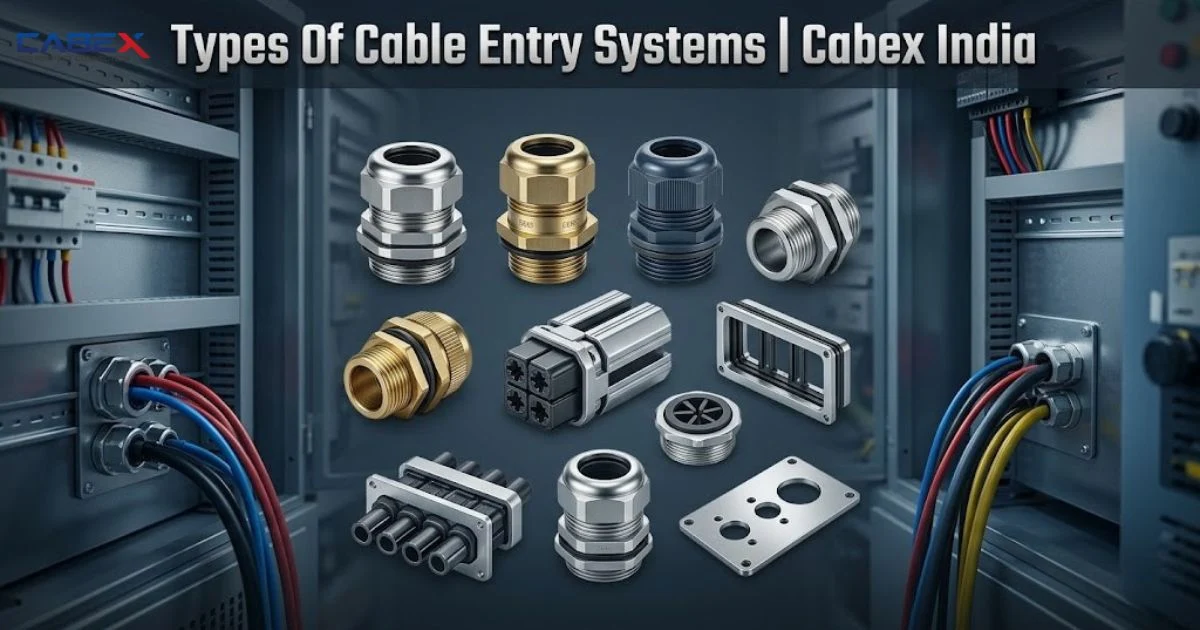
Cable entry systems provide secure, efficient ways to route multiple cables into enclosures without individual drilling or complex sealing. These systems are essential in modern industrial setups for protecting cables from dust, water, and strain while enabling quick installations.
Introduction to Cable Entry Systems
Cable entry systems, often called CES, allow the organized passage of pre-terminated or unterminated cables through panels, cabinets, or enclosures. Unlike traditional methods, types of cable entry systems support high-density cable routing with superior sealing, typically achieving IP54 to IP68 ratings.
They have evolved from basic grommets to modular, splittable designs, driven by demands in automation, renewable energy, and hazardous environments. In India, growing sectors like power plants and manufacturing boost their adoption for compliance with standards like IEC 60529.
Cable Glands vs Cable Entry Systems
When comparing cable glands vs cable entry systems, glands suit single-cable, high-security needs like explosion-proof zones, while entry systems excel in multi-cable, tool-free setups.
Cable glands require threading and torque for sealing, ideal for hazardous areas, but they demand more time for pre-terminated cables. Cable entry systems offer modularity, sealing multiple cables via membranes or grommets, reducing installation by up to 70% in panels.
| Feature | Cable Glands | Cable Entry Systems |
| Cable Capacity | Single cable per gland | Multiple cables (4-72 per plate) |
| Installation | Threaded, tools required | Snap-fit, tool-free |
| Sealing & Protection | IP68, Ex-proof | IP54-IP66, strain relief |
| Best For | Hazardous, single entries | Panels, pre-terminated |
| Cost Efficiency | Higher per cable | Lower for high-density |
Main Types of Cable Entry Systems
Types of cable entry systems fall into frames, plates, and grommets, each tailored for specific cable types and enclosure sizes. Splittable designs dominate for flexibility in industrial applications.
Splittable Cable Entry Frames
Splittable frames, like those with SPP or SPG inserts, split for easy cable insertion then reassemble for sealing. They handle up to 65mm diameter cables with IP66 protection, ideal for control panels. Available in 90-degree or straight variants, these frames use stainless steel screws for durability. They support both terminated and unterminated cables, minimizing downtime in automation setups.
Cable Entry Plates
Cable entry plates come in square/rectangular or round forms, featuring multi-entry points without drilling. Double-membrane designs provide strain relief for 4 to 72 cables per plate.
Rectangular plates suit standard enclosures, while round ones fit circular cutouts. They offer halogen-free, weatherproof sealing, common in telecom and power distribution.
| Plate Type | Entries per Plate | Typical IP Rating | Material Options |
| Square/Rectangular | 4-72 | IP54-IP65 | Polyamide, Stainless Steel |
| Round Modular | 8-24 | IP65 | Plastic, Metal |
| Gland Plates (CCFI/CCFO) | Variable | IP66 | Composite |
Grommet-Based Systems
Grommet systems use push-out membranes like Quickseal or blind grommets for rapid sealing. GSQ grommets are halogen-free, chemically resistant, and seal up to IP65.
These are perfect for hybrid setups mixing power and data cables. Phoenix Contact’s CES line exemplifies tool-free mounting with coned sleeves for IP65 seals.
Materials and Construction
Most types of cable entry systems use polyamide for lightweight durability, stainless steel for corrosion resistance, and brass for hazardous compatibility. Recent eco-friendly shifts include recyclable composites.
Brass variants from Indian makers align with ATEX/IECEx standards. UV-resistant and flame-retardant coatings enhance longevity in outdoor or high-heat environments.
IP Ratings and Standards
Ingress Protection (IP) ratings define performance: IP65 resists jets, IP68 handles submersion. Cable entry systems typically hit IP54-IP66, per EN 60529/UL50E.
Compliance includes ATEX for explosives, IECEx globally, and PESO in India. Modular systems support UL Type 4X for North American markets.
| IP Rating | Solid Protection | Liquid Protection | Common Use Cases |
| IP54 | >1mm objects | Splashing water | Indoor panels |
| IP65 | Dust-tight | Low-pressure jets | Outdoor enclosures |
| IP66 | Dust-tight | Powerful jets | Industrial automation |
| IP68 | Dust-tight | Continuous immersion | Submersible apps |
Applications Across Industries
In power plants, types of cable entry systems manage high-voltage bundles with IP67 seals. Automation uses modular frames for robotics, reducing vibration strain. Telecom infrastructures favor grommet plates for fiber optics. Oil & gas prefers hybrid systems blending glands and entries for safety.
Advantages and Innovations
Key benefits include space savings, no-drill installs, and scalability for IoT/smart grids. Innovations like sensor-integrated systems monitor temperature/humidity. Compared to cable glands vs cable entry systems, CES cuts labor costs in high-volume routing. 2026 trends emphasize modular, eco-materials for sustainability.
| Advantage | Benefit | Example Impact |
| Multi-Cable Support | Up to 72 cables/plate | 50% faster installs |
| Pre-Terminated Friendly | No reconnectoring | Downtime reduction |
| High IP Sealing | IP66 standard | Harsh environment reliability |
| Customizable | Splittable designs | Versatile applications |
Installation Guide
Select frame/plate matching cutout size. Insert cables through split halves or membranes, reassemble, and secure with screws/clips for seal. Test IP integrity post-install. For retrofits, use adapter plates. Always follow manufacturer torque specs.
- Measure enclosure cutout.
- Choose inserts/grommets for cable OD.
- Route cables, seal, and lock.
- Verify with IP test kit.
Maintenance and Troubleshooting
Routine checks involve visual inspections for cracks and seal integrity. Replace worn grommets annually in dusty sites.
Common issues: Loose fits from vibration—tighten screws. Water ingress—upgrade to IP68. Cabex India offers certified spares.
Why Choose Cabex India?
Cabex India, based in Jamnagar, Gujarat, leads in ATEX/IECEx-certified components since 1995. Their portfolio includes advanced cable glands and emerging cable entry systems, blending with earthing accessories for complete solutions. With 25,000 sq ft facilities, they export to Europe, Middle East, serving power, oil & gas. Rigorous testing ensures zero defects, positioning Cabex India as a reliable partner for types of cable entry systems in India.
Conclusion
Types of cable entry systems revolutionize cable management, offering flexibility over traditional cable glands vs cable entry systems debates. Cabex India delivers certified, innovative solutions for India’s industrial needs, ensuring safety and efficiency.
FAQs
What are the main types of cable entry systems?
Main types include splittable frames, entry plates, and grommet-based systems, each suiting different cable volumes and protections.
How do cable glands vs cable entry systems differ?
Glands secure single cables in hazardous areas; entry systems handle multiples quickly without tools.
Are cable entry systems suitable for hazardous areas?
Many achieve IP66/ATEX, but pair with glands for full Ex-proof needs.
What IP ratings do types of cable entry systems offer?
From IP54 for indoors to IP68 for submersion, per EN 60529.
Does Cabex India offer cable entry systems?
Yes, alongside glands, with global certifications for industrial applications.