
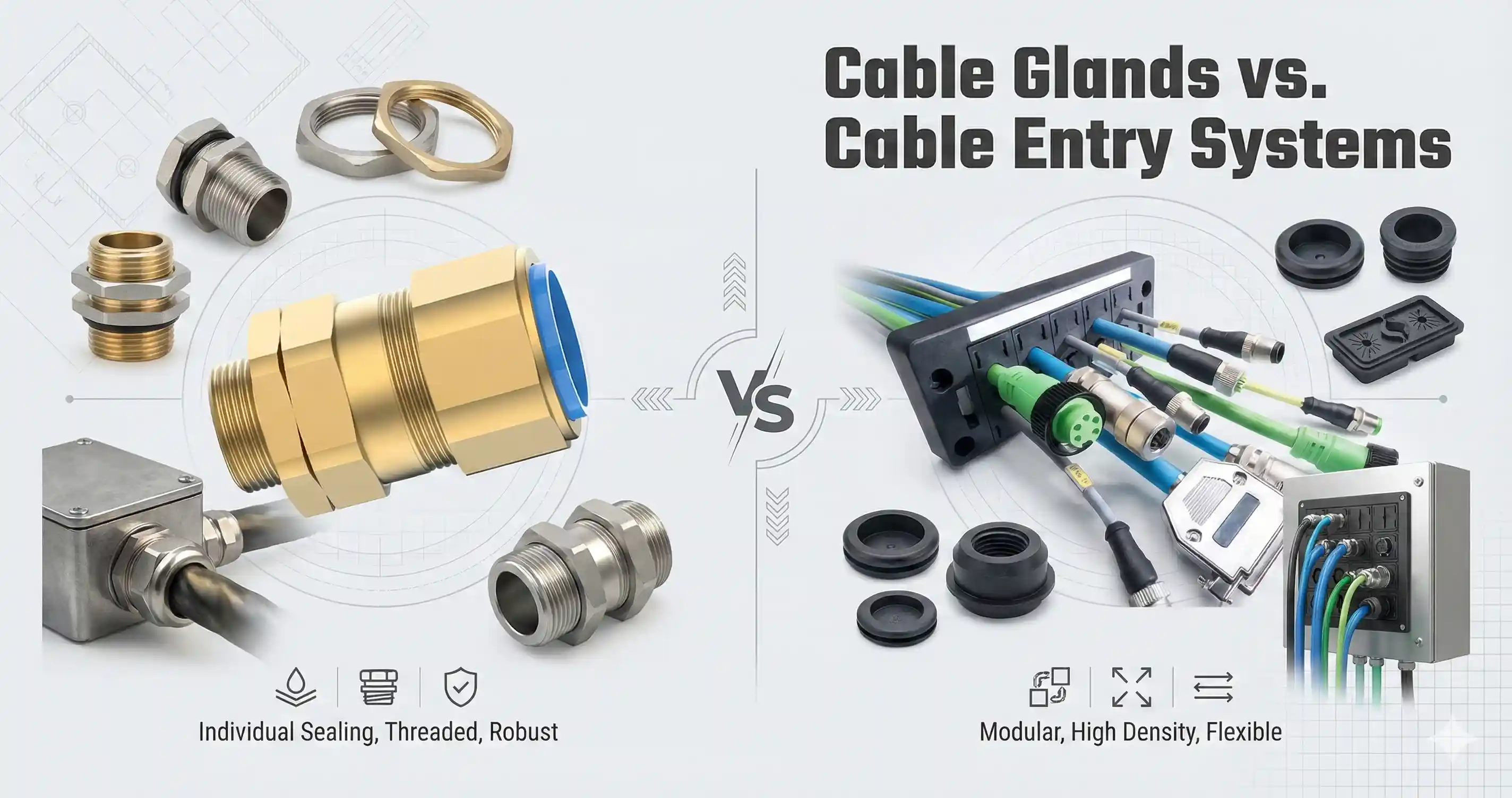
When it comes to safe, reliable, and compliant cable management, choosing between Cable Glands vs Cable Entry Systems is a decision that directly impacts performance, safety, and long-term maintenance. Engineers, OEMs, panel builders, and procurement teams often ask: Which is better for my application traditional cable glands or modern cable entry systems?
At Cabex India, we work closely with industrial clients across power, automation, oil & gas, railways, and infrastructure projects. This guide is designed to answer every practical, technical, and commercial question you may have—aligned with Google’s 2026 Content Guidelines and real-world use cases.
What Are Cable Glands?
Cable glands are mechanical devices used to secure and seal the end of an electrical cable where it enters equipment. They provide strain relief, grounding, and environmental protection.
Key Functions
- Secure cable termination
- IP-rated sealing against dust, water, and chemicals
- Electrical grounding and bonding
- Mechanical strain relief
Cable glands are commonly used with armored and unarmored cables in industrial panels, hazardous areas, and outdoor installations. Example: Double Compression Cable Glands are widely used in heavy-duty and vibration-prone environments due to superior sealing and armor clamping.
What Are Cable Entry Systems?
Cable entry systems (CES) are modular or split-frame solutions that allow multiple cables often pre-terminated to pass through enclosures while maintaining sealing integrity.
Key Benefits
- Tool-free or quick installation
- Ideal for pre-terminated cables
- Flexible cable routing
- High-density cable entry
They are increasingly used in automation cabinets, control panels, and data-driven industries.
Cable Glands vs Cable Entry Systems: Core Differences
Feature Comparison
| Feature | Cable Glands | Cable Entry Systems |
| Cable Type | Single cable per gland | Multiple cables |
| Installation | Threaded, torque-based | Modular / snap-fit |
| Sealing | Excellent IP & explosion-proof | Good IP, not Ex-proof |
| Pre-terminated Cables | Not ideal | Highly suitable |
| Maintenance | Requires disassembly | Easy re-entry |
This table highlights why Cable Glands vs Cable Entry Systems is not about “better” but “right for the job.”
Installation & Safety Comparison
Safety and Compliance
| Parameter | Cable Glands | Cable Entry Systems |
| IP Rating | IP66–IP68 | IP54–IP66 |
| Hazardous Area Use | Yes (ATEX/IECEx) | No |
| EMC Protection | Strong | Moderate |
| Fire Resistance | High | Medium |
For explosive environments, cable glands remain the gold standard. Many customers searching to Buy Flameproof Cable Glands Online choose certified solutions from Cabex India.
Cable Glands vs Cable Entry Systems: Application-Based Guide
Use Cable Glands When:
- Working in hazardous or flameproof zones
- Using armored or heavy industrial cables
- Maximum strain relief is required
- Compliance with ATEX / IECEx is mandatory
Use Cable Entry Systems When:
- Multiple pre-terminated cables are involved
- Frequent maintenance or upgrades are expected
- Space optimization is critical
- Automation and control panels are used
Understanding Cable Glands vs Cable Entry Systems from an application lens helps reduce downtime and improves lifecycle cost.
Integration with Other Cable Management Systems
In real installations, glands and entry systems often coexist with conduits. Knowing What is Electrical Conduit helps engineers design safer and more organized cable routes, especially when combining CES with Flexible vs Rigid Conduit Fittings for vibration control and structural stability.
How to Choose Between Cable Glands vs Cable Entry Systems
- Is the area hazardous or non-hazardous?
- Are cables pre-terminated?
- How often will cables be replaced or added?
- What IP rating is required?
- Is EMI/EMC protection critical?
Selection Matrix
| Requirement | Best Choice |
| Explosion-proof | Cable Glands |
| Fast installation | Cable Entry Systems |
| Heavy-duty industrial | Cable Glands |
| Automation cabinets | Cable Entry Systems |
This structured approach simplifies the Cable Glands vs Cable Entry Systems decision-making process.
Why Choose Cabex India?
- Certified, tested, and application-specific solutions
- Wide portfolio of cable glands and entry systems
- Expert technical support
- Trusted by industries across India
Whether you’re evaluating Cable Glands vs Cable Entry Systems for a new project or upgrading existing infrastructure, Cabex India delivers reliability you can engineer around.
Conclusion
The debate around Cable Glands vs Cable Entry Systems is not about replacement—it’s about optimization. Cable glands remain essential for safety-critical and hazardous environments, while cable entry systems excel in flexibility and speed. Choosing the right solution improves safety, reduces downtime, and ensures compliance. Explore certified cable management solutions with Cabex India today and make the right connection every time.
FAQs
What is the main difference between cable glands and cable entry systems?
Cable glands seal and secure one cable at a time, while cable entry systems allow multiple cables through one opening.
Are cable entry systems waterproof?
Yes, most offer IP54 to IP66 protection, but they are not suitable for hazardous areas.
Which is better for industrial safety?
For high-risk zones, cable glands are safer due to certified sealing and grounding.
Can both be used in one project?
Absolutely. Many modern panels use both, depending on cable type and function.